Thursday, March 08, 2007

Twenty Years of Learning


By DAN BARNETT

This column began March 4, 1987, and has continued as a weekly feature of this newspaper for some 20 years. I'm fairly astonished at that. When it started I was a spry young man in his mid-30s with boundless energy; now, about a thousand columns later, the energy is still there — but it takes twice as long to do anything. Make that three times as long.

Though much of my life is spent using computers these days, I remain a bookish short, enthralled and entranced at some of the things I've read, appalled at others. But I'm not going to name names.

The growth of desktop publishing has meant just about anyone could become a published author. It's easy to get a friend to write a review and post it on Amazon.com, but it remains difficult for local authors to achieve some of the recognition they deserve. Perhaps this column has helped in that regard. One of my great joys is learning that someone bought a book I've reviewed and enjoyed it. One of the great joys of authors is that someone bought the book.

Back in the summer of 1968 I decided to keep a list of every book I read. I was devouring a lot of science fiction in those days, so the first few handwritten pages are full of works such as "A Canticle For Leibowitz" by Walter M. Miller Jr. As the years passed my interests broadened to include Saul Bellow, C.S. Lewis, Alasdair MacIntyre, Charles Dickens. By the end of 1986, when the list ended, I had reached book number 1,016. Some six months later a new kind of list began, this one called the "Biblio File."

I'm missing the first few columns, but the others I do have suggest that back then I was a chatty soul, devoting column inches to local folks who had had letters published in the Wall Street Journal or who had written magazine articles on overcoming addiction. Actual books by local authors were relatively rare, so I took to trying to make a local connection to books from the wider world. "With winds clocked unofficially at more than 100 mph a few weeks ago at the Chico airport — and with the word 'drought' increasingly on our lips — weather is once again in the forefront." That was in March 1988, and I reviewed a couple of weather-related works, including "Rhymes to Predict the Weather" by someone named Don Haggerty.

A year earlier, in a column called "To Squash a Conspiracy," I noted the appearance at Chico State University of an animal rights advocate. Apparently I wandered in on his lecture and asked about, well, vegetable rights. "His face grew pale. A carrot doesn't have a biography, at least that I know of, he said." But later I came across a book that claimed that vegetables feel things in ways we can't understand. I concluded that there is then nothing left for humans to eat and ended that April 1, 1987, column with: "Never again will I trust an artichoke. Never."

As more local books have been published I've put away sophomoric humor. Well, no I haven't, but my focus has been on the books themselves. I hope in most reviews I can convey the main point and give you a feel for the writing. I've learned a lot, and read a lot, and am ready for more. If that potato would just stop eyeing me.

Dan Barnett teaches philosophy at Butte College. To submit review copies of published books, please send e-mail to dbarnett@maxinet.com. Copyright 2007 Chico Enterprise-Record. Used by permission.
Posted by Picasa

Thursday, March 01, 2007

Four months on the road, 10,000 miles, to find California's best


By DAN BARNETT

Thanks to the Internet, it's easy these days to compile and publish lists of things, such as bed and breakfast getaways or suspension bridges or pet friendly parks, but rarer for authors actually to visit the venues they write about. That's what impressed me about "Best of California's Missions, Mansions and Museums" ($21.95 in paperback from Wilderness Press) by Ken and Dahlynn McKowen out of Sacramento.

The couple, along with Dahlynn's two children, 9-year-old Shawn and his sister, 14 year-old-Lahre, hit the road for four months, visited some 200 sites and racked up 10,000 miles on the odometer. The result, after some editing, are chatty descriptions of 135 family-friendly California missions, mansions and museums. This is a good guide to consult if one is planning a summer vacation in the Golden State.

The listings, write the authors, "provide a broad geographic and subject-matter selection of California's missions, mansions and museums, primarily as they relate to California's history and culture." Picking the "best" was difficult, subjective of course, and a lot of places were not included (such as most science and technology museums) that didn't meet the criteria of illuminating state history.

In the area of missions, "our final choice came down to 13 missions that we felt included not only wonderful museums, but retained much of their original or at least their early 20th century restored historic fabric. ... We chose our favorite mansions in much the same way as the missions, but we added accessibility -- how frequently they are open to the public for tours."

For museums, the authors concentrated on smaller collections. "We didn't choose them because of their size or the value or rarity of their collections, although we certainly considered those things. ... We considered their uniqueness, not only in the types of collections and the variety of artifacts, but also in how they relate to California's overall history or to their local community's history."

The book is divided geographically, from the North Coast, through the Great Valley and on to the South Coast and desert. Each section has a numbered locator map, trivia questions and introduction. Each two- or three-page entry features a "what's here" list, a "don't miss this" note, a description of the venue, usually a small black and white photograph and a box providing operating hours, cost, location and the Web site. The book also features an index and a list destinations by category.

The chapter devoted to the Great Valley includes entries for the Turtle Bay Exploration Park (including the Sundial Bridge) in Redding, and Chico's own Bidwell Mansion State Historic Park.

The authors note that the second floor of the mansion "features several of the home's 12 bedrooms. That was not a good location for bedrooms in a town where summer temperatures reach 100 degrees, and upstairs rooms become even hotter. Possibly, the plantation windows served as summer escapes to cooler sleeping arrangements on the outside balcony. The indoor toilets that Bidwell included were thought strange by his neighbors and visitors. Many believed that having to perform such bodily tasks inside a house, rather than in an outhouse, was unsanitary."

And there is some Great Valley trivia. "Where can you find the very first Pony Car (Mustang) manufactured by Ford?" It's at the Towe Auto Museum in Sacramento. The car is a white convertible, the first to roll off the assembly line back on April 9, 1964.

See you on the road!

Dan Barnett teaches philosophy at Butte College. To submit review copies of published books, please send e-mail to dbarnett@maxinet.com. Copyright 2007 Chico Enterprise-Record. Used by permission.
Posted by Picasa

Saturday, February 24, 2007

Noted author Francis Moore-Lappé coming to Laxson Auditorium Tuesday


By DAN BARNETT

Chico State University's "On the Creek" lecture series will feature the author of "Diet for a Small Planet," Frances Moore-Lappé, at Laxson Auditorium at 7:30 p.m. Tuesday. The presentation is free but a ticket is required from the University Box Office, Second Street at Normal Avenue (898-6333).

Moore-Lappé will speak, courtesy of Chico Performances, on "Living Planet, Living Democracy: Lessons from the Citizens of the World," a subject she explores in one of her newest books, "Democracy's Edge: Choosing To Save Our Country By Bringing Democracy To Life" ($24.95 in hardcover from Jossey-Bass). This is the third book in a trilogy that includes "Hope's Edge," on which her daughter Anna collaborated, and "You Have the Power: Choosing Courage in a Culture of Fear," which was written with Jeffrey Perkins.

Though "Democracy's Edge" is a polemical work (there seem to be two kinds of Americans in the book: what Moore-Lappé calls the Far Right -- exemplified by the Bush Administration and its corporate cronies -- and everyone else), it is also intended to be a book of hope. There are stories of dozens if not hundreds of citizen groups that are making a real difference in politics, education, and workers' rights in accord with her definition of democracy.

"Living Democracy" involves "negotiating interests by relying on fair play, honest dialogue and mutual respect." It's "not just righting a particular injustice that limits people's freedom. It's changing how decisions are made." Humanity's task, says the author, "is to envision and create institutions, from our schools to our media to our businesses, that foster our democratic selves -- people able to feel and express empathy and to see through the walls of race, culture and religion that divide us, people who know how to exert power while maintaining relationship."

By contrast, what she calls "thin" democracy -- in which politicians proclaim "power to the people" but arrogate power to themselves instead -- perpetuates "four constricting measures" that limit the expansion of Living Democracy. These "misfits" include the assumption that two political parties are enough; that any real limits on campaign spending violate free speech; that "the free market brings us all prosperity"; and that "to keep generating wealth, corporations must consider only the financial bottom line." (While Moore-Lappé welcomes globalization "understood as ... communication and sharing across national borders," she rejects what she calls "global corporatism.")

"Democracy's Edge" is designed to counter each of those ingrained notions with success stories of people united by a common purpose changing how democracy is done. She spotlights the work of such organizations as the Association of Community Organizations for Reform Now (ACORN) and the Industrial Areas Foundation (founded by "Saul Alinsky, the godfather of community organizing"). Hers is a leftist agenda, though she does not use that term, preferring instead to frame her proposals as "walking with bold humility" in reclaiming the kind of human relationships that Living Democracy ought to be about.

A chart at the end of the book invites readers to "consciously generate language that communicates what is emerging and what we want to bring into being." Her preferred term is "engaged citizen" rather than "activist." The seemingly neutral term "conventional farming" becomes "chemically dependent farming." "Liberal" becomes "progressive, democratic." She calls "pro-choice" the "pro-child movement including the right of every child to be wanted with opportunities for a full life." Finally, "taxes" are "membership dues for a strong, healthy society."

Moore-Lappé paints a provocative picture, worth the spirited public discussion it generates.

Dan Barnett teaches philosophy at Butte College. To submit review copies of published books, please send e-mail to dbarnett@maxinet.com. Copyright 2007 Chico Enterprise-Record. Used by permission.
Posted by Picasa

Thursday, February 15, 2007

Poet, essayist Gary Snyder to appear at Laxson Auditorium March 2 for free lecture


By DAN BARNETT

As part of Chico State University's On the Creek Lecture Series, which is dedicated to exploring sustainability issues, noted poet and essayist Gary Snyder will appear at Laxson Auditorium on March 2 at 7:30 p.m. The presentation is free.

Snyder has lived in the Sierra Nevada foothills since 1970. Awarded the Pulitzer Prize for poetry in 1975 for "Turtle Island," he has twice been a finalist for the National Book Critics Circle Award, in 1992 and 2005. He is a recipient of the Bollingen Poetry Prize, the Robert Kirsch Lifetime Achievement Award and the 2004 Japanese Masaoka Shiki International Haiku Grand Prize.

His latest book, "Back on the Fire" ($24 in hardcover from Shoemaker and Hoard), features recent essays, most previously published, that intermingle autobiography, reflections on the place of the writer in the modern world and a concern that those who have benefited from the natural world (all of us) become more thankful and "give something back."

Snyder sees the world through Daoist-Confucian-Mahayana Buddhist eyes and has little patience for those who romanticize nature with their "quasi-religious pantheistic landscape enthusiasms." In Snyder's "literature of the environment," "we will necessarily be exploring the dark side of nature -- nocturnal, parasitic energies of decomposition and their human parallels." He adds, in another essay: "Nature is not fuzzy and warm. Nature is vulnerable, but it is also tough, and it will inevitably be last up at bat."

Many of the essays deal with the forest, and fire, as a kind of symbol of changing public policy toward the wilderness. "Our wild forests have long had an elegant and self-sustaining nutrient and energy cycle, and staying within that should be a key measure of true sustainability." Periodic low-level fires are necessary for keeping the forest healthy; logging practices that remove the surviving trees after a major fire make it more difficult for the forest to sustain itself. Just as governments have to think in terms of thousands of years in dealing with nuclear waste, Snyder writes, we ought to be thinking of a "thousand year forest plan" as well. Ecology is about process, "a creation happening constantly in each moment. A close term in East Asian philosophy is the word Dao, the Way, dô in Japanese." As he writes in a poem, "--Nature not a book, but a performance, a / high old culture."

The art Snyder advocates "takes nothing from the world; it is a gift and an exchange. It leave the world nourished." "We study the great writings of the Asian past," he writes, "so that we might surpass them today. We hope to create a deeply grounded contemporary literature of nature that celebrates the wonder of our natural world, that draws on and makes beauty of the incredibly rich knowledge gained from science, and that confronts the terrible damage being done today in the name of progress and the world economy."

One November day, Snyder has cleared brush from around his house and sets fire to the pile. "Clouds darkening up from the West, a breeze, a Pacific storm headed this way. Let the flames finish their work -- a few more limb-ends and stubs around the edge to clean up, a few more dumb thoughts and failed ideas to discard -- I think -- this has gone on for many lives!

"How many times / have I thrown you / back on the fire."

Dan Barnett teaches philosophy at Butte College. To submit review copies of published books, please send e-mail to dbarnett@maxinet.com. Copyright 2007 Chico Enterprise-Record. Used by permission.
Posted by Picasa

Friday, February 09, 2007

Retired Chico State professor explores the self's yearnings


By DAN BARNETT

Former Chico State University professor David Downes has achieved international renown as an expert on the poetry of Gerard Manley Hopkins. Now, in his retirement years, Downes has taken to writing novels, drawing on stories from his boyhood growing up in the Cripple Creek gold district in Colorado ("The Belle of Cripple Creek Gold") and his exploration of how self, belief and love are interconnected ("The Angel in Wax").

In his new story, "Sailing: Inside Passages -- The Mysteries of the Inner Sea" ($10 in paperback from Xlibris), Downes, writing as "David Anton," puts his characters aboard the cruise ship Europa for a tour of the western Mediterranean -- which becomes a tour of their inner lives.

Merlin Morgan is 55, a retired literature professor. Marina, his Mother (the story always capitalizes the word), is very rich indeed; widowed for a decade, she had never remarried and always worried she had made her son's life too easy. Merlin, looking at himself in the mirror, "saw an older man, cynical about life, who had taken a hard look at the ways of the world and his role in it and concluded there was far more evil than good in life, and thus happiness in each individual life was a gamble involving the luck of the draw in a losing game."

On board the ship, Merlin, Marina and Milli (Marina's close friend), find themselves sharing a meal with four other passengers, including Nolan Merrill, "a retired banker in his early 80s. He was a bit fragile physically, spoke in a soft voice. His attractive daughter, Zelda, Merlin guessed, was unmarried, dedicated to making her Father's last years secure and happy. He liked hearing her speak; she possessed a rich, deep, toned voice that was very pleasant to hear. The flamboyant Masons were a true match. Victor was a retired car salesman, somewhere in his sixties, and his wife Alta, in her late fifties, an inveterate bridge player."

Most of the action in the story is inner. The tablemates find themselves disembarking at various ports of call, to shop or sightsee, and the cruise itself is uneventful. But Merlin is struggling with a growing sense of emptiness and lack of companionship. At one point he has a long talk with Nolan who asks Merlin point blank: "Do you have any religion?" All Merlin can do is mutter that he was baptized Catholic and then he adds: "Religion never took with me. And I think my education gave me reasons not to have any beliefs." But then, speaking more frankly, he tells Nolan that "I think I am, in some way now, more open to some sort of spiritual experience. Now that I am moving into middle life, I feel the need to allow myself to consider fresh possibilities."

"Sailing" is about some of those fresh possibilities. Merlin realizes that his exploration of the ruins of Carthage on one of the stops is merely superficial, passionless. Nolan, on the other hand, sees beneath the surface. As Merlin tells Zelda: "Your Father really saw them for what they were -- dusty covers for a civilization that lay under them that was rich and powerful, interesting and consequential in history. He made me realize this."

And so Merlin's story unfolds as real love, which had passed him by in earlier years, finds true anchor. Anton has written a thoughtful and engaging tale in which a cynic finds the magic of hope.

Dan Barnett teaches philosophy at Butte College. To submit review copies of published books, please send e-mail to dbarnett@maxinet.com. Copyright 2007 Chico Enterprise-Record. Used by permission.
Posted by Picasa

Friday, February 02, 2007

Chico writer explores national parks in books designed for pre-teens


By DAN BARNETT

Prolific children's book author Mike Graf, who teaches child development at Chico State University, is publishing a series of beautifully designed and illustrated stories about the national parks. The books are already winning awards.

The series is called "Adventures with the Parkers," and features the fictional family of Bob and Kristen Parker and their twins, fourth-grader Morgan and her brother James. The first is called "Bryce and Zion: Danger in the Narrows" and the second, "Grand Canyon: Tail of the Scorpion." Each is $9.95 in paperback from Fulcrum Publishing; forthcoming titles include "Yellowstone: Eye of the Grizzly" and "Yosemite: Harrowing Ascent of Half Dome," both scheduled for March release.

The first two "Adventures with the Parkers" books were recipients of the "Teachers' Choice Awards for the Family" for 2006; and "Scorpion" placed as a finalist in 2006 at USABookNEWS.com in the children's book category as one of the best books for children in 2006.

According to Graf's Web site, www.author-illustr-source.com/mikegraf.htm, the author "has backpacked the world's national parks, interviewed storm-chasers and special-effects wizards, met the last surviving Angel Island immigrant, rafted through spectacular caves, researched wolf restoration, rock-climbed in Yosemite, explored ghost towns" and has had a stint as a local TV weatherman.

"Scorpion" contains dozens of full-color and black and white photographs, along with sketches by Marjorie Leggitt, illustrating some of the most important and interesting features of the Grand Canyon. Set in the context of a family outing to a national park, the stories include diary entries from James (who wants to be a reporter) and Morgan, with sidebars throughout that amplify some of the aspects of the story.

On the way to the park, for instance, the family listens to the "Grand Canyon Suite" by Ferde Grofé, and an insert tells readers about the Painted Desert, which "stretches from southeast of the Grand Canyon to near the New Mexico border. Minerals in the soil make it rainbow colored." There's also a box about Grofé himself, noting that the most famous part of his most famous suite "is the 'On the Trail' section, which has the clip-clop sound of hooves."

The Parker family arrives at the Grand Canyon Lodge (first opened in 1928 and rebuilt after a fire in 1932) and, after an abundance of sightseeing, Dad, Morgan and James are ready for a hike down the Canyon, while Mom stays topside to do some long-anticipated painting.
The reader is told that "hikers should not attempt to hike down to the river and back in one day. While hiking down may seem easy, hiking up can be extremely difficult. It is 7.1 miles and 4,650 feet of climbing from Phantom Ranch to the top of the South Kaibab Trail, with no water available along the way."

During their hike the Parkers befriend an older couple who have run out of water; Morgan starts reading "Brighty of the Grand Canyon" by Marguerite Henry, about a very special burro; the hikers use an ultraviolet light to see innumerable little scorpions pretty much camouflaged in normal light; and James becomes ill for a time in the high heat.

Along the way the reader is treated to magnificent full-color images of the ages-old Canyon and some of its denizens (including condors). The book is impressive in its simple, interesting storyline and pacing, and its selection of facts. It's an ideal gift for a pre-teen; just be prepared to change your summer vacation plans!

Dan Barnett teaches philosophy at Butte College. To submit review copies of published books, please send e-mail to dbarnett@maxinet.com. Copyright 2007 Chico Enterprise-Record. Used by permission. Posted by Picasa

Thursday, January 25, 2007

School's in: A murder mystery that features Immanuel Kant, detective


By DAN BARNETT

"Inside the ample glass jar, the severed head lolled in a swirling sea of cloudy preserving alcohol. Tangled gray-red sinews, clots of blood and gore shifted gently in the straw-colored liquid like the trailing tendrils of a jellyfish."

Something fiendish had happened to the victim; his head preserved a secret only the finest mind might discern.

It is February, 1804. Hanno Stiffeniis, a magistrate in Lotingen, Prussia, is summoned by King Frederick Wilhelm III to Königsberg. "Our beloved Königsberg (is) in a grip of terror," the King writes. The summons takes Stiffeniis completely by surprise.

Stiffeniis sets up headquarters at the Fortress of Königsberg. The basement, where prisoners are herded to an uncertain fate, reminds Stiffeniis of Hades; "the upper floors were as confusing as the maze of Crete. Gloomy, ill-lit passages shot off left and right of the main corridor, no feature distinguishing one way from any of the others."

That seems to describe the investigation into the strange murders in Königsberg. Which way to turn? Some believed Napoleon was planning to invade Prussia and was leaving a calling card of terror. Others proposed not a political but a spiritual cause. All of the victims (just a handful, but unsettling in the extreme) were killed as they were kneeling; the cause of death was unknown but rumor was spreading that the Devil's Claw had done them in.

Stiffeniis tells the tale, and what a tale it is, involving not-soon-forgotten characters such as an albino prostitute; Dr. Vigilantius, a necromancer and follower of Emmanuel Swedenborg; and Immanuel Kant himself, now retired and sickly, who is collecting the heads of the victims.
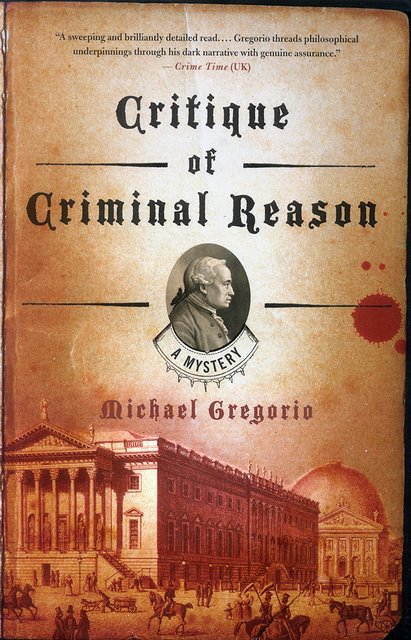
Heady stuff, indeed, this "Critique of Criminal Reason" ($25.95 in hardcover from Thomas Dunne Books) by Michael Gregorio, a philosophy professor who lives in Italy. Gregorio draws on the new authoritative biography of Kant by Manfred Kuehn and interweaves invented characters and real personages into the lives of Kant and Stiffeniis.

Immanuel Kant is one of the giants of philosophy, an exponent of pure reason who famously wrote that all rational beings would wish to do away with emotion since it leads right thinking astray. According to the Kuehn biography, Kant wrote a little-known work, "Dreams of a Spirit-Seer," in which he seemed to mock Swedenborgian spirituality; in "Critique of Criminal Reason" Kant tells Stiffeniis that it's "the only book of mine for which I have ever apologized."

In the story, Kant himself has called Dr. Vigilantius to "listen" to the corpse of one of the victims and Kant who sets up a clandestine laboratory in which he collects the heads-in-jars. This is a side of Kant that seems very much out of character with the little man of Königsberg whose daily walks were so carefully timed residents could set their clocks. But Kuehn confirms that the elderly Kant was working on a manuscript at the time of his death that attempted to unite his metaphysics with physics, the natural world. Gregorio deftly uses this device to deepen the mystery surrounding the last days of Kant, who, in the story, becomes obsessed with the idea writing about "murder without motive," "cold-blooded murder."

The revelation of the murderer is satisfying but not surprising; in a way the story is more about the secret side of Kant and of Stiffeniis when faced with the mesmerizing aspect of Death, and the central importance of love. This "Critique" is engaging and thought-provoking. I'm assigning it as homework.

Dan Barnett teaches philosophy at Butte College. To submit review copies of published books, please send e-mail to dbarnett@maxinet.com. Copyright 2007 Chico Enterprise-Record. Used by permission. Posted by Picasa

Sunday, January 21, 2007


Chico-based husband and wife team put whimsical words to outlandish animals

By DAN BARNETT

Michael Agliolo of Chico is a professional photographer, someone who creates images for ad agencies and stock photo companies and who teaches digital photography at Butte College. After years of picture taking, he discovered the computer and "what I was capable of creating within the unlimited resources of a keyboard and a mouse. So was born a long-lasting affair of the heart, inspired by my love of photography and a new found ability to manipulate the ten of thousands of images I'd collected over the years."

His wife, Nancy, began to look through the images, especially the ones of animals, and "started writing prose to some of the more amusing pictures." Well, more like poetry: What might a bear or cow or bird say given the oddball situations created by Michael? The answers started to appear on Christmas cards the couple sent to family and friends, and often they'd hear "you two should do a book." And so, Nancy writes, they have.

"Animals Thinking Out Loud," by Mike and Nancy Agliolo, is a full-color, shiny-page gift-paperback available in selected downtown Chico stores and also from the authors. Interested readers can write Mike Agliolo Productions, 2196 Oak Park Ave., Chico, CA 95928, magliolo@dcsi.net, or call 891-5100 for pricing information. (Ron Sanford, Kirk Yarnell and Marty Snyderman have also contributed images.)

The cow with binoculars on the cover is typical of the animal pictures inside. Each full-page image, beautifully rendered in sharp focus and colorful detail, is joined by some bouncy text by Nancy which begs to be read aloud (especially with kids). Take the piece called "COWard."

In a pasture not so far away,
Standing firmly in the mud,
I spy my fair Fernando
Chewing quietly on his cud.
I view him from afar because
I'm just a shy bovine.
I dream about that fateful day
I hope to make him mine.
I wish I were a braver cow
And looked more like my mother.
Then I'd go and talk to him ...
He moooves me like no udder!

Such "thoughts" accompany pictures of bears in a forest (one of them reading a newspaper on the loo), a hummingbird frustrated at a garden on a computer screen, and a turtle with a jet pack: "Some may say that it's absurd, / And some may wonder why. / But he knows that it's assured / Ol' pokey's gonna fly! // With this thing, he'll catch some air. / Two turbos are a must. / Now he can race that crazy hare / And leave him eating dust."

Computers play a role in four of the images (there are three ancient Macintoshes and one nondescript Windows laptop), a nod to how the composite pictures were produced in the first place. In one, a big old polar bear gazes lovingly into a monitor that shows a tropical sunset. "I see me walking on the beach, / A scene that's very pleasing. / But then I wake and realize, / My toes are next to freezing!"

Mike Agliolo has created a beautiful image of Pegasus, eagle wings flapping ("I live only in your dreams") and, on another page, a large cow with a rather peculiar birthmark (a bar code): "Never once did it occur to me, / That others were appalled. / They'd whisper to each other / That I'd be better off born bald!"

For Nancy and Mike, this project is more than just puppy love.

Dan Barnett teaches philosophy at Butte College. To submit review copies of published books, please send e-mail to dbarnett@maxinet.com. Copyright 2007 Chico Enterprise-Record. Used by permission. Posted by Picasa

Saturday, January 13, 2007


Granddaughter remembers Red Bluff cattleman Charles F. Stover

By DAN BARNETT

Cheryl Conard Haase lives with her husband, Bill, on some 11 acres near Red Bluff. Though plagued by medical difficulties, and no longer able to ride, her love for the ranch life, and for her grandfather, "Charley" Stover, whom she called Papa, are unabated. For two years, Haase (pronounced "hoss") worked on compiling pictures, documents and memories surrounding Stover, who in 1944 was instrumental in organizing the now world-famous Red Bluff Bull Sale.
Stover was honored in 1960, when he was 81, as California Cattleman of the Year and honorary president of the Red Bluff Roundup Association. The Sacramento Bee reported Stover owned 35,000 acres of ranch land in Tehama County, raised "2,500 head of purebred Herefords" and held the yearly Chester Rodeo on his Big Meadows Ranch from 1920-1939.

Stover died in 1961 but left a rich family heritage beautifully captured in "Too Many Irons in the Fire: The Life and Times of Charles F. Stover and the History of the Ranching Families of Tehama, Lassen and Plumas counties, 1850-2006." (The book's cover pictures brands registered to family and friends.) The large, 300-page paperback is available for $34.98 at Shasta Western Shop in Cottonwood. You can also visit B & B Booksellers in Chester, Facts & Fictions in Red Bluff and The Bookworm in Oroville or write Canyon Vista Ranch, 12561 Wilder Road, Red Bluff, CA 96080.

In the introduction, Haase writes that she and her brother Dean "learned to ride before we could walk. ..." "It was Papa," she says, "who gave me the opportunity to live my life in a way that made me happy and feel worthy of the legacy that he left me." Dean, she continues, "was the apple of his eye, and the grandson he always wanted. We never knew our biological grandfather and did not realize Papa was our step-grandfather until we were teenagers. He was our Papa always."

Cheryl was not exactly an angel. She remembers taking her older sister's collection of Shirley Temple dolls for a bath in a house trough. And "during my first grade year at Lassen View School, in Dairyville, I was relegated to stay in the classroom every recess and lunch hour for cussing. My poor mother came to school chagrined and apologetic to my teacher ... explaining I'd been raised in a corral around the cowboys. As a rule the cowboys never swore in front of women, but hiding behind the corral, where they didn't think I could hear, I learned it all!"

Every page of the book is full of black and white family pictures, newspaper clippings, or large photocopies of various documents, from grocery lists to an invoice for Charley's 1917 Cadillac ($2,250 for the car plus $95 for "extras"). A page from his diary, dated Sept. 26, 1917, lists steers branded from eight owners; Haase notes that "when branding calves, each owner needed to bring at least two of his irons, so that there would always be a hot one when the time was right. When several owners were present, there were a lot of irons in the fire! The cowboys had to be wide awake, paying close attention to remember which one was 'ripe' and ready to grab, and which iron belonged to whom. ... In cowboy lingo, 'too many irons in the fire' means that a person has too many things going on at the same time."

It's a nostalgic read, and that's no bull.

Dan Barnett teaches philosophy at Butte College. To submit review copies of published books, please send e-mail to dbarnett@maxinet.com. Copyright 2007 Chico Enterprise-Record. Used by permission. Posted by Picasa
Saturday, January 06, 2007


Schott in the dark - A high caliber almanac

By DAN BARNETT

Slide-rule companies pretty much went out of business with the advent of computer age. Though in the Internet age the printed page is far from endangered, traditional reference works are. All the words of the massive bound volumes of the Encyclopaedia Britannica, for which I paid $1,500 back in 1974, now come on DVDs thrown in for free with the purchase of some other computer program. The fabulously popular Wikipedia online is even beginning to rival Britannica in accuracy. And with data of every kind freely available on the Web, whither the yearly printed almanac? The "World Almanac and Book of Facts" or the "Information Please Almanac" now have a quaintness to them, almost as if someone published them year after year but had forgotten why.

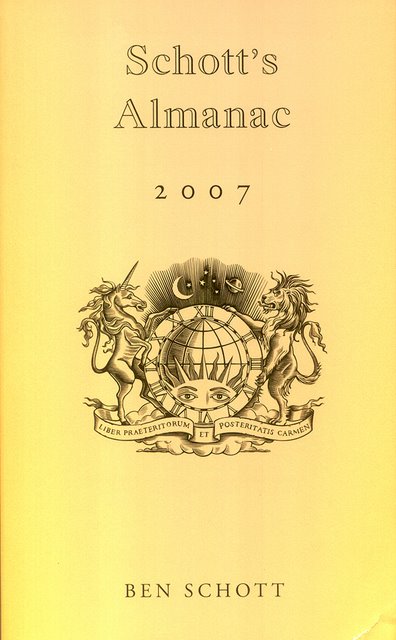
So London-based Ben Schott decided to reinvent the yearly almanac. The result is "Schott's Almanac: 2007" ($25.95 in hardcover from Bloomsbury USA), designed especially for American readers (there are also British and German versions). In the brief introduction, the author writes, " 'Schott's Almanac' reflects the age in which it has been written: an age when information is plentiful, but selection and analysis are more elusive. ... 'Schott's Almanac' aspires to provide an informative, selective and entertaining analysis of the year. 'Schott's' is an almanac written to be read."

Superficially resembling the more traditional almanac, with familiar section titles like "books and arts" and "the States," "Schott's" is shorter (368 pages) and its content far quirkier. It's unlikely that years from now we will be driven to look up "street names, unusual" to find the "7 'wackiest' street names, according to a 2006 poll by Car Connection Web site." (A few of the selections, for the record: Psycho Path, in Traverse City, Mich.; Divorce Court, in Heather Highlands, Pa.; and, in Story, Alaska, Farfrompoopen Road, "the only road leading to Constipation Ridge.")

Oldsters beware, too. The print is minuscule and the overall tone decidedly hip. There are lots of fun lists (the "Hacker, Cracker, & Geek Speak" lexicon distinguishes among geeks, nerds, dweebs and dorks) but lots of serious talk as well, especially in the survey of the year that leads off the book. You'll find an official definition of genocide, a biography of Mahmoud Ahmadinejad, and a short article on Holocaust denial. Some of the sections (sports, the nation) are more prosaic than others (such as media and celebrity, which leads off with a comparison of the cover stars pictured on issues of People and US Weekly) but all in all Schott's lives up to its claim to be readable.

Odd corners abound. Here's a poem from Thomas Hood (1799-1845): "Dirty days hath September, / April, June and November, / From January up to May / The rain it raineth every day. / February hath 28 alone, / And all the rest have 31. / If any of them had two and 30 / They'd be just as wet and dirty."

Then there are the Ig Nobel prizes, for real research that seems pointless, with the 2005 winners in chemistry: "Edward Cussler and Brian Gettelfinger (University of Minnesota) for their tireless investigation into whether people swim faster in syrup or in water."
The "Oddest Book Title of the Year" award for 2005 goes to author Gary Leon Hill for "People Who Don't know They Are Dead: How They Attach Themselves to Unsuspecting Bystanders and What to Do About It."

Don't look for a review anytime soon.

Dan Barnett teaches philosophy at Butte College. To submit review copies of published books, please send e-mail to dbarnett@maxinet.com. Copyright 2007 Chico Enterprise-Record. Used by permission. Posted by Picasa

Friday, December 29, 2006

2006 - The year in local books

By DAN BARNETT

It was an eclectic year in local publishing. This column recognized some 40 books by local authors or those with local roots, and the subject matter ranged from nefarious doings at the zoo to computer animation. You'll find reviews of these books all archived here at Musable.

Poetry, novels and children's books

The Biblio File celebrated five volumes of poetry, including "Crossings" by Audrey Small; "Try to Write a Poem Without the Word Blood In It" by Sally Allen McNall; "Skyways," edited by Patricia Wellingham-Jones; "Tom Thomson In Purgatory" by Troy Jollimore; and "Poems From My Soul" by Alma Garrett.

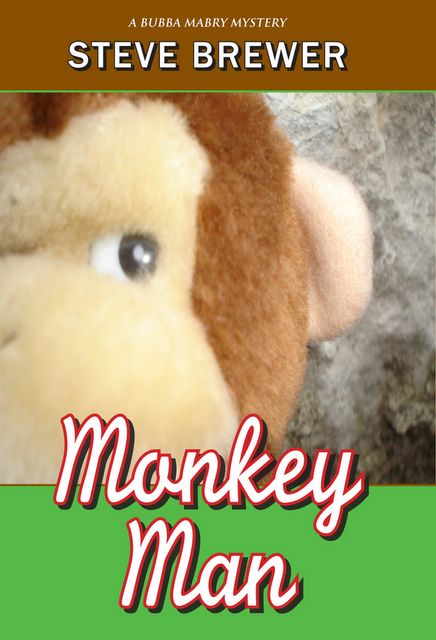
I reviewed five novels, including two from Redding writer Steve Brewer, "Whipsaw" and "Monkey Man" (that's the one with the zoo doings). Charlie Price and "Dead Connection" were also from Redding. Then there were "Promised Land" by Helga Ruge and "Brother Eagle, Sister Moon" by Phil Dynan out of Corning.

Incidentally, I have some big novels on my shelf still unreviewed. I'm a slow reader and thus exceedingly selective about novels (which require lots of emotional investment and just plain time). But write the history of Chico radio stations and you're in!

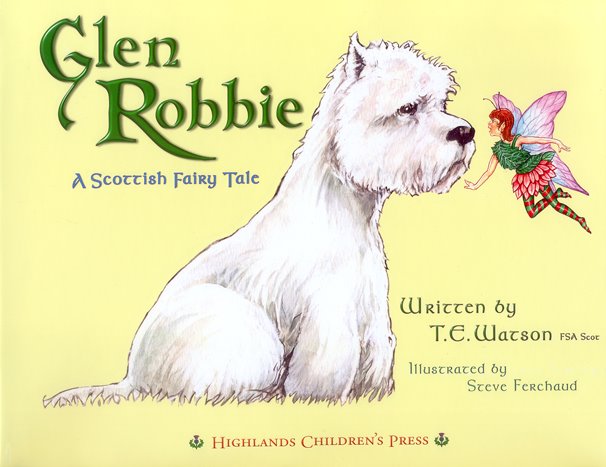
The third five is children's books. I love their exuberant colors and creative expression. We had "Here Is the African Jungle" from Phyl Manning; "Perry the Pack Rat Finds a Friend" by Mardell E. Alberico; Debbie Cobb's "Gracie's Big Adventure With Augustine the Beaver"; and two from T. E. Watson: "The Man Who Spoke With Cats" and "Glen Robbie."

History/memoir

The largest category this year. Two about the military: "A Patch of Ground: Khe Sanh Remembered" by Michael Archer; and "Special Agent, Vietnam: A Naval Intelligence Memoir" by Douglass H. Hubbard Jr. Then there were three in Arcadia's "Images of America" series: "Chico" (Edward V. Booth, John Nopel, Keith Johnson, Darcy Davis); "Oroville" (James Lenhoff); and "Paradise" (Robert Colby). Colby also produced "Old Days in Butte" and Teresa Ward and the Richvale Writing Group checked in with "Richvale: A Legacy of Courage, Dedication, and Perseverance."

Olivia Claire High gave us "An Angel Among Us: A Mother's Heartfelt Story"; Lucia Barbini Falcone wrote "Over Bridges, Across Tables: Growing Up On the Island of Murano"; we had "Essays From the Ten" by Daniel Thomas; "Exploring Chico's Past, And Other Essays" by Michele Shover; "Six Boys and a Bag of Dirt" by Dick Cory; "Under the Influence: Working-Class Drinking, Temper-ance, and Cultural Revo-lution in Russia, 1895-1932" by Kate Transchel; and "Bicycling Beyond City Limits: A Journal of Endurance, Friendship and Discovery" by Michael F. Foley (Chico to South Carolina in 55 days).

Miscellaneous

We were also graced with "Storytelling Through Animation" by Mike Wellins; "Body Intelligence: Lose Weight, Keep It Off, and Feel Great About Your Body Without Dieting!" by Ed Abramson; "Take Back Your Life: Recovering from Cults and Abusive Relationships" by Janja Lalich and Madeleine Tobias; "Legacy By Design: Succession Planning for Agribusiness Owners" by Kevin Spafford; "Geology of the Sierra Nevada, Revised Edition" from Mary Hill; "The Chico User's Guide" by Eric Norlie; and "Who ARE You People? A Personal Journey Into the Heart of Fanatical Passion in America" by Shari Caudron.

Photography/Art

Finally, two coffee-table delights: "Mobile Mansions: Taking 'Home Sweet Home' on the Road" by Doug Keister; and "The Murals of John Pugh: Beyond trompe l'oeil" by Kevin Bruce.

A tip of the hat to you all!

Dan Barnett teaches philosophy at Butte College. To submit review copies of published books, please send e-mail to dbarnett@maxinet.com. Copyright 2006 Chico Enterprise-Record. Used by permission. Posted by Picasa

Wednesday, December 20, 2006


An area writer's Christmas grace

By DAN BARNETT

Her debut as a teenager was not auspicious. "I squandered every bit of my teen ... and early adult years. I was pregnant at 13. I had an abortion. At 14, I was with child again, and at 15 I gave birth to a baby girl in June of '72. Around this same time I started experimenting with different types of drugs and alcohol to find something to make me feel at ease with life, because I was pretty bound by feelings of inferiority, inadequacy and anxiety. Six months after the birth of my little girl, her father died of an overdose of alcohol and heroin (he was only 16)."

Though her life spirals yet further downward, local author Alma Garrett, who looks back on those years in "Poems From My Soul" ($12 in paperback from Red Lead Press, www.redleadbooks.com), finds another, infinitely greater nativity, and the power of God come to earth. "Wonder of All Wonders," reads the title of one poem: "Love pure and Holy, undefiled, / Wrapped in a manger / In the form of a child." "You rain down treasures / From heaven above;" she writes in "Reign, Rein, Rain," "Your grace, Your mercy / Your peace, Your love."

The book is a deeply personal testimony about that love. In the first part, searing narrative is interspersed with poetic commentary. In the latter part, as if a great song has broken forth, Garrett writes again and again of "The Call": "There's a call, can't you hear it? / To be one with the Father, son and Holy Spirit."

"Seventeen years ago," she says in one of the last narrative passages, "I surrendered the use of drugs, alcohol and my life to Jesus. ... It has been an uphill climb as well as a challenge, and I've got a long way to go. ... I don't mean to say that I am perfect. I haven't learned all I should even yet, but I keep working toward that day when I will finally be all that Christ saved me for and wants me to be."

Her earlier life featured a succession of boyfriends. They were pretty but deceptive packages, addicts of various kinds. One of her poems is entitled "Don't Be Taken In."

"In 1983," Garrett writes, "I moved out of the Bay Area to a small town in Northern California. I moved to get away from everything I knew and everything I became. I was getting tired of drugs and the mess they made of my life, I was tired of the people in my life, I was tired of men using me, and all I knew was that I needed a change. I didn't understand that if nothing changed on the inside (my heart), then no matter where I went my environment would be the same. ... I would take my jealousy, my fears, my anger, my memories, my pain. I would take everything."

As for drugs, she did take everything. The last piece in the book, "Tripping (Revised)" juxtaposes a kind of cool, swaggering rhythm with an abrupt warning of the spiritual dangers: "Shoot it, toot it, drink it, chew it, / Pop it, drop it ... YOU BETTER STOP IT."

But that's not the end of Garrett's story, a testimony of Christmas grace. "Work in me Thy Father's will," she writes in another poem, "To do of Thy good pleasure; / Birth in me the likeness / Of heaven's most precious treasure."

Dan Barnett teaches philosophy at Butte College. To submit review copies of published books, please send e-mail to dbarnett@maxinet.com. Copyright 2006 Chico Enterprise-Record. Used by permission. Posted by Picasa
Friday, December 15, 2006


Ridge historian's story of Paradise is richly illustrated and a grand gift

By DAN BARNETT

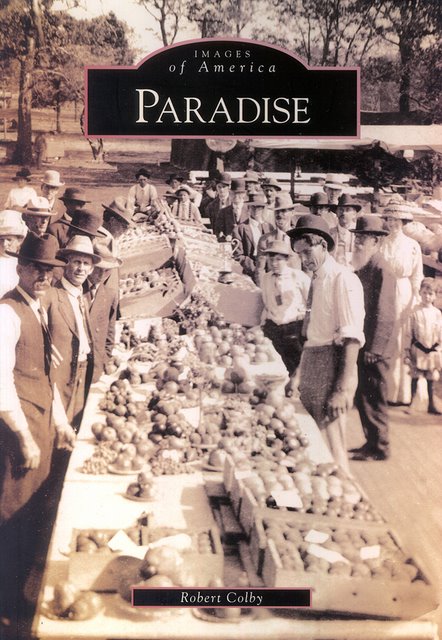
Robert Colby, former editor of Tales of the Paradise Ridge, has just published "Paradise" ($19.99 in paperback from Arcadia Publishing), part of the publisher's "Images of America" series of pictorial treatments of towns and cities across the country.

"Paradise" is available at area bookstores or through Arcadia's Web site (www.arcadiapublishing.com). The book completes the story of Paradise and the upper ridge begun last year in "Magalia to Stirling City," also published by Arcadia, written by Colby and the late Lois McDonald, to whom "Paradise" is dedicated.

Colby's introduction recounts the origin of the town (for awhile it was called "Orloff"), the development of agriculture on the ridge and the formation of the Paradise Irrigation District (PID) in 1916. Then, in more than 200 beautifully reproduced black-and-white historical photographs, seven chapters take the reader from a consideration of the area's Maidu inhabitants on through the late-19th and early-20th centuries, to Paradise as it was in the 1940s, '50s and '60s.

Each photograph carries a long explanatory caption. Several chapters focus on some of the important names associated with Paradise. In 1884, for example, Francis "Fannie" Breese, just 17, helped raise $21.50 toward the $41 needed to purchase three acres of land from her uncle for what was to become Paradise Cemetery.

More recently, Erle Stanley Gardner, who wrote 82 Perry Mason novels, "bought 20 acres at the end of Crestview Drive" in the early 1950s to escape all the folderol his fame had brought him. Colby writes that Gardner "was no stranger to Butte County, having spent his teenage years in Oroville in the early 1900s, where he was suspended from Oroville Union High School for pulling pranks on the principal."

In "The Case of the Runaway Corpse," published in 1954, Gardner had one of his characters actually give the directions to the Paradise hideaway, in reality known to "only a few of his closest associates. ... Here he could relax, write, and ride his dirt bike. The term 'dirt bike' was years in the future, but J.W. Black, a longtime Paradise resident and master mechanic, constructed ones for Gardner and himself to ride in the surrounding mountains."

"Paradise" is full of such tidbits. There are also pictures of harvest fairs (the one on the cover shows the "Woodman's Dance Platform at Olive Street and College Avenue in 1912-13") and the famous pipes of PID. "From the beginning," Colby writes, "leaks in the PID water system were a problem. Because of steel shortages in World War I, pipes made of redwood staves bound with steel wire were used. ... Even today, much of PID's budget goes to replacing the inferior World War II steel pipe."

A train engineer and brakeman were killed on June 25, 1909, "when a 27-car lumber train left Stirling City for Chico. Leaving the Magalia Depot, the train 'ran away' on the down slope, passing the Paradise Depot at 70 miles per hour, and three quarters of a mile below the depot at Neal Road, it derailed." An extraordinary photograph of the wreck shows only a mass of twisted metal.

"Paradise" is a must-have for those interested in local history. Oh, and let Santa know, too, for old times' sake.

Dan Barnett teaches philosophy at Butte College. To submit review copies of published books, please send e-mail to dbarnett@maxinet.com. Copyright 2006 Chico Enterprise-Record. Used by permission. Posted by Picasa

Thursday, December 07, 2006


Kids' books by local authors emphasize relationships

By DAN BARNETT

Local authors have been busy writing children's books and it seems just the right opportunity to let readers know what's available this holiday season.

KHSL-TV weekend anchor Debbie Cobb has published "Gracie's Big Adventure With Augustine the Beaver" ($10.95 in paperback from Laurob Press). The book is available in Chico at local bookstores as well as Bird in Hand and Creative Apple.

Paradise illustrator Steve Ferchaud uses muted earth tones to tell the story. A recent E-R article by Laura Urseny revealed that there is a hidden "G" (presumably for Gracie) in each of Ferchaud's paintings. I went back and looked and found several obvious ones, but a few pages have me stumped. Put it this way. Finding Waldo was easy!

The story begins with young Gracie as she plays in her backyard. In a nearby pond young Augustine the beaver, curious soul, decides to explore the world beyond. The cars and noise and a big dog in the neighborhood give him quite a fright until he sees the swimming pool at Gracie's house and dives right in.

And so Gracie meets Augustine. But what to do with him? At first she tries to hide him "without being noticed by her very nosey brother, Joey." But Joey finds out and now there are two to keep the secret. Mom and Dad seem unaware until, that night, Augustine leaves Gracie's closet to do some more exploring. And that means the pool. This time Gracie's parents hear the big splash.

"Gracie had some explaining to do. She told her parents the truth. ... After a good night's rest, a family meeting was held." What to do with Augustine? "After a big feast prepared just for Augustine, Gracie and Joey carefully loaded him into the red wagon and pulled him all the way back to the pond." Along the way the little wagon and its inhabitant cause quite a stir. Augustine learns a lesson about wandering from home, and Gracie and Joey sleep securely knowing they've done the right thing.

* * *

Relationships are also at the heart of a very different kind of book, "Perry the Pack Rat Finds a Friend" ($15.95 in hardcover from Words of Whimsy Publishing out of Orland), written and illustrated by Mardell E. Alberico. Using funny drawings and bright, primary colors, Alberico tells the tale, so to speak: "Perry the pack rat lived in a nest / which was filled with beautiful things. / He had baubles and bangles, bracelets that jangle / and a lovely assortment of rings."
Perry has lots of stuff, all right: "He had silver and keys, thimbles and cheese / and marbles enough to lend. / He had dice, which were nice, a clock that could talk, / but Perry did not have a friend."

That, of course, is a problem, and Perry hatches a plot to find a friend and offer him lots of loot. But then Perry, on one of his many pack rat trips, finds a mole who (because he is unable to see) has lost the way to his hole in the ground.

Perry helps Sir Mole find the hole and tries to impress him with his baubles -- but the mole doesn't need rings and is not impressed. The two become friends, and Perry learns sometime important. "So now Perry knew, he could see it was true, / friendship is gained through kind deeds."

It's a gentle reminder that's not just kid stuff.

Dan Barnett teaches philosophy at Butte College. To submit review copies of published books, please send e-mail to dbarnett@maxinet.com. Copyright 2006 Chico Enterprise-Record. Used by permission. Posted by Picasa
Sunday, December 03, 2006


Richvale history, family memories told in sumptuous book and companion photo CD

By DAN BARNETT

"Richvale," writes Dennis Lindberg, "is often referred to as the birthplace of the California rice industry. Formerly known as Selby Switch, a railroad siding, the new town was named in 1909 by the Richvale Land Company developers, who were implying that the land was rich and would grow anything."

That turned out not to be the case. The soil was good only for growing rice, but the process was not exactly easy. Lindberg, the chair of the Richvale Writing Group, notes that "this difficult, backbreaking venture required dedication and perseverance from those who came, primarily from Midwestern states, and stayed to overcome the obstacles they found at every turn in the road." The Writing Group, with more than 40 members over the last half decade, was determined to preserve the memories of Richvale in its early years. Facilitated by Butte College writing instructor Teresa Ward, the group has produced a fitting tribute to their families and has given the wider reading public an extraordinary compendium of life as it was.

"Richvale: A Legacy of Courage, Dedication, and Perseverance" ($65 in hardcover) is available at the Butte County Rice Growers Association in Richvale; in Gridley at Ace Hardware and the Gridley Museum; the Bookworm and the Butte County Historical Society in Oroville; as well as Made in Chico.

Lyon Books in Chico is presenting a special program featuring the book, and some of its contributors, at 3 p.m. Sunday. The public is invited, as a news release says, to meet "some very lively octogenarians; readers will include Norman Lofgren, Dennis Lindberg, Mervin Parsons, Vivian Potter and the youngster of the group Susan Rystrom Stone."

There is also a companion photo CD ($10), which features 364 pictures from the book along with 617 additional images, from family photos to pictures of harvesting equipment.

The first half of the book includes almost 100 articles telling stories of the California Rice Industry, telephone party lines and the history of Richvale's not-so-hidden vices (think snuff, ballroom dancing and cigarette smoking). The last half presents the stories of some 90 Richvale families, including the founders of the Lundberg Family Farms.

Vivian Fagerstone Potter writes of the first two-car accident in Richvale, in 1930 "at the intersection of Eucalyptus and Lofgren." Potter was 8 and she should know. She was the driver, "seated behind the huge, wooden steering wheel of our spiffy, black, Model T Ford. ... My father, Oscar, was sitting on the passenger seat beside me. ... As we were slowly headed south on Eucalyptus Road, nearing the intersection, I saw the other vehicle, an open-style Model T, approaching from the left, headed west. I stared very wide-eyed and could clearly see my friend Magnus ('Maggi') Nataas Jr., age 11, seated behind the driver's wheel, with a terrified wide-eyed look on his face as the two cars, ever so slowly, slowly, rolled toward the intersection." The two cars met and, writes Potter "went 'crunch, crunch?' There was almost a question mark in the slight noise, as if the T's didn't know what an accident was."

The book is dedicated to Luella Lofgren (1916-2005), the daughter of a Richvale farm family, who added her contributions to the book and encouraged the other writers as well.
For those with ties to Rich-vale this book is a must. For those who treasure the lively memories of an earlier era, "Richvale" is a work of heart.

Dan Barnett teaches philosophy at Butte College. To submit review copies of published books, please send e-mail to dbarnett@maxinet.com. Copyright 2006 Chico Enterprise-Record. Used by permission. Posted by Picasa

Thursday, November 23, 2006


Source of our bounty: What Adam Smith the economist really thought

By DAN BARNETT

Adam Smith (1723-1790), author of "The Wealth of Nations," one of the most famous unread books ever published in English, has been co-opted by liberals and conservatives alike as either "the apostle of capitalism and the champion of laissez faire" or one who called on government to intervene in organizing the financial affairs of a country. Both pictures are inaccurate, at least according to novelist and critic James Buchan, formerly a foreign correspondent for the Financial Times and author of "Frozen Desire," a book about the nature of money.

Buchan has written an enlightening and wry little treatise called "The Authentic Adam Smith: His Life and Ideas" ($23.95 in hardcover from Atlas Books/W.W. Norton). In Smith's time "neither economics nor capitalism existed as mental entities. Smith was brought up in a backward corner of an unmechanised world, where the steam engine had not yet been brought to bear on the textile industry let alone transportation, where wages were so low it was cheaper to knit stockings by hand than by machine. ... Smith's estimate of British national income was ... less than the revenues of a large London or New York department store. ... Smith thought the most beneficial deployment of capital was in agriculture."

In 2005, visiting Kirkcaldy, Scotland, Smith's birthplace, then Federal Reserve Chairman Alan Greenspan called Smith "a towering contributor to the development of the modern world." Perhaps. What really happened, Buchan writes, is that Smith "fell among economists and politicians who constitute, more even than professional footballers, always the least-literate sections of English-speaking society."

This Thanksgiving, we are thankful for Buchan's small masterpiece in evoking an Adam Smith rarely seen. As Smith revised "Wealth of Nations," famous for its focus on the division of labor, he added a telling chapter to Book One. "He wrote," says Buchan, "that the 'disposition to admire, and almost to worship, the rich and the powerful,' while to an extent natural and conducive to the peace of society, was 'at the same time the great and most universal cause of the corruption of our moral sentiments.'"

While "Wealth of Nations" secured his fame, Smith's most important work, Buchan claims, is "The Theory of Moral Sentiments." "It is through sympathy," Buchan writes, "that we imagine the happiness of the rich and successful, follow the fashions they set, pursue ambition beyond our animal requirements and submit to distinctions of social class." Our sympathetic feelings judge what Smith called the "propriety" of others -- and of ourselves. "We sympathise more strongly with displays of social or benevolent emotions," Buchan says, "than with shows of resentment or hatred." There is no divine "moral sense" here, but only social arrangements, and that, says Buchan, "leaves society prey to manipulation."

Smith, friend of the irreligious but contented David Hume, rarely attended church and rarely quoted scripture. The "invisible hand" in "Wealth," describing how individual self-interest serves the public good, is not a reference to some divine "magic" but, says Buchan, points merely to "human faculties," what Smith calls "the private interests and passions of individuals." These, and the quest for respect from equals, are, in Buchan's summary, "what drive commercial society." Perhaps, Smith writes, God has ordered even our misfortunes on this "forlorn station of the universe," but that is not for us to speculate on. We must concern ourselves with our own happiness.

This is Smith's real legacy to the modern world. It is not an unmixed blessing.

Dan Barnett teaches philosophy at Butte College. To submit review copies of published books, please send e-mail to dbarnett@maxinet.com. Copyright 2006 Chico Enterprise-Record. Used by permission. Posted by Picasa

Thursday, November 16, 2006


For Children's Book Week -- Paradise author tells some Scottish tales


By DAN BARNETT

Children's books seem to be pouring from T.E. Watson's pen. The prolific Paradise author is just out with two Scottish stories.

The folk tale (told to him by his Gran) is called "The Man Who Spoke With Cats" ($18.95 in hardcover); the fairy tale is "Glen Robbie" ($22.95 in hardcover). Both are published by Highlands Children's Press and both are full of colorful and captivating pictures from master artist Steve Ferchaud.

Watson is proud of his heritage. The biography on his Web site (www.tewatsononline.com) says that "his DNA hails from the beautiful city of Elgin, Scotland, about 40 miles east of Inverness, Scotland. Which is surrounded with a multitude of historic Scottish landmarks ... the famous Loch Ness, the battlefield of Culloden Moor ... the Fairy Glen."

For research on Robert Louis Stevenson, a fellow Scot, the Web site notes that Watson received the title "FSA Scot" from the Society of Scottish Antiquaries.

"The Man Who Spoke With Cats" is a simple story of an old man named MacGregor whose companions, four talkative cats, are Little Face, Cleo, Tavish and Blue Eyes. Tavish asks MacGregor what he'll be doing on festival day. The man replies, with a twinkle in his eye, "I am going to visit friends. I will have my fill of bangers and mash, and then take a ride on the roundabout atop the tall white horse with the golden bridle." (A glossary points out that bangers and mash are sausage and mashed potatoes, and a roundabout, if you haven't guessed, is a merry-go-round.)

So what will the cats do? Little Face has a big day ahead: "My day," she tells MacGregor, "will be spent in the barley chasing midgies (large mosquitoes) and hunting mice." The rest had a big day of rest lined up, but, after MacGregor had gone for the festivities, the cats noticed that Blue Eyes, the Siamese, had disappeared. Therein, of course, lies a tale -- or tail, about caring for others who may have been forgotten.

"Glen Robbie" mixes in common Scottish words with a fairy story (again, a glossary in the back explains all). "On the anniversary of ten thousand moons," the story begins, "deep in the Highlands of Scotland, a wondrous wee village called Glen Robbie appears, but no one knows exactly where or exactly when. It is a magical place. There are the tallest trees, the greenest fields, and lochs so clear you can see tae the bottom."

On a certain day the fairy village appears and the Elder gathers all the denizens for their mission, to help someone from the outside. "Come down, come down, come down from the trees! / Come down from the branches and out from the leaves! / Today is the day tae fly with all speed / Tae find someone helpless, someone in need." There is some urgency in all this. The fairy folk have to find a human in need and help that person or, "if we dinnae find someone, Glen Robbie will vanish never tae be seen again."

What follows is the story of Kera and Podwink, Angus the West Highland White Terrier, and two human children. And, oh, yes, a hungry fox. Angus and the fox don't exactly see eye-to-eye and in the end the children have quite a story to tell their Gran. And Glen Robbie "peacefully faded away intae the evening mist and disappeared from sight." But, thanks to Kera, it will be back.

Dan Barnett teaches philosophy at Butte College. To submit review copies of published books, please send e-mail to dbarnett@maxinet.com. Copyright 2006 Chico Enterprise-Record. Used by permission. Posted by Picasa

Friday, November 03, 2006


Redding novelist sics a PI on monkey business at the Albuquerque Zoo

By DAN BARNETT

Steve Brewer may live with his family in Redding, and give readings from his novels in the Bay Area, but he left his heart in Albuquerque. Not to worry, though; private investigator Bubba Mabry is on the job in that fair city and reports back in a series of novels that are easily digested and self-deprecatingly funny.

Publishers Weekly says "Monkey Man" ($24 in hardcover from Intrigue Press) is something like the seventh Bubba Mabry mystery. This was my first, so I'm sure I've missed the nuances (like a reference to the power of patronage in Albuquerque), but it's great fun nonetheless. Mabry has a Southern heritage but runs Bubba Mabry Investigations out of his home near the University of New Mexico. His office is, shall we say, a little unkempt, so he meets clients, like slip-and-fall attorney Marvin Pidgeon, somewhere else. Mabry favors restaurants with pastries.

It's not exactly the good life now that he had married Albuquerque Gazette reporter Felicia Quattlebaum, but better than his past existence. "For years," he tells readers, "I lived in one of the cheap neon-lit motels that dot East Central -- Old Route 66 -- before Felicia came along and made me act respectable." Felicia is a firebrand, always on the lookout for a good story, always prepared to "comfort the afflicted and afflict the comfortable." And when Mabry becomes the center of attention after a very public murder in broad daylight, his wife chews him up one side and down the other for not giving her the scoop. She's one salty reporter.

Jeff Simmons, a bean counter at the Zoo In Albuquerque (ZIA), had arranged a meeting with Mabry at one of the Flying Squirrel eateries in town to tell the PI of some alleged monkey business. Animals at the zoo seemed to be dying off at a suspiciously high rate, but before Mabry could get the details someone in a monkey suit sauntered into the restaurant, walked over to Mabry's table, and shot Jeff Simmons dead. The monkey man gets away, leaving only the ape suit behind.

Mabry wants to wash his hands of the whole mess. Maybe let his friend, police Lt. Steve Romero, handle matters. Romero is a cop's cop, smart and tough, and why wouldn't he be named "Steve"? But Romero is constantly annoyed at Mabry, who just won't go home and let the cops do their work. Especially not after Mabry is retained by Simmons' fiance, Loretta Gonzales, Simmons' co-worker at the zoo, whose father is the founder of ArGon Foods (read "money"). She gives him a check for a couple of grand to get the investigation going. Mabry is hooked.

The reader will be, too. Brewer introduces a group of oddball zookeepers, like a curator of mammals named "Gibbons" and a zoo representative named Jim Johansen, "a handsome, tanned guy who decked himself out in safari garb. He regularly appeared on local television shows, talking up exhibits, bringing live parrots and snakes and baby crocodiles from the zoo, sometimes scaring the toupees right off the news anchors." Before he knows it, Mabry is knee-deep in monkey, uh, stuff, and he hates monkeys. There are twists and turns along the way, not least in the animal cages, and lots and lots of doorbell ringing, complication and confusion but in the end Bubba figures some things out in spite of himself.

And we readers wouldn't have it any other way.

Dan Barnett teaches philosophy at Butte College. To submit review copies of published books, please send e-mail to dbarnett@maxinet.com. Copyright 2006 Chico Enterprise-Record. Used by permission.
Friday, October 27, 2006


Chico-based California Nut Festival selects featured book

By DAN BARNETT

The California Nut Festival, scheduled for Feb. 17-24, is a week-long celebration of Chico's tree nut heritage, from almonds and walnuts to pistachios and more.

The festival is sponsored by the Far West Heritage Association, stewards of the Chico Museum and Patrick Ranch. In advance of the festivities, discussion groups are being formed to talk about the book-in-common, a provocative title to say the least.

"The Botany of Desire: A Plant's-Eye View of the World" ($13.95 in paperback from Random House) is by Michael Pollan, an instructor at the Graduate School of Journalism at UC Berkeley. Lyon Books in Chico will donate to the festival a portion from sales of the book. If you'd like to start a book group, contact Nancy Ostrom (nostrum@csuchico.edu).

Pollan writes that "the seeds of this book were first planted in my garden. ... I happened to be sowing rows in the neighborhood of a flowering apple tree that was fairly vibrating with bees. And what I found myself thinking about was this: What existential difference is there between the human being's role in this (or any) garden and the bumblebee's?"

What follows are four long essays about co-evolution, in which "both parties act on each other to advance their individual interests but wind up trading favors: food for the bee, transportation for the apple genes." Agriculture is about human-plant co-evolution, Pollan says; "it makes just as much sense to think of agriculture as something the grasses did to people as a way to conquer the trees."

Each of the essays is about some kind of human desire. The apple represents sweetness (not very abundant in the Old West); the tulip is beauty (feeding tulipomania in Holland from 1635-1637); marijuana feeds the human desire for intoxication; and the potato is a symbol of the human desire to control the natural world.

The apple chapter focuses on John Chapman, "Johnny Appleseed," who "understood he was working for the apples as much as they were working for him." Pollan writes that until Prohibition, "apples were something people drank. ... Johnny Appleseed was bringing the gift of alcohol to the frontier." And that brings up a key theme in the book, the interplay between "Apollo" (reason) and "Dionysius" (ecstasy), between the garden and the wilderness.

The author samples high grade cannabis in Amsterdam and muses on the nature of the "high," something, he says, that melts away short term memory and explains "the sense that time has slowed or even stopped. For it is only by forgetting that we ... approach the experience of living in the present moment."

The potato is about biotechnology. Pollan writes of a Monsanto patent on the NewLeaf potato (since, apparently, withdrawn from market) which is bioengineered to contain a natural pesticide. That would cut down on the need for chemical sprays to protect potatoes, but it would also mean, unless great care were taken, that bugs would more quickly adapt to the NewLeaf variety (since spraying is only periodic but the potatoes them-selves are around for the entire season).

This is the dance of co-evolution. "The survival of the sweetest, the most beautiful, or the most intoxicating proceeds according to a dialectical process, a give-and-take between human desire and the universe of all plant possibility. It takes two, but it doesn't take intention, or consciousness." When it comes to plant and human, we are "in this boat together."

Dan Barnett teaches philosophy at Butte College. To submit review copies of published books, please send e-mail to dbarnett@maxinet.com. Copyright 2006 by Chico Enterprise-Record. Used by permission.
Thursday, October 19, 2006


A history of Butte County in the 1800s, town by town

By DAN BARNETT

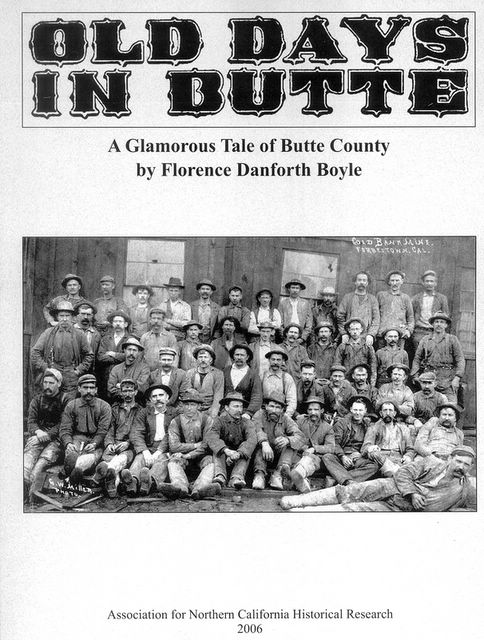
She called it "a glamorous tale of Butte County." In the early 1940s, longtime Oroville resident Florence Danforth Boyle (1892-1973) wrote 196 "chapters" about county history for the Oroville Mercury-Register.

Those columns have been collected in large-size paperback format as "Old Days in Butte" ($19.95), published by the Association for Northern California Historical Research and edited by Robert Colby. The book covers the history not only of Paradise, Chico and Oroville (originally Ophir) -- though the latter gets only scant attention -- but also Biggs, Gridley, Stringtown and dozens more.

I think Lyon Books in Chico can get copies and it's also available from Association for Northern California Historical Research representative Barbara Mahler at bmahler116 @aol.com. It sets a high standard for local history. Colby and those who worked with him to compile and edit "Old Days in Butte" looked carefully at each column, putting unverified or folklore accounts in italics and adding corrections in brackets.

For example, the column for Feb. 23, 1942 quotes a verse ("Here I lay me down to sleep, / To wait the coming morrow; / Perhaps success, perhaps defeat / and everlasting sorrow. / Let come what will, I'll try it on / My condition can't be worse -- / But if there's money in the box / It's money in my purse") and then says:

"The author of that little verse was at one time a resident of Thompson's Flat -- a man whose daring exploits later made him one of the most famous characters in the old west. He was Black Bart, colorful highwayman feared by every stage driver in Butte County during its early days. The little piece of poetry was found attached to an empty express box taken from a stagecoach held up by Black Bart. It was his custom to leave a verse with every box he opened after taking its contents. Black Bart was reported to have posed as a dentist while living at Thompson's Flat, wealthy mining community located but two miles north of Oroville."

With the benefit of subsequent research, Colby adds an editor's note: "Current research indicates that Black Bart left poetry in only two holdups, on Aug. 3, 1877 in Sonoma County and on July 25, 1878 above Berry Creek in Butte County. ... Also, there is no evidence that he lived in Thompson's Flat." I love this attention to detail.

"Old Days in Butte" also includes an invaluable name and place index by Carlene Marek and a map of Butte County, drawn by Steve Schoonover, locating the towns, existing and long gone, described in the book.

The Foreword is by Betty Boyle Davis, Florence Danforth Boyle's daughter. Davis' account is rich with detail; I was especially struck by her mother's early interest in pioneer history -- and her hiking abilities. As a high schooler she hiked "to Berry Creek, Brush Creek, Yankee Hill and other outlying areas. On one occasion she encountered three mountain lions. She did not miss a step, just raised her arms in a threatening manner, let out a ferocious war whoop and continued on her way. The frightened animals ran away."

Florence Danforth Boyle was deeply involved in the establishment of a place to "house pioneer relics." Eventually "the Butte County Pioneer Museum was deeded to the city of Oroville in 1999 to insure its future."

An insight into our past is ensured with the publication of "Old Days in Butte." Don't miss it.

Dan Barnett teaches philosophy at Butte College. To submit review copies of published books, please send e-mail to dbarnett@maxinet.com. Copyright 2006 Chico Enterprise-Record. Used by permission.

Thursday, October 12, 2006


Artoberfest features new anthology of 'Skyway Poets'

By DAN BARNETT

The "Skyway Poets" began in Paradise in 1990 as a group of writers who met regularly to critique each other's work and to conduct occasional readings. Since joining in 2002, Patricia Wellingham-Jones, through her PWJ Publishing, has brought out a number of chapbooks featuring group members.

A new anthology, containing the work of 10 Skyway Poets, will be introduced Saturday at noon in Diamond Alley between Third and Fourth streets in downtown Chico. "Skyways," edited by Wellingham-Jones, is available for $10 in paperback from Lyon Books in Chico or from www.wellinghamjones. com.

The Skyway Poets are also featured with selected poems displayed in the windows of the Chico Chamber of Commerce offices on Salem Street, part of the Window Art Project during the month-long Artoberfest celebration.

Two-thirds of the 30 poems featured in "Skyways" were written in response to "assigned words given as prompts for new poems at the end of each monthly session" of the writing group. Those words are given in brackets in the table of contents so the reader can have a bit of fun seeing the workings of the poetical mind. Ann Doro, for example, uses "layer":

Layered in doubt I listen again
to the family legend.
Grandpa borrowed a neighbor's bull
While they were at the movies.
It took less time than the telling
for that sire to mount every
cow in the pen
and start a dairy farm.
No way, I want to say. ...

She entitled the poem, "Bull?"

Zora Maksente uses "handle" to write of her father, a chef, in "Making a Comeback":

He grips a huge wooden-handled
spatula in his right hand, turns
vast amounts of sizzling raw
beef chunks,
over and over, on the grill's hot
surface. ...

During The Great Depression
at day's end all unsold food
was handed out the backdoor
to growing lines
of hungry people until --
it caught up with him, too.

Sally Allen McNall is stuck with "pitch" in "Touch Pitch," with the last lines funny and wondrous at the same time:

If she pries the yellow resin
from the tree with her fingers
and puts it in her mouth,
spit coats it, it won't stick
to her teeth, and it tastes exactly
how the tree tastes to itself.

Sylvia Rosen presents "color" in "Kaleidoscope":

... I began to imagine the earth
as a giant kaleidoscope
in the sky
tossing us all into
a variety of patterns
against the mirrored
illusions of our eyes
as if we were all chips of
tinted glass
shimmering together in
our brief moment
against the light
as we move to touch
and then depart

Patricia Wellingham-James takes "ride" for a ride in a strange poem called "Folded," in which a man "folded his ailing wife in three pieces" and called them "Bat, Bat-hag and Nag":

... On fine days the man
tucked
his wife
into his shirt pocket, took
her
on long scuffling walks
through scarlet and
brown
autumn leaves,
to the lake where they
used to
paddle
on starry nights, along
the
winding trail
through firs and pines to their
favorite picnic table.

On these jaunts
Bat, his own true love, the spirit
of flying adventure, rode next
to his heart. ...

But there is still "Bat-hag" and "Nag" to contend with, and that's "the rest of the story."

Other contributors include Lara Gularte, Joy Harold Helsing, Mona Locke, Birgitte Molvig and Audrey C. Small. "Skyways" is a small gem, and plenty of fun.

Dan Barnett teaches philosophy at Butte College. To submit review copies of published books, please send e-mail to dbarnett@maxinet.com. Copyright 2006 Chico Enterprise-Record. Used by permission.
Thursday, October 05, 2006


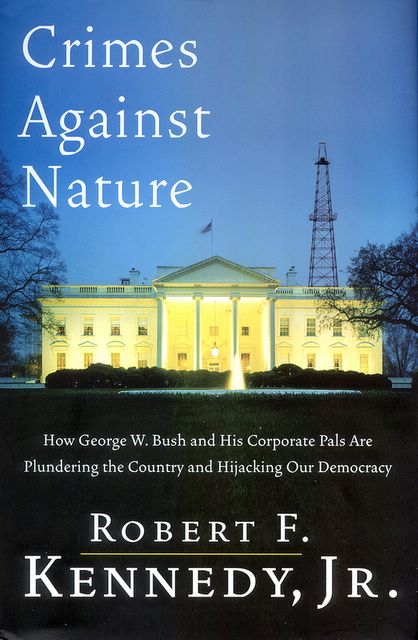
Friday in Chico -- Robert F. Kennedy Jr. on importance of environmental activism

By DAN BARNETT

The scenario is chilling.

"I live in Mount Kisco, New York," writes Robert F. Kennedy Jr., "11 miles downwind of the Indian Point Nuclear Power Plant. ... On the morning of September 11, 2001, United Airlines Flight 175 from Boston passed within a few thousand feet of Indian Point as it followed the Hudson River down to its rendezvous with Tower Two of the World Trade Center. Had it banked left and crashed into the plant instead, it could have triggered a large release of radiation. The surrounding area, including New York City, might have been rendered uninhabitable for years."

So, asks Kennedy, what has been done to protect the nation's nuclear power plants from terrorist attack? Virtually nothing, he says. In fact, "federal law absolves nuclear power plant operators from any legal duty to protect their plants from attacks 'by enemies of the United States.'"

According to Kennedy, this is but one of innumerable examples of the wholesale dismantling or gutting of laws designed to protect the public against the excesses of the nuclear, coal, oil, chemical, pharmaceutical, agriculture, media and other industries that he claims have conspired with the Bush administration to undermine the free market and subvert the will of the people. These abuses are detailed in "Crimes Against Nature: How George W. Bush and His Corporate Pals Are Plundering the Country and Hijacking Our Democracy" ($21.95 in hardback, $13.95 in paperback from HarperCollins) published in 2004.

He is scheduled to speak in Chico Friday at 7:30 p.m. at Chico State University's Laxson Auditorium as part of the President's Lecture Series, one in a series of On the Creek Lectures "dedicated to exploring sustainability issues that affect the world today." Tickets range from $35 for premium seats to $20 for students and children. For more information, call the University Box Office at 898-6333.

According to publicity materials, "Robert F. Kennedy Jr.'s reputation as a resolute defender of the environment stems from a litany of successful legal actions: prosecuting governments and companies for polluting the Hudson River and Long Island Sound; winning settlements for the Hudson Riverkeeper; arguing cases to expand citizen access to the shoreline; and suing sewage treatment plants to force compliance with the Clean Water Act."

Though Kennedy says "this book is not about a Democrat attacking a Republican administration," he writes "most national environmental leaders," when asked about "the greatest threat to the global environment," wouldn't answer "overpopulation, or global warming, or sprawl. The nearly unanimous response would be George W. Bush."

The popularity of Earth Day in 1970, he writes, surprised the polluters, so over the next three decades they "bamboozled" the public and bought off the loyal opposition until their triumph, with some notable exceptions, in the "stealth" policies of the Bush administration bowing to the agendas of King Coal and Big Pork.

Kennedy accuses the administration of "fear-mongering," though he does a fair amount of that himself. Nevertheless, as the book's copious notes attest, something really nasty is going on after all. "Corporate capitalists," he writes, "don't want free markets, they want dependable profits, and their surest route is to crush the competition by controlling the government. The domination of our government by large corporations leads to the elimination of markets and, ultimately, to the loss of democracy." Think of Big Energy -- or Big Agriculture. The manure is getting deeper, Kennedy says, and it's time we get shoveling.

Dan Barnett teaches philosophy at Butte College. To submit review copies of published books, please send e-mail to dbarnett@maxinet.com. Copyright 2006 Chico Enterprise-Record. Used by permission.

Friday, September 29, 2006


Big Band crooner honored in Oroville, teams with Magalia writer to tell life story

By DAN BARNETT

He begins the story this way: "Smog hadn't been invented yet when I was born Harry Bradbury Albretsen on Oct. 21, 1916, in Eagle Rock, California, a suburb of Los Angeles."

Almost 90 years later, on Sept. 17, 2006, this same man, now known as "Garry Stevens" (a stage name he adopted in 1941), was honored with a surprise birthday celebration as he sang at Feather Falls Casino in Oroville with "The Fabulous Swing Kings," the Chico-based dance band. It had been a long road, but Stevens was still smiling.

Pictures from the birthday bash appear on the Jazz Connection Magazine Web site (www.jazzconnectionmag.com). Publisher Stephen Fratallone of Magalia helped organize the surprise; he writes me that "I have always been a fan of Big Band music since I was 12 (I'm 49 now). I play saxophone and I took private lessons from Don Raffell, a prominent studio musician who played in the Charlie Spivak band when Garry was Spivak's boy vocalist. That's when I first heard of Garry Stevens." Fratallone discovered that Stevens was still alive, living in Benicia, and they became fast friends.

That friendship has led to the publication of "Band Singer: An Autobiography" ($15 in paperback from jazzconnection@hotmail.com) by Garry Stevens with Stephen Fratallone. The book contains a discography and a generous sampling of black and white photographs. Stevens by now has outlived most of his friends, and he notes their passing throughout the narrative. But the story is full of "Zip-A-Dee-Doo-Dah" as Stevens works to "Ac-Cent-Tchu-Ate the Positive." It's a fun book.

Stevens worked with Nelson Riddle, also a member of the Spivak band, and he writes that "one of Nelson's arrangements became a chart-topper for the band and it helped to keep me in the public ear for a couple of years during the musicians' union strike. It was Irving Berlin's holiday classic, 'White Christmas.' We recorded it on July 1, 1942, in New York. ... Bing Crosby, of course, had the definitive hit version of the song" but Stevens' version continued to be played on jukeboxes through the mid-1940s. He also recorded "My Devotion," which "became one of the more popular romantic ballads to come out of World War II."

Stevens enlisted in the Army Air Corps. "Before the war, I was named one of the top male band vocalists in the country. I was going to go back to civilian life and try to pick up where I had left off. It didn't occur to me that the music business had changed during those years and retracing my steps would prove to be very difficult." He joined the Gordon "Tex" Beneke band, whose pianist was Henry Mancini. No longer a "boy singer," Stevens began to relish the term "band singer." "A band singer sings in tempo. Cabaret singers like Frank Sinatra and Tony Bennett sing more ad-lib. ... When you sing with a band, you sing for dancers and in tempo. If you start to ad-lib, you'll throw the dancers a curve, and they won't like it."

In the 1950s Stevens had a local television show, later worked in real estate, and got back into music in 1980, eventually moving to California and joining the Big Band Academy of America. Stevens' personal life has had its ups and downs, but music has been his soul. He calls himself the "oldest self-taught band singer in the business." At 90, he's still jazzed.

Dan Barnett teaches philosophy at Butte College. To submit review copies of published books, please send e-mail to dbarnett@maxinet.com. Copyright 2006 Chico Enterprise-Record. Used by permission.