Showing posts with label Christianity. Show all posts

Tuesday, December 23, 2025

“Why Am I Still A Christian?”

“Why Am I Still A Christian?”
The Advent season, with its glitter and good tidings, has a dark side. The promised one who will loosen the stranglehold of death has not yet come. “In 2025,” writes Ricky Hayes in his spiritual autobiography, “the headlines have been littered with assassinations and murders. I didn’t know the victims, but I know they didn’t deserve it. That’s the sickening part about Death: it doesn’t discriminate, it doesn’t ask, it doesn’t care. All it does is take.”

Hayes, born and raised in Chico, found Death “would pop up again and again—sometimes as a shadow in the corner of my room, sometimes in hospital corridors, sometimes in the faces of people I loved.” So, he asks, why did God “let me carry this fear like an uninvited passenger for my entire life?”

Hayes explores that question (and many more) in “Why Am I Still A Christian?” ($13.99 in paperback from Publishers Brew, publishersbrew.com; also for Amazon Kindle). The story is “messy, it’s raw, it’s sometimes irreverent, but it’s real.”

The first half of the book is Hayes’ spiritual odyssey, and it’s messy indeed. “It’s about how grief, doubt, porn, legalism, cult-like religion, and plain old despair nearly convinced me to leave Christianity behind. But it’s also about how, through all that chaos, Jesus kept showing up. Not the Jesus of fire insurance, shame, and performance, but the Jesus who refuses to let go, even when you’re screaming at Him.”

The second half focuses on specific theological issues, with a biting critique of the modern American church which all too often, Hayes writes, suggests “salvation depends on our performance instead of Christ’s finished work.” In fact, “what I have learned most of my life from Christians, both Fundamentalist and Charismatic, is how not be be a Christian…. We’re supposed to influence people to be reconciled to God by loving one another, not by fighting a cultural war.”

The promise has been fulfilled: “The cross is about God revealing the greatest love one can give through the light of the world, Jesus Christ. Whatever blackness hinders our souls from seeing his beauty, God will shine through if we desire him to do so.”


Tuesday, April 22, 2025

“A Place For Weakness: Preparing Yourself For Suffering”

“A Place For Weakness: Preparing Yourself For Suffering”
Near as I can tell, Paradise High School student Mike Horton, born in 1964, found himself embracing the Christianity of the Protestant Reformation, which emphasizes God’s sovereignty. Many years later, as Professor of Systematic Theology and Apologetics, he taught at Westminster Seminary in California and has published or edited more than forty books. 

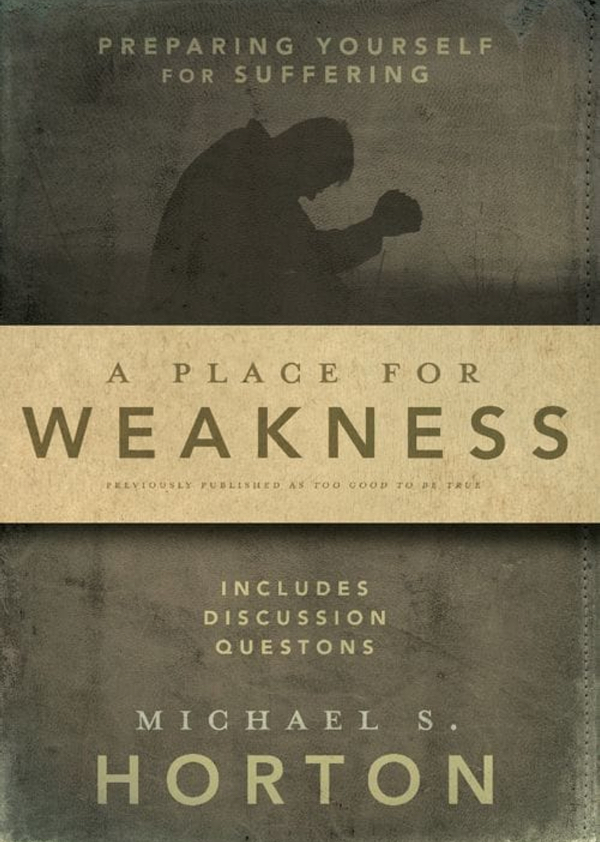
In 2006 he wrote a Bible study called “Too Good To Be True: Finding Hope In A World Of Hype.” It was not a theoretical treatise, but included deeply personal accounts of pain and grief, and so the publisher renamed it. “A Place For Weakness: Preparing Yourself For Suffering” ($22.99 in paperback from Zondervan; also for Amazon Kindle), by Michael S. Horton, is a thoughtful companion for the Christian church’s experience of Eastertide.

As Wikipedia puts it, “Traditionally lasting 40 days to commemorate the time the resurrected Jesus remained on earth before his Ascension, in some western churches Eastertide lasts 50 days to conclude on the day of Pentecost….” For Christians, Eastertide is a paradoxical celebration of the “already” and the “not yet.” The book is divided into two sections, exploring the “God of the cross” and the “God of the empty tomb.”

Horton warns against  a “theology of glory” which “presumes to ascend self-confidently to God by means of experience, rational speculation, and merit.” Instead, believers are called to a “theology of the cross” that “sees God only where God has revealed himself, particularly in the weakness and mercy of the suffering.” The proper theology, he writes, is really a “theology for losers.”

In pastoral ministry Horton has dealt often with suffering. He recounts the story of a pastor friend who took his own life, and, closer to home, his wife’s multiple miscarriages, subsequent difficult births (“premature triplets”) and “hormone-induced depression.” His aging father suffers a brain tumor which causes unimaginable anguish.

“We cannot climb up to God,” he writes, “but he has descended to us. This is the gospel in a nutshell, and it sustains us in suffering.” Bottom line: “It is death’s victory, not its reality, which is overcome in Christ’s resurrection.” 

One day all will be made whole. But not just yet.


Tuesday, December 24, 2024

“Advent: The Season Of Hope”

“Advent: The Season Of Hope”
“Part of why we observe Advent,” writes Episcopal priest Tish Harrison Warren, “is to make Christmas weird again, to allow the shock of the incarnation to take us aback once more.” Advent (from a Latin word that means “coming”) begins on the fourth Sunday before Christmas, “which through each passing week will slowly unfurl the story of Jesus’ life, death, resurrection, ascension, and sending of the Holy Spirit.”

Advent closes with a focus on the coming of the Christ Child celebrated on Christmas Day. Yet, as Warren points out in “Advent: The Season Of Hope” ($20.99 in hardcover from InterVarsity Press; also for Amazon Kindle), Christians believe “not just in one coming of Christ but in three: the coming of Christ in the incarnation, the coming of Christ in what Scripture terms ‘the last days,’ and the coming of Christ in our present moment, through the Holy Spirit’s work and through Word and sacrament….”

Her book is a warm and accessible entry into Advent’s four weeks of waiting, hoping, anticipating. In five short chapters (Yearning, Longing, Crying Out, Stirring, Approaching) she melds church history with her personal story of coming to terms with Advent. By that she means what she first thought was a month-long preparation for Christmas was actually about much more. “I was surprised to discover … that Advent is uncomfortably and unavoidably apocalyptic, more concerned with a vast cosmic battle than dashing through the snow in a one-horse open sleigh.”

It's not about bad second-coming theology, which produces fear, but the yearning for the return of Christ “in glory,” where “Death will be undone. Tears will be wiped away,” where “all of our longings meet their end in Christ coming again, bringing healing, peace, joy, and an unimaginable wholeness in his wake.”

The coming of the Holy Spirt at Pentecost created the church, however imperfect, and, as she quotes theologian Michael Horton, who grew up in Paradise, it is now “the age that Jesus inaugurated … disrupting the powers and principalities that keep us from recognizing him.”

And so, she writes, “We need him to come to us, to rescue and restore us, even today, in our everyday lives.”


Tuesday, October 22, 2024

“Heretic Too!: An LGBTQ-Celebrating, Divine Violence-Denying, Post-Christian Universalist’s Responses To More Of Evangelicalism’s Concerns”

“Heretic Too!: An LGBTQ-Celebrating, Divine Violence-Denying, Post-Christian Universalist’s Responses To More Of Evangelicalism’s Concerns”
Chico writer Matthew Distefano, theological provocateur and Tolkien-lover, returns for another jab at the conservative evangelical tradition he grew up in. “Heretic Too!: An LGBTQ-Celebrating, Divine Violence-Denying, Post-Christian Universalist’s Responses To More Of Evangelicalism’s Concerns” ($19.99 in paperback from Quoir; also for Amazon Kindle) is a sequel to his earlier “Heretic!”—though this time he calls himself not a heretic but an “apostate.”

Though “I still think Jesus is the bee’s knees” (and so, he adds, is Buddha), “I don’t necessarily care about all the ins and outs of the faith. I no longer care about the Apostles’ or Nicene creeds, or any of the creeds for that matter. I no longer consider myself part of the Church…. Instead, I’m way more interested in who Jesus was as a human being, why it’s important to study his life, and, if you’re so inclined, to put into practice his ethical teachings.” 

Later, though, Distefano notes that “I live on the fringes of Christianity,” and its pull continues to be evident in each chapter, which critiques many of the teachings found in evangelical circles. “It’s not that I don’t care for what Christians have to say, it’s just that I’ve become more enamored with Buddhism than I ever thought imaginable,” and “one can be a Christian and practice Buddhism.”

The bottom line is that through the strife of our present life, “love wins”—or should. Distefano wants to dismantle the doctrines that, he says, separate person from person, and that includes hell, marriages with gender-assigned roles, and heterosexual sex as the only “normal” kind (the author has come out as bisexual). The book ends with impassioned letters against Christian nationalism and the rise of Trumpism.

“Often times,” he writes, “I am cheeky, and sometimes I can be rather biting.” His theological explorations are peppered with barnyard epithets which, in an odd way, are the sign of his caring. He envisions love abounding (which doesn’t mean anything goes), a world with the sensibility of the Hobbits’ Shire, a place one can enjoy good pipeweed (in his case, cannabis) and talk with friends far into the night.


Tuesday, July 30, 2024

“Christ Or Caesar: Church And Nation In Christian Perspective”

“Christ Or Caesar: Church And Nation In Christian Perspective”
“Christian symbols and prayers among the mob storming the U.S. Capitol. Nationalistic celebrations and politically partisan sermons in churches. … The relationship between church and nation in the United States is a source of much confusion and strife.” 

So write Presbyterian elder Allan H. Harvey and Senior Associate Pastor Carl S. Hofmann, both of Grace Commons Church in Boulder, Colorado. Hofmann was the guest speaker, via Zoom, at a Chico discussion group considering the authors’ book, “Christ Or Caesar: Church And Nation In Christian Perspective” ($5 in paperback from Barmen Publishing).

Harvey and Hofmann describe themselves as “non-fundamentalist Protestants who seek to follow Jesus but recognize that our writing, like our lives, will inevitably be imperfect and is not the final word.” They invite Christians and others to consider what it means “to give our allegiance to Christ alone, not to any ancient or modern political Caesars.”

Intended for a general audience, the first two chapters provide Biblical context, about Abraham, Egypt, and Babylon and then for Jesus, the Church, and Caesar. In the Old Testament, “God’s people are to carry out their international mission to bless the people of all nations and ethnic groups.” In the New Testament, Israel’s mission is fulfilled in Jesus; in him “God enfolds, heals, and redeems all nations, not just particular ones.”

When Christians seek to wed the church’s mission to the authority of the state, as the “German Christians” did under the Nazis, and often in church history, such nationalism becomes idolatry. Jesus’ followers expected him to overthrow the Roman power and “make Israel great again”; but he said his kingdom “was not of this world.”

The authors consider the “errors of Christian nationalism,” how it distorts American history and seeks to use secular power over others; it is, they say, “theologically wrong.”

The final chapter considers the practical: it’s not about “gaining power for ourselves. Instead, we should be giving ourselves away for the good of our neighbors around the world.” It’s difficult to discuss with family and friends, Hofmann told me; it requires discernment and much prayer; the bottom line: “our ultimate source of hope is Jesus, not politics.”


Tuesday, April 18, 2023

"The Story Of Christianity Told As Good News For All"

The Story of Christianity Told As Good News For All
My friend and retired Butte College philosophy instructor Ric Machuga begins his new book with a provocative theological statement: "I believe in the God who can and will save everyone. My belief," he continues, "is grounded in a literal reading of St. Paul: 'Just as one man's trespass led to condemnation for all, so one man's act of righteousness leads to justification and life for all' (Romans 5:18)."

The claim is provocative, of course, because at first glance it seems to override human free will. What about those who choose not to believe? In the book's sixteen chapters Machuga tackles the question head on, first through a philosophical lens and then through a theological lens. Even those who vehemently disagree will find I-never-thought-about-it-that-way insights in "The Story Of Christianity Told As Good News For All" ($15.99 in paperback from Quoir, quoir.com; also for Amazon Kindle).

If moderns sometimes talk about “choosing to believe,” Machuga questions the coherence of that claim. He tells his own story of how "God’s choreography" brought him to belief in universal salvation, belief that for him is as undeniable as the roses outside his office window. "Belief is voluntary," he writes, "but it is not chosen."

Central to Machuga's argument is that in Christianity, God is "non aliud," meaning "not 'another thing or person' in the universe." His key theological claim tracks with Augustine, that God created “a world with space and time, not in space and time.” God is not just another a thing in the universe competing with human free will. 

The book uses some important, and mostly jargon-free, philosophical distinctions to draw out the implications of this view, which allow for affirmation of the traditional Christian Creeds within the context of “salvation for all.” And, importantly, it places new emphasis on the doctrine of the Trinity and the revelation of this transcendent God through the God-man, Jesus of Nazareth.

Machuga’s own story of this gift of belief is woven into his account, and it’s clear his prayer is that this volume may also be part of the Holy Spirit’s choreography for the person who takes up this book, and reads.


Tuesday, October 25, 2022

"Matthew 25 Christianity: Redeeming Church And Society"

Donald Heinz, Lutheran minister and Chico State emeritus Professor of Religious Studies, offers in his new book what he calls a field guide to a new Christian movement, one based on the words of Jesus in Matthew 25.

"You've heard the story," Heinz writes; "it is the end of the age and all people are lined up, like sheep and goats, before Jesus as the cosmic judge. A series of questions ensues and judgments are made. Did you see me among them, Jesus as King asks, when there were homeless to be sheltered, naked to be clothed, hungry to be fed, thirsty to be given a drink, strangers to be welcomed, the imprisoned to be visited? If you did these things for the least of these, you were serving me. Now you will inherit the kingdom prepared for you since the foundation of the world."

For Heinz, "Matthew 25 Christianity: Redeeming Church And Society" ($29 in paperback from Cascade Books; also for Amazon Kindle) has both an inner and outer expression. Within the Christian tradition "new movers and movements came to take Christianity seriously, and were gripped by it, and made the concern with 'the least of these' the cause of their religious life" (think Francis of Assisi, Martin Luther King Jr.).

But today "we have isolated or distanced the poor, or insulated our social imagination" until "it is nearly impossible to see them." He proposes churches identify as "Matthew 25" congregations--but there must be more.

If his book seeks to take the likely original reference in Matthew 25 (to Jesus' itinerant disciples, often poor) and bring it into "new social contexts" and a care for "all the people of the world who are in need," he also advocates for the institutionalization of such a social gospel framework within governmental structures. It's not a theocracy, Heinz writes, but a call for the voice of Matthew 25 to become part of public discourse. 

In the end Heinz invites readers to "sell all and sign on": "The apostle Paul took a world-friending God public, rendering the Jesus movement a light to the world. What are we going to do with this?"


Tuesday, April 05, 2022

"Your Faithful Brain: Designed For So Much More!"

"Joy," writes Christian counselor Leonard Matheson, "is the designated state of a faithful brain, fully integrated with God, within itself and with others. Joy erupts as we're fully engaged in the moment."

After retiring from Washington University in St. Louis, and teaching graduate students in counseling at Covenant Theological Seminary, Matheson and his wife Mary moved to Chico where he is now in private practice, the founding director of Chico-based EPIC Neurorehabilitation & Psychology Services.

Drawing on his work in occupational therapy and neurology, Matheson views Christian spirituality through the lens of brain science. Published in 2014, "Your Faithful Brain: Designed For So Much More!" ($19.95 in paperback from WestBowPress; also for Amazon Kindle), by Leonard Matheson, PhD, is a popular (and very personal) exploration of his findings.

Chapters explore characteristics of the faithful brain (grace-blessed, loving, truth-guided) and include summaries and discussion questions. 

Though Matheson had pushed faith away, he writes that "God was placing in my life people who eventually would draw me back to Jesus, including Danny Munday" whom he met in "Rancho Los Amigos Hospital on the first day of my career, February 3, 1970." 

Shrunken with spinal muscular atrophy (he would die at 15), Danny was totally dependent on others to remove the mucous from his lungs before he choked to death. Yet Danny was joyful; his goal in life was to kiss Jane Fonda (and it actually happened). Matheson learned of "the potential for joy up close to death."

Though people make decisions, not brains, a key insight into more faithful decision-making is the neuroplasticity of the brain; it can change and adapt. "As we practice following Jesus," Matheson writes, "our values begin as ideas we can consider and then test. ... As this process repeats, neuroplasticity gradually creates neural patterns of values that permeate the brain," developing "our character to gradually reflect the character of Jesus."

Such alignment is never perfect; we can't fathom all the possible neural combinations, Matheson says, since there are a "Godzillion" of them. But he is convinced that our brains can be rehabilitated and that we can live a life of joy, even up close to death.


Tuesday, November 23, 2021

"I Lift My Eyes To The Hills: God's Help In Times Of Trouble"

Back in 1983, when Stephen Payne was going to Chico State, he and a friend, he told me in an email, "decided on a lark to build a raft out of inner tubes and plywood and float down the Sacramento River for two days." Aside from almost capsizing in a patch of whitewater, they made it, a cause for thanksgiving. 

Now living with his wife, Laura, in Southern Oregon (with an uncle and aunt in Orland), Payne finds continuing reasons for thanksgiving, not least of which is Laura surviving stage-4 melanoma. Yet, as a Christian, he recognizes that "in the midst of the storm, when all had seemed bleak, it was not easy for me to remain grateful to God." 

He found comfort in the Psalms which provide assurance that "the Lord will watch over your coming and going, both now and forevermore." Thus, "whether he answers as we hope or not, he is still faithful, and he is still good."

That conviction is expressed in his coffee-table book "I Lift My Eyes To The Hills: God's Help In Times Of Trouble" ($19.99 in hardcover, self-published, available at www.liftmyeyestothehills.com), featuring his stunning full-color photographs of the natural world (and its people), all set within the context of the Psalms of thanksgiving.

Ten chapters each focus on a verse, such as Psalm 96:12, "let all the trees of the forest sing for joy." Payne presents a brief exposition; a set of his glorious images taken in Oregon, California, and around the world; his own accounts of nearly capsizing as he faces metaphorical whitewater; and chapter discussion questions.

He and Laura spent a decade with Wycliffe Bible Translators translating the New Testament for the Kwatay people in Senegal; Steve now trains national translators. Through it all he continues his love of photography. 

Tourists snap the sunset's "burst of color" and then leave, but with patience the photographer begins to see "the high clouds overhead start to glow with the pastel shades of alpenglow." That, he writes, is like committed love, for God or one's spouse: "enduring, soft, tender, and patient," even in the midst of rapids.

Tuesday, October 19, 2021

"Where The Light Fell: A Memoir"

Ten years ago author Philip Yancey spoke at the El Rey in Chico, part of a series of talks sponsored by Bidwell Presbyterian Church. The best-selling author of  "What's So Amazing About Grace?", Yancey chronicles how "God chooses to make himself known primarily through ordinary people like us."

Now comes autobiography, a "prequel" to his other books. "Where The Light Fell: A Memoir" ($28 in hardcover from Convergent Books; also for Amazon Kindle) focuses on his early life through college days, a stunning tale of growing up in Georgia, of racism and white poverty, and of a mother visiting her own dashed dreams onto her two sons--with irreparable harm.

In 2007, in the aftermath of a life-threatening car accident, Yancey thinks that "in the face of death, old fears would come surging back. An upbringing under a wrathful God does not easily fade away. Instead," he says, "I experienced an unexpected serenity. I had an overwhelming sense of trust, for I now knew a God of compassion and mercy."

It wasn't always so. A year after his birth in 1949 his father, convinced God would heal him, succumbs to polio. Mother (that's what she wanted to be called) dedicates Philip and his older brother, Marshall, to become missionaries, a dream she and her late husband would never fulfill. "My brother and I are the atonement to compensate for a fatal error in belief."

Raised in fundamentalism, Philip and Marshall learn how to move audiences with tearful testimonies even as they imbibe racism. Over time Marshall is estranged from Mother, trying out new lifestyles every week, buying into hippie and drug culture, and Philip becomes the sneak and "trickster." 

"Like Marshall, I fully expected God to crush me someday--the threat Mother held over us. Yet from the Bible I am learning about a God who has a soft spot for rebels...."

Life is like a jigsaw puzzle, Yancey writes. "Only over time does a meaningful pattern emerge. ... In retrospect, it seems clear to me that my two life themes, which surface in all my books, are suffering and grace." Readers will find both in abundance in Yancey's unforgettable story.


Tuesday, October 05, 2021

"Witness: Hearing The Voice Of God: A Spiritual Autobiography"

Chicoan Terry Hunt remembers being at the hospital bedside of a woman who had come to his talks at St. John's Episcopal Church. Dying, she didn't know what to do. "Maybe," Hunt said to her, "it is just like being born: there is nothing you have to do." Then he added: "Actually there is one thing you can do when it is your time to die, you can watch for Jesus and when He comes you follow him."

And then Hunt thanked her for trusting him "because you thought I might have a connection with God. I have wanted so deeply to be His priest, and you have recognized me as His man. Many others have not. Do you see now what a great gift you have given me?"

This spiritual longing suffuses "Witness: Hearing The Voice Of God: A Spiritual Autobiography" ($17 in paperback, self-published; also for Amazon Kindle). The book is at times shockingly confessional as Hunt, now in his eighties, recounts his ordination as an Episcopal priest and the rocky relationships at the churches he served; business choices that went south; the painful ending of his official priesthood; and the divorce from his first wife.

Through it all, God was speaking "through events, or through the voice of friends, and sometimes enemies; through dreams, and other strange and luminous metaphors; and I mean He sometimes spoke in a quiet voice: one I heard, not with my ears, but in my mind." But though these "messages were not always easy to recognize or decipher," Hunt calls such moments "spiritual seeds," "opportunities to become more fully self-aware and responsible beings."

Married to Carol Jean since 1975, the couple since 1990 a fixture in Chico, Hunt has found that self-awareness can come powerfully through writing. Teaching workshops in spiritual autobiography, he has invited others to discover God's presence.

A series of epiphanies in Hunt's life (one with rattlesnakes) revealed his deep anger (especially at his father), showing him the wilderness he must go through in following Jesus. It's the way of becoming a disciple, "recruiting people to the union," to "spiritual transformation." 

And, for Hunt, the journey continues.


Tuesday, September 14, 2021

"Christ's Emperor: A Novel Of Theodosius The Great And The Triumph Of Christianity"

Retired Butte College administrator Les Jauron reaches back in history for his debut novel about the last Roman emperor to rule the entire Empire. 

"Christ's Emperor: A Novel Of Theodosius The Great And The Triumph Of Christianity" (self-published for Amazon Kindle), focuses on Theodosius' rule from 379-395 AD, especially his military planning and exploits and his attempt to bring Trinitarian (Nicene) Christianity to the Eastern Empire (which received plenty of pushback from Arian Christians and pagan Senators). 

Jauron, a West Point grad and retired military officer, writes in a notes section that "one of my primary motivations with this novel was to understand why Theodosius made the decisions he did." Sometimes he has to make alliance with the invading Goths to ward off other invaders; at other times he fights his cousin when he attempts to usurp the throne.

Most notable is Theodosius' relationship with Bishop Ambrose, whose authority over the Nicene Christians presents a formidable hurdle to any rapprochement with Arians (who believed there was a time "when the Father existed and the Son did not") and pagans. If Emperor Constantine had made Christianity legal in the Empire, Theodosius' hand is forced to make all other religions effectively illegal in the Empire.

Though throughout the novel a good number of severed heads of enemies and betrayers are delivered to Theodosius and others, Jauron is more interested in battle strategies; the letters that fly as fast as horses between various co-emperors; and in the excruciating decisions Theodosius must make to preserve his family dynasty and ensure Ambrose's favor.

Timasius, one of Theodosius' trusted commanders, confronts the Emperor after he defers to Ambrose in not punishing those who destroyed a synagogue. Theodosius replies: "To accomplish my objective to make Christianity the unifying force in the Empire, I need Ambrose and I don't need the Jews. So, the Jews get screwed, I look weak, and Ambrose looks like a hero. It genuinely sucks.... our world is not fair, it is not just, it just is. I have to accept this to be an effective ruler."

Much to ponder in this long novel about ends and means.


Tuesday, March 16, 2021

"The Titanic And Today's Church: A Tale Of Two Shipwrecks"

Former Magalia resident Warren B. Smith, who moved with his wife Joy to Fortine, Montana, was deeply enmeshed in the New Age movement until his Christian conversion, which he wrote about in "The Light That Was Dark: From The New Age To Amazing Grace," first published in 1992. 

Another, more recent, convert, Doreen Virtue, notes that her parents lived in Magalia and that Smith's book "provided stark comparisons between what Scripture says and what 'A Course In Miracles' says," showing "that 'Course' is the opposite of the Bible!" Her story is told in "Deceived No More: How Jesus Led Me Out Of The New Age And Into His Word," published in 2020 by Thomas Nelson.

Now, in a provocative new book, Smith writes that New Age themes have infiltrated the church. He compares the situation to the most famous "unsinkable" ship: "Many in today's professing church," he says, "are unaware they are also on a sinking ship that is headed for destruction." 

"The Titanic And Today's Church: A Tale Of Two Shipwrecks" ($14.95 in paperback from Mountain Stream Press, newagetoamazinggrace.com; also for Amazon Kindle) makes an analogy between the tragic sinking in 1912 of the HMS Titanic and the stance of many "undiscerning" church leaders. Both, he writes, are beset with "design flaws, tragic oversights, false confidence, complacency, pride, greed, denial, disregarded warnings, mixed messages, and unpreparedness."

Each of the dozen chapters begins with a part of Titanic's history, then likens it to the contemporary church. In "A Little Leaven," Smith notes that modern research has found not a giant gash but rather, to quote the New York Times, "a series of six thin openings across the Titanic's starboard hull." 

Similarly, he says, a "small teaching--a little (heretical) leaven," the idea of "God within," that God is "in" everything, is spread knowingly or unknowingly by Oprah, Rick Warren, Henri Nouwen, and many others, making shipwreck of Biblical faith. "God is the creator," Smith writes, "and He is distinct and separate from His creation. He is not 'in' everyone and everything." The Gospel lifeboat, he adds, is faith in Jesus Christ.

The book will launch much discussion.


Tuesday, January 12, 2021

"From The Dark Domain: Novel Number One In The Luke Thomas Series"

Keith Potter served Paradise Alliance Church as lead pastor during the 1990s. Now living with his wife, Sue, in Eugene, Oregon, he is Vice President for Advancement at Bushnell University (formerly Northwest Christian College) in Eugene.

In Potter's new novel, Arthur Gilliam, comatose in a care facility, is visited by a younger pastor, Luke Thomas, making his rounds.

"From The Dark Domain: Novel Number One In The Luke Thomas Series" ($18 in paperback from Resource Publications; also for Amazon Kindle) is a story within a story. Thomas, "District pastor" in San Diego, finds a manuscript Gilliam has written, a long letter to his estranged son, Donnie, recounting a life broken, yet redeemed by God, which forms the crux of the novel.

Ever attracted to beautiful women, Gilliam falls hard for Alice. Donnie is conceived on their wedding night, but Alice is sexually cold and physically brutal. "As a protector, I failed beyond measure," he writes his son.

She kicks Donnie out at sixteen. Later, after Alice dies, Arthur is alone, preaching but not much believing that stuff about Jesus. He moves to Tahuya, Washington. His neighbor, Lisa, is wondrous to look at, and she is attracted to the wimpy Arthur. Yet Lisa abruptly leaves and Arthur ponders what God is doing.

In the early 1990s he takes a job teaching English in Rwanda at a Christian school. The headmistress, Prudence Nayinzira ("a woman who could have been Miss Universe"), is a Tutsi. One of the older students, Faustin Bizimana, a Hutu, becomes spiritual mentor to Arthur, and together they challenge each other in following Jesus.

"My own becoming," Arthur writes, "presented hand-in-hand with that obscure little country; both of us crowded with regrets and unrealized impulses for the good, and yet capable of harm...." Soon, they all must face the Rwandan genocide as attackers come again and again. If by God's grace Arthur finds courage at last, what form will it take?

And how can Luke Thomas communicate this to those who have loved Arthur?

Potter's novel is masterful--and the searing Rwandan events will leave readers breathless in the face of a God-haunted world.


Thursday, October 03, 2019

"Love Revolution: Rediscovering The Lost Command Of Jesus (Revised Edition)"


In 2001, with almost three decades in the pastorate, Chicoan Gaylord Enns experienced debilitating burnout. Months later he faced cancer surgery. Granted time away from his congregation to regain his strength, he began studying the Bible and, on May 1, 2002, found the answer to a simple question that profoundly changed his life.

The story is told in "Love Revolution: Rediscovering The Lost Command Of Jesus (Revised Edition)" ($15.99 in paperback from Love Revolution Press, loverevolutionnow.org; also for Amazon Kindle). 

In Matthew 28:18-20 Jesus tells his followers to make disciples, "baptizing them ... and teaching them to obey everything I have commanded you." For Enns, baptism referred to faith in Jesus Christ--but what exactly had Jesus commanded?

Enns writes that Jesus taught many things, but only commanded one thing, as in John 15:12: "Love each other as I have loved you." As Enns observes, "I had started ... with a question: What all did Jesus command His disciples to obey? ... It was the New Commandment--His Command."

This contrasts with the Old Covenant commands, the first, to "love the Lord your God with all your heart and with all your soul and with all your strength" and the second, to "love your neighbor as yourself." How can one ever fulfill the first? Doesn't the second interfere with it? As Enns writes, "I struggled with a nagging sense that I wasn't really living up to what God expected of me. My responsibilities as a husband, father, son, friend and pastor kept me from being as devoted to God as I felt I should be."

Jesus' command broke through all this. "Rather than shouting 'I love You, God!' into the sky for hours, I began to realize that maybe I should give just a couple of shouts and then go back into the kitchen and help my wife clean up the pots and pans after dinner. ... In the New Covenant, loving God and loving our neighbor are expressed as we put our faith in Jesus Christ and love one another."

Enns is a winsome writer and a gentle guide. Readers will find much food for thought.


Thursday, April 18, 2019

"Is There Purpose In Biology?: The Cost Of Existence And The God Of Love"


With the approach of every Good Friday, Christians around the world contemplate the suffering that Jesus endured on the cross. His resurrection on Easter morning is a promise that one day our world's torment will be banished forever.

Yet, for many, the presence in our world of so much suffering, over geologic ages, seems more a product of chance than any larger theological purpose. For some prominent voices, it's what Denis Alexander calls "a denial of any ultimate reason for the existence of a biological process such as evolution."

Alexander, an evolutionary biologist and cancer researcher, Emeritus Director of the Faraday Institute for Science and Religion in Cambridge, and a Christian, maintains in a recent book that mere chance doesn't rule in biology. He argues that while a theological conclusion can't be drawn from studying biological processes, they are surprisingly compatible with the Christian story.

"Is There Purpose In Biology?: The Cost Of Existence And The God Of Love" ($16.99 in paperback from Monarch Books; also for Amazon Kindle) is currently being discussed by the Chico Triad on Philosophy, Theology, and Science. The group brings academics, students, and independent scholars together each month to wrestle with big ideas, such as Alexander's claim that "evolutionary theory is consistent with a creator God who has intentions and purposes for the world."

Early chapters in the book focus on the meaning of "random mutations" as part of the engine of evolutionary biology, showing that in the world of DNA it's not a matter of "anything goes," not "random in any strict mathematical sense of the word."

But what might be God's purposes for evolution? Through a theological lens, Alexander suggests the development of biological diversity, which is intrinsically valuable; that "creatures like ourselves should emerge" who can engage in loving relationship with God; and that "the end of our own planet does not entail the end of life as we presently know it."

Carrying out these purposes is necessarily a costly process in a world governed by physical laws. There is much suffering. But, Alexander might say, Good Friday is not the end of the story.

Thursday, November 22, 2018

"The Year Of Our Lord 1943: Christian Humanism In An Age Of Crisis"


How do we rebuild a community after horrific devastation? How do we pursue the common good to mitigate future disasters? Do religious traditions have a part to play in teaching us how to bear our griefs and to express thanksgiving in the midst of suffering?

Such questions arise in a new book by Alan Jacobs. Jacobs is an academic (Distinguished Professor of the Humanities in the Honors Program at Baylor University) writing with clarity and verve for a wider audience. Former Paradise resident John Wilson, who edited the now-defunct Books and Culture literary journal, published numerous articles by his friend Jacobs.

In 1943 it was apparent that the Allies would triumph in World War II. A number of writers, working separately but united by a Christian worldview, agonized about rebuilding. What kind of education would be needed to avoid the temptation toward authoritarianism or, alternatively, acquiescence in the idea that all values are merely socially constructed with the highest good "getting along"?

Jacobs considers the responses of five important literary and philosophical figures in "The Year Of Our Lord 1943: Christian Humanism In An Age Of Crisis" ($29.95 in hardcover from Oxford University Press; also for Amazon Kindle). In weaving together the central themes of these Christian intellectuals--Jacques Maritain, T. S. Eliot, C. S. Lewis, W. H. Auden, and Simone Weil--Jacobs raises questions for our own times, and our own rebuilding.

For him, these writers "share the conviction that this restoration will not be accomplished only, or even primarily, through theology as such, but also and more effectively through philosophy, literature, and the arts. It is through these practices,which I believe are best called 'humanistic,' that the renewal--or if necessary the revolutionary upheaval--of Western civilization will be achieved. That was the project that these figures, in the various ways and with their sometimes fierce disagreements, shared."

The final chapter is devoted to French Reformed writer Jacques Ellul, whose seminal studies on the rise of technology and propaganda show there are no simplistic answers on the road ahead to rebuilding an enduring community. But we didn't expect there to be.


Thursday, March 29, 2018

"Cross Roads"


The startling success of "The Shack," by Wm. Paul Young, sparked discussions about forgiveness and the nature of God. The central human character in the novel was Mackenzie Allen Phillips. True to his initials, he helped "map" in story form how God's love might work itself out in the midst of tragedy.

Now, in a subsequent novel no less imaginative, Young takes on the self-centeredness of one Anthony Sebastian Spencer. In "Cross Roads" ($15 in paperback from FaithWords; also for Amazon Kindle), readers learn that Tony Spencer wants control.

When Loree, his wife, "bowed out gracefully" after Tony's inattention, he wooed her back, married her again, threw a big celebration, and then promptly divorced her. A product of a failed foster care system, disbelieving the "God stuff" he had heard as a child, he "had quit crying about it. He had made mistakes and hurt people, but who hadn't?"

Then Tony is hit by a medical trauma that puts him in a coma, and as he lies dying at an Oregon hospital he "awakens" to an outdoor setting with hiking paths and a number of oddly caring strangers.

Jack makes clear the difference between real and true: Not believing God's love for Tony "becomes what is real to you, and you then create a world that holds not believing the word of this God, or the love of this God, or even in this God at all, as a fundamental cornerstone of your life's construction…. Does your inability to believe the word of this God make what this God has said not true?"

A Jesus-figure enters, giving Tony the ability to physically heal one person. A woman called Grandmother helps Tony see himself for what he truly is.

Who will he choose to heal at the hospital? On that hangs the fantastical tale, by turns funny and full of tears, of what it means for selfishness to be transformed into self-giving love. There is hope, the novel says, for us all.

Wm. Paul Young is the scheduled guest at the Jesus Center's third annual spring luncheon fundraiser on Saturday, April 21 at the Lakeside Pavilion in Chico. Tickets are $55 with more information at jesuscenter.org/events.


Thursday, March 15, 2018

"Mere Science And Christian Faith: Bridging The Divide With Emerging Adults"


Greg Cootsona, who pastored for many years at Bidwell Presbyterian Church in Chico, has a deep concern for "emerging adults," those between the ages of eighteen and thirty. They marry later and often don't fit in to church activities geared to couples or families.

Many also feel estranged from what evangelical churches say about science (if science is even addressed) and withdraw from Christianity, becoming the "nones" and "dones." This is especially acute in Oakland-San Francisco-San Jose, but also in the Chico-Redding area.

Cootsona, now teaching at Chico State University, is also administering a grant project through Fuller Theological Seminary that seeks not only to find out what this group thinks about science and religion but to develop guidance for churches seeking to engage emerging adults.

"Mere Science And Christian Faith: Bridging The Divide With Emerging Adults" ($17 in paperback from InterVarsity Press) is, writes Cootsona, "both a manifesto and a field guide. As a manifesto, it's designed to convince you that the church must embrace mainstream science for its future."

As a guide, it shows how churches can enter with emerging adults into the conversation about human origins, climate change, the findings of cognitive science, the meaning of technology, and questions about sexuality and gender.

"Emerging adults," Cootsona writes, "hear about conflict, but they seek collaboration or independence." He focuses on integrating science and faith, where possible. "This means that no discovery can dictate our theology or ethics, but also that no form of human insight and knowledge is outside of Christ. Put simply, God knows far more about science that Albert Einstein."

Accessibly written, personal and even poignant at times, the book is essential to any who are interested in emerging adults. It goes a long way toward achieving the goal of weaving "together mainstream science and the good news of mere Christianity into a narrative that's truly beautiful and beautifully true."

Cootsona is scheduled to present a "Mere Science" seminar, based on his book, on Saturday, April 7 from 8:30 - 10:30 a.m. at Bidwell Presbyterian Church. Cost is $10 per person with childcare and a continental breakfast provided. To register, visit bidwellpres.org/events.


Thursday, February 08, 2018

"Recapturing The Wonder: Transcendent Faith In A Disenchanted World"


The rhythms that shape our lives, Mike Cosper writes, are often profoundly secular--and commercial. From Super Bowl Sunday to Valentine's Day and beyond, our lives are full of commodified sentiment. They have become "disenchanted."

Cosper, founder of Harbor Media and a former pastor in Louisville, Kentucky, says that for many there is "a subtle-but-strong resistance to faith and a skepticism toward anything that veers toward the supernatural. … A disenchanted world is a material world, where what you see is what you get." Religion becomes a personal take-it-or-leave-it affair.

His new book invites readers into a different set of rhythms, into a Cosmos ("an orderly creation full of meaning, … full of mystery, a place where … an unseen spiritual realm is constantly at work….").

As Christians prepare for Ash Wednesday and Lent, a time of contrition, the book's message, about rethinking the stories we tell ourselves, seems fitting. Those from different faith traditions will find much to savor as well.

"Recapturing The Wonder: Transcendent Faith In A Disenchanted World" ($17 in paperback from InterVarsity Press; also for Amazon Kindle) focuses on seven "pathways" or spiritual disciplines to aid readers in "embracing a different story and, with it, a different set of habits and practices."

Cosper notes the importance of the rhythms of the Church year and introduces "breath prayers" to mark the shorter moments of our lives. This is not a life of "spectacle and hype" (he contrasts the "glory cloud manifestations" at Bethel Church in Redding with the idea that God's presence "is often much simpler, quieter, and more subtle").

There are big moments, of course. Easter is coming. "Who needs a greater drama than death, resurrection, and scandalous grace?"

At times we need to enter into solitude with God, but then into solidarity with others. Gifts we give should reaffirm "bonds between people." There is a time of feasting and fasting (and Cosper provides practical help).

Such a life "oriented around the spiritual disciplines is not a pathway to pleasing God but a pathway to experience the joy of God that is already ours in Jesus." It is to live in an enchanted world.