Thursday, February 16, 2006


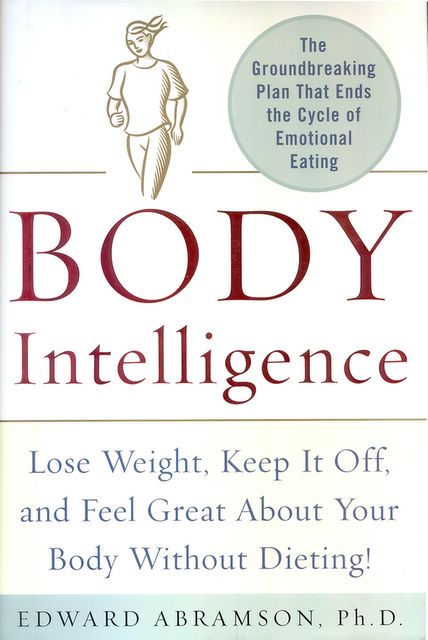
Former Chico State University psychology professor to talk about 'body intelligence'

By DAN BARNETT

Ed Abramson retired from academic life in 2001 after three decades teaching in the Chico State University psychology department.

Now in private practice in Lafayette, Abramson is in Chico today to speak to a psychology group. He'll also be signing copies of his new book at Lyon Books, 121 W. 5th Street in Chico at 5 p.m. today. The public is invited.

The book is the fruit, if you will, of years of experience with those who want to lose pounds but who just can't seem to succeed. The missing ingredient is also the title of the book. "Body Intelligence: Lose Weight, Keep It Off, and Feel Great About Your Body Without Dieting!" ($21.95 in hardcover from McGraw-Hill) is the most sensible guide I've ever read about weight management.

In a nutshell, diets don't work because they're just about counting things (calories, portions, grams of fat) and not about counting on things (like healthy habits of eating and exercise). Once the right habits are established, dieting can become a thing of the past. Abramson describes "body intelligence" as the integration of "research on the psychology of eating and appetite, body image, and exercise to provide a more complete view of weight regulation." Diets are about restrictions; body intelligence is about, well, living!

Body intelligence is about coming to terms with food, body image, and exercise (each of which is covered in detail in the book): "Once you understand the different reasons for eating, and become aware of how you use food, you will find that some of these needs can be met without eating. As you develop alternative ways of meeting these needs, you will lose weight. When you have a realistic, but non-punitive view of your body, you will avoid much of the discouragement that has undermined your previous weight-loss efforts.

"A healthy body image will enable you to convert the new eating behaviors into permanent habits. Similarly, understanding the bad feelings associated with exercise will help you get past these feelings so you can develop a routine that is not painful and which actually may be enjoyable."

Some of Abramson's observations may sound counterintuitive. "As your body image improves," he says, "your willingness to get involved in physical activity will increase." But wait -- doesn't the motivation to exercise come because we feel bad about ourselves?

Maybe in the short term, but if we have developed habits of dissatisfaction with our bodies before exercising, we'll never be satisfied with them after exercising.

"Even after losing weight, you might still be unhappy with your thinner body. Instead of being preoccupied with fat, you might be dissatisfied with your stretch marks, wrinkles, the shape of your nose or some other less-than-perfect feature."

How about this one? "Never eat chocolate (or other craved food) while you're hungry."

What? Don't eat when we're hungry? Hunger is a complex phenomenon but what is clear is that we frequently say we are hungry not because of physical need but because of a whole array emotional states and external cues.

I was doing just fine until I passed the bakery with all those delicious smells. I ate and ate at a party because everyone else was eating. One day my wife asked if I was hungry. I couldn't tell until I had looked at my watch. Ouch!

Eating chocolate when we're "hungry" sends all the wrong habit-messages. What we might be more satisfied with, if we're physically hungry, is a nutritious meal (eating chocolate to get full doesn't work very well). Once we're physically satisfied, eating chocolate can be quite pleasurable (I'm told).

One more. If a person has "been fat for some time" (Abramson says "fat" is a perfectly good word) "other people may have difficulty adjusting to your new eating and exercise behaviors and may be uncomfortable with the weight loss that follows."

You'd think spouses and friends would be overjoyed that all the nagging has paid off, but think again. The person finally connecting with body intelligence changes old habitual relationships -- and that can be threatening.

"Body Intelligence" is written in a caring and sympathetic tone, with plenty of short case histories and brief surveys to make the ideas clear.

Abramson discusses the controversy over high carb diets, assesses surgical weight-loss solutions, and explains how parents can raise children with body intelligence.

Weigh to go!

Dan Barnett teaches philosophy at Butte College. To submit review copies of published books, please send e-mail to dbarnett@maxinet.com. Copyright 2006 Chico Enterprise-Record. Used by permission.

Thursday, February 09, 2006


Pictorial volumes on Chico and Oroville from those well-versed in local history

By DAN BARNETT

Kudos to Arcadia Publishing (www.arcadiapublishing.com) for its extraordinary paperback series that showcases vintage black and white photographs from towns across the country.

Local historians write the introduction and captions and each book, though presented in an appealing uniform format, has its own personality and focus.

It's tempting to devote individual columns to each of the volumes of north state interest, but, space being of the essence, I'll do periodic roundups instead. That in no way mutes my advice: If you have any interest in area history, buy these books and send a thank-you note to the publisher.

"Images of America: Chico" ($19.99, published in 2005), combines the words of Edward V. Booth (former Enterprise-Record staff member and son of longtime E-R staffer Eddie Booth, who died in 1994) with the pictorial and historical expertise of Keith Johnson of the Butte County Historical Society and the unmatched John Nopel who, it can be said, has forgotten more about Chico than most of us will ever know.

Photographer Darcy Davis has added special attraction with "what does it look like now?" pictures of old-time Chico. (The E-R's Steve Schoonover, Laura Urseny and Ari Cohn are also credited.)

The book focuses primarily on Chico's grand old buildings and thoroughfares, and the then-and-now photographs are mesmerizing. Several pages are devoted to City Plaza in its various transformations, and the text is so up-to-date the current construction is also mentioned. You can look down The Esplanade of the 1920s and then see the same boulevard in 2005; there's Bidwell Mansion in 1868, just after it was finished, and then there's the mansion as it looks today. The most stunning change, though, is from the 1872 picture of Chico's Town Hall building, between Third and Fourth streets, to today's site, occupied by The Underground and the Towne Lounge, with not a politico in sight.

There's the 1916 shot of West First Street with the steps of Chico (now Bidwell) Presbyterian Church on the right and the steps to what would become Tres Hombres restaurant on the left -- and actual inches of snow on the ground! There are the buildings that became Chico State University; an aerial view of Diamond Match in 1918; and a picture of something the caption says "most people likely never knew existed": a rail line on West Fifth to the Sacramento River which "carried streetcars taking workers from Chico to the new sugar-beet processing plant that opened in Hamilton City in 1907." (PassengerS had to cross the river in a boat.)

There aren't many boats in "Images of America: Oroville, California" ($19.99, 2001) but there are a lot of gold dredgers, trains and bridges. Author James Lenhoff (whose own home on Montgomery Street, built in 1878 and "purchased and restored by the author and his wife in 1961," is among those pictured) has an abiding love of Oroville and its people. Lenhoff includes engravings of early scenes and is given to identify, by name if possible, those pictured in the many photographs.

The last chapter, "Luminaries and Modern Times," gives us images of Forty-niner Captain Ralph Bird, who "has been called the Father of Oroville because he laid out the new city of Oroville in 1855, naming the streets after himself and other contemporary associates"; George C. Perkins, "Oroville's most outstanding pioneer, going on to be elected governor in 1879" and later senator; Thomas Alva Edison, who "in 1879 ... established the Edison Ore Milling Company in Oroville to promote his gold-separating machine and seek platinum for his new light bulbs ... (who) visited Oroville at least once"; and Erle Stanley Gardner, the creator of Perry Mason, who "was raised in Oroville" and whose "father was a gold dredging engineer."

Though Oroville Dam played a large part in the life of the town in the 1950s and '60s, and there is a stunning picture when work was finished in 1968, most of the book's pictures are devoted to mining, the development of downtown and Oroville's schools and houses of worship. Oroville boys marched off to war in 1917; "the first statewide Citrus Fair was held on the courthouse lawn in downtown Oroville in 1887; and there is a picture of the historic Union Hotel, begun in 1864 on the corner of Myers and Montgomery Streets.

These books open historical doors and it is wise that we enter.

Dan Barnett teaches philosophy at Butte College. To submit review copies of published books, please send e-mail to dbarnett@maxinet.com. Copyright 2006 Chico Enterprise-Record. Used by permission.

Thursday, February 02, 2006


Former Chico State University student puts emotion into computer animation

By DAN BARNETT

We stand on the shoulders of giants.

Back in 1968, Ira Latour joined Chico State University as a professor of art history. The school's Web site notes, "Latour was in Ansel Adams' first class of the photography department at the California School of Fine Arts in 1945. ... Now retired, he was a 1999 Ansel Adams Research Fellow at the University of Arizona's Center for Creative Photography."

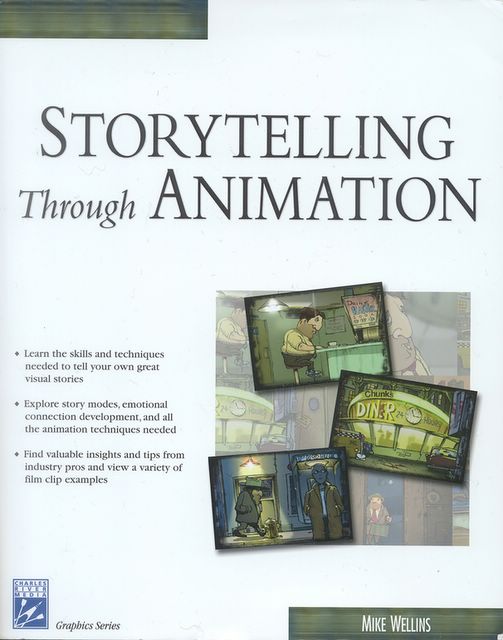
One of Latour's students, Mike Wellins, has taken a photographer's eye into the booming field of computer animation. In his new book, "Storytelling Through Animation" ($49.95 in paperback, with a companion CD, from Charles River Media, Inc.), Wellins pays fitting tribute to his mentor:

"Ira is perhaps the most prolific artist, filmmaker and photographer I've ever known. He has always been a great source of encouragement, humor, and inspiration."

In a letter, Latour notes that "Mike teaches a course in computer animation each summer at Fresno State in our California State University Summer Program. He has made many films, both computer-crafted and live-action, for which he has won numerous awards. Several of his 'epics' have been premiered here at the Pageant Theater in Chico."

The book focuses on how the story appears on the screen. The first two parts deal with "emotions in motion" and "visual storytelling" and only then does the author take up preproduction, production and postproduction issues. Throughout the book Wellins has included long interviews with practicing professionals, including Disney animator Glen Keane ("The Lion King" and many others), Pixar animator Andrew Gordon (the lead animator for the character Mike in "Monsters, Inc.") and Mike's brother Dean ("Osmosis Jones" and an upcoming Disney project).

Wellins emphasizes that the considerations needed for live-action film (sound, lighting, narration, character development and so on) are the same for animation (either stop motion or computer generated). He notes that "The history of film and animation is about a fascination with illusion -- the illusion of movement and the story. The characters on the screen aren't just a projection, but become people to whom the audience is emotionally connected. ... From each frame, pose and choice, the filmmaker who has distilled the ideas down to their key emotional connections and truly understands what connection he is trying to make overall will have that much more control and creative ammunition on every decision he makes."

Wellins illustrates his points with dozens of black-and-white photographs and diagrams, a color section and an included CD that contains several short features. One, Wellins' own "Shards of Death," is available for free viewing on the Internet. The feature only runs a couple of minutes and features an interview conducted by a mean-looking monster with a "small blue fairy creature" who wants a job in a video game. The ugly monster has a soft side (that's part of the humor) and plays counter to type. The small creature is cute, cute, cute and that sets up "a hopeless situation: a cute character applies for a job in a violent video game, and the scarier the character tries to be, the cuter the character becomes. In directing both characters," Wellins continues, "the setup of two such extreme characters creates a natural dynamic of tension and absurdity."

In this case it's important that the camera does not draw attention to itself. There is some camera movement, but not enough to distract from the bizarre interview going on. There is an explosive ending but, as the big sweet monster might say, it's all in a day's work.

Wellins' description of the "animatic" or story reel, a kind of first draft of the visual story that helps establish how long "each scene, shot or effect will ultimately be," is fascinating. "Animatics are created by photographing or scanning the storyboards and other elements and then editing them to time with a dialogue, scratch track or other temporary sounds and music." That's the start. Here the author returns to emotions, because the animatic must take into account the pauses needed when one character delivers bad news to another, or the quick cuts needed in a comedy film.

"Storytelling Through Animation" is a wonderful and detailed introduction to the field from someone who sees clearly every aspect of a film that must be in place in order for the animation to "click" with audiences. He, too, stands on the shoulders of giants.

Dan Barnett teaches philosophy at Butte College. To submit review copies of published books, please send e-mail to dbarnett@maxinet.com. Copyright 2006 Chico Enterprise-Record. Used by permission.
Thursday, January 26, 2006


Now for something completely ridiculous

By DAN BARNETT

In the late 1950s, a writer named "Grendel Briarton" (who turned out to be writer Reginald Bretnor with the letters rearranged) began publishing a long series of shaggy dog stories in The Magazine of Fantasy and Science Fiction called "Through Time and Space with Ferdinand Feghoot." After lengthy buildup, each would end with an audacious pun.

Imagine the following example expanded into a 20-minute disquisition and you get the idea. Jacqueline Spear, the famous anthropologist, dressed in furs among tribal peoples until one day she discovered her duds had been abducted. For Feghoot, it was easy to see that "Dr. Jacqueline missed her hide."

But Feghoots are so 20th-century. That brings us to Bill Dutcher, who, we are told, "lives in Oklahoma with his wife, Terry" and their two daughters. (He should move to Arizona, where they really have a sense of Yuma.) He is self-described as "a seldom-published writer who would like to be rich and famous, but not for the same thing. He is working on the former as an independent oil and gas producer in Oklahoma City, and on the latter as the creator of 'Fictoids.'"

Fictoids? They are, writes Dutcher in "Fictoids: Short Fiction ... Very Short" ($12 in hardcover from Dutcher & Co. Inc.), "a bit of fictional history, making a statement or telling a story in one sentence. A typical fictoid tells who did what, when and where. A fictoid may even be partially true, but is never entirely true, or it would be a factoid. In fact, a fictoid is just a fictional factoid."

Dutcher's Web site (www.fictoids.com) explains that he got the idea in the late '90s watching CNN and its fascination with factoids. Dutcher may not know it, but his invention is the new Feghoot for the attention-deficit new century. No more wading through a long story to get to the stupid ending. The stupid ending is contained in the first sentence!

The invention of fictoids is also the story of a self-publisher. As Dutcher writes on his site, "In 2003, encouraged by family and friends, I decided to put my favorites into a self-published book. This led to a long period of negotiating with myself over which fictoids should be in the book. By this time, I had written hundreds of fictoids, but my inner-editor felt some of the fictoids were too easy, too abstract or just not funny enough to justify being in the book. There was also the issue of how many fictoids should be in the book. Once it was decided that the book should be around 200 pages, the editing continued, but each time I would write a new fictoid I would delete an old one." Dutcher goes on to say how he picked the illustrator, New Yorker cartoonist Jack Ziegler. Turns out you can go on the New Yorker Web site and pretty much hire their cartoonists. So he did.

The day I'm writing this column Amazon ranked the book No. 52,126 (up from No. 81,767 the previous day -- Dutcher must have sold a couple of copies). Readers who dream of their own self-publishing bonanza may want to follow Dutcher's story. He appears on the verge of breaking into the coveted No. 36,152 spot on Amazon but we'll see.

In the meantime, to the fictoids. The ones I liked the best are reminiscent of the old Feghoots, only without the length, setting up the pun or other wordplay and then getting out of the way (fast). "The Minnesota Endangered Species Act of 1974 stipulated that the mink shall inherit the earth, but if they don't go for it, they could leave it to beaver." "Egyptian Pharaoh Amir Ziplok invented self storage in 850 BC, then marketed his invention through a clever pyramid scheme."

More? "In 1928, Fannie Footloose, a highfalutin flip flapper who loved to shimmy and Charleston, shocked Newport's high society when she suddenly fled the social scene and sailed off for Paris with foppish fashion photographer F. Stop Fitzgerald."

Even more? "When the Ammonite people were driven out of Egypt in 1220 BC, their luggage was carried by the Samsonites."

Enough? "Since 1994, commuters entering Manhattan in car pools have been required to use bridges instead of tunnels, due to rising health concerns over car pool tunnel syndrome."

All I can say is, if you have to have your head examined for liking fictoids, bill Dutcher!

Dan Barnett teaches philosophy at Butte College. To submit review copies of published books, please send e-mail to dbarnett@maxinet.com. Copyright 2006 Chico Enterprise-Record. Used by permission.

Thursday, January 19, 2006


The 1968 siege of Khe Sanh -- A Chico visitor's Vietnam memoir

By DAN BARNETT

Michael Archer, who lives in Reno with his wife and three children, signed up for the Marines in 1967.

He and his best friend, Tom Mahoney, enlisted not for patriotic reasons but, for Tom, to get out of Oakland, and, for Michael, to live the adventure and "to prove myself." By 1970, with the Corps downsizing, Michael was released to civilian duty after a tour of Vietnam and months spent in Khe Sanh during its siege by soldiers from North Vietnam. Tom would never return.

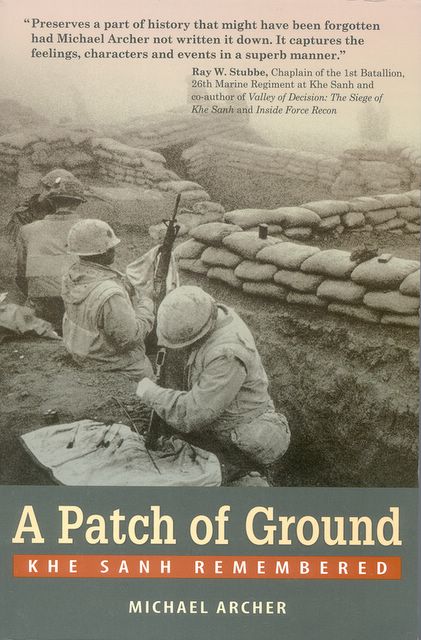
Archer had long wanted to write his story, but earlier attempts brought too much emotion. Now, drawing on his own records and the published accounts of others, "A Patch of Ground: Khe Sanh Remembered" ($15.95 in paperback from Hellgate Press) takes the reader into the heart of the U.S. war in Vietnam told in very human terms. Archer's prose is vivid and detailed, the account of his actions "in country" both humble and humbling, and the incidents he relates sometimes darkly humorous and sometimes intensely frightening. There are more than two dozen black-and-white photographs with several maps to help orient the reader.

A radio operator out of the Khe Sanh Combat Base, located not far from Laos and the Demilitarized Zone that separated North and South Vietnam, the author is surrounded by unforgettable characters: Tiddy, Pig, Old Woman (known for his constant high-pitched complaining), Savage, Captain Mirzah "Harry" Baig and many more. Archer's deft style draws the reader into the story so that it becomes more than ancient history.

Michael Archer will be coming to Chico for public appearances and a luncheon for Khe Sanh veterans. He will be signing books at 6 p.m. Friday at Lyon Books in Chico and at 3 p.m. Saturday at Barnes & Noble. In a letter Archer writes, "January 21st has special significance to the survivors of the 1968 siege of Khe Sanh because it is the anniversary of the day that momentous battle, the most protracted, costly and consequential of the Vietnam War, commenced."

The statistics, as recounted in "A Patch of Ground," are hard to grasp. "Over 1,000 Americans died fighting for Khe Sanh in 1968, and another 4,500 were wounded. ... South Vietnamese military losses were in the range of 750 dead and 500 wounded. The North Vietnamese Army suffered nearly 12,000 dead with probably twice that many wounded."

The book's central chapter, "Overrun," is the most harrowing. Archer is on radio duty at Khe Sanh Village. Early the morning of Jan. 21, 1968, word comes from the combat base "putting all forces in the area on red alert." Minutes later, "gunfire ... encircled the compound and, mixed with our outgoing fire, created an unbelievable racket. The deafening roar in the center of a pitched battle nearly defies description: a seamless earsplitting blend of chattering bursts of semi-automatic rifles, the oscillating knock of machine guns, teeth-jarring detonations of rocket-propelled grenades, and the deep, reverberating thump of exploding mortar shells. ... Alone in the bunker, fear cramped my neck muscles and tremors shook my head like a seizure. Tears filled my eyes and I started to repeat the same question aloud, 'What am I gonna do? What am I gonna do?'" The reader cannot turn away.

When Archer returned home to the Oakland-Berkeley area at the height of anti-war sentiment, his "anger and frustration were sometimes overwhelming." No one seemed to understand "the unconscionable brutality of North Vietnam's terror apparatus." Willard Park in Berkeley became "Ho Chi Minh Park" and mailboxes were painted to resemble Viet Cong flags. Archer blamed the hippies for their romanticism, the politicians for wavering, the military for dishonest assessments and admits to decades-long bitterness which "eventually, mercifully, sputtered out." Then he could write.

The war, he realized, was a kind of noble futility. He would think of the tens of thousands who lost their lives and remember "the insolent young faces of my buddies, the fine red dust of Khe Sanh etched into their every pore (and) the ease, humor and courage with which they endured such relentless peril."

"In those moments," he writes, "it did not matter how I felt about the war, the nation that wished to forget, or myself. It mattered only that I was proud to have stood with them and defended a little patch of ground."

Dan Barnett teaches philosophy at Butte College. To submit review copies of published books, please send e-mail to dbarnett@maxinet.com. Copyright 2006 Chico Enterprise-Record. used by permission.

Thursday, January 12, 2006


Chico novelist's love story unfolds against an international diplomatic background

By DAN BARNETT

Chico resident Helga Ruge, a German native, is no stranger to international diplomacy.

An author's note says Ruge "came to America as the bride of Foreign Service Officer Neil Ruge in 1950," though the couple, and later their two children, "lived abroad for most of their 20 years in the diplomatic service." Neil retired in 1969 and "the family settled in Chico, where Neil taught business law and Helga taught German" at Chico State University. Neil died in 2000, and Helga's memoir, "Flashbacks of a Diplomat's Wife," is a tribute to her late husband.

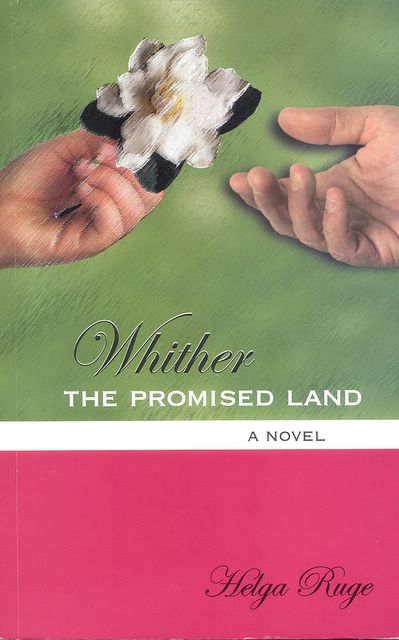
Now Helga has entered the world of fiction, drawing on her experiences to create a love story, set in 1960 and 1961, involving 23-year-old Octavia Angelini, a beautiful and spirited Sicilian who immigrates to America to find her fortune, and Jeff Carpenter, Vice Consul of the United States, whom she first meets on a beach in Palermo, Italy. "Whither the Promised Land" ($11.95 in paperback from Clay & Marshall Publishing Company out of Chico, claymarshallpubl@aol.com) chronicles Octavia's rise from maid, to hatcheck girl, to a mesmerizing presence on the international diplomatic front. America's "promised land" status is fully vindicated, though of course there are twists and turns in the torrid (though decidedly not sordid) love affair between Jeff and Octavia.

Ruge writes about the "exhilarating experience" of creating her characters. "I felt immensely powerful as I created life, formed human shapes and personalities with all their strengths and weaknesses."

Octavia is larger than life. Searching for work in her newly adopted country, she lands a job in New York as a maid for an Italian diplomat and his wife who need help with their two children. She is absolutely gorgeous and has brains to spare.

"I studied English, French and some German at the university," she tells Count Geminiano, "and because my father insisted I learn something practical as well, I took a course in typing and also one in modeling."

Jeff is no slouch, either. Octavia tells her Aunt Laura that "Jeff's parents were fairly well off but not rich. They helped him some when he went to Harvard, but mostly he had to rely on scholarships." Jeff double majored in history and political science.

Why did Octavia leave her family in Palermo? "I've always had a desire to immigrate to America for reasons I wasn't quite sure of," she tells her aunt. "I had even applied before I met Jeff -- but after he was gone, I was determined to come over here. I knew it was hard to leave behind my parents and ... everyone and everything dear to me for an insecure future, yet an inner voice urged me to go to the Promised Land, and I followed it."

The State Department recalls Jeff to Washington, D.C. and sends him to Moscow to help deal with an impending crisis. It was May 1960. "The temperature of the Cold War had risen perceptibly. Headlines everywhere focused on the U-2 incident, which Khrushchev exploited to the maximum, politically speaking. For months, Francis Gray Powers had eluded the Soviets in his highly sophisticated, unarmed reconnaissance plane, taking pictures of sensitive defense installations. No Soviet missiles had reached Powers until that fateful first day in May when his plane suffered a direct hit. Now in a Moscow jail, Powers had time to reflect on his extraordinary capture while American diplomats negotiated to get him freed and back to the U.S."

But the driving force of the novel is the lovers' passion for each other and the question of whether Jeff can marry a non-citizen (and a Sicilian -- did she have Mafia connections?) and still keep his job, his life's calling.

There are plenty of emotional ups and downs, and neither Jeff nor Octavia are exactly virginal, but it's clear that they are made for each other. Descriptions of their lovemaking are discreet, but the reader gets the idea: "Words were superfluous at this deliberate hour of love's triumph. Only the rising passion between the two lovers spoke of immense joy and heartrending pain as their souls and bodies were fused through the eternal rhythm of life, so revealingly new and all-encompassing and yet oh so temporary, so fleeting."

It's clear Ruge had immense fun with this confection and readers can look forward to future work as she blossoms as a novelist.

Dan Barnett teaches philosophy at Butte College. To submit review copies of published books, please send e-mail to dbarnett@maxinet.com. Copyright 2006 Chico Enterprise-Record. Used by permission.
Thursday, January 05, 2006


Crossing into 2006 with Skyway Poet's words

By DAN BARNETT

Chico poet Audrey C. Small is part of a small coterie of writers, the Skyway Poets, who meet monthly, alternating between Chico and Paradise, to listen to and critique each other's work.

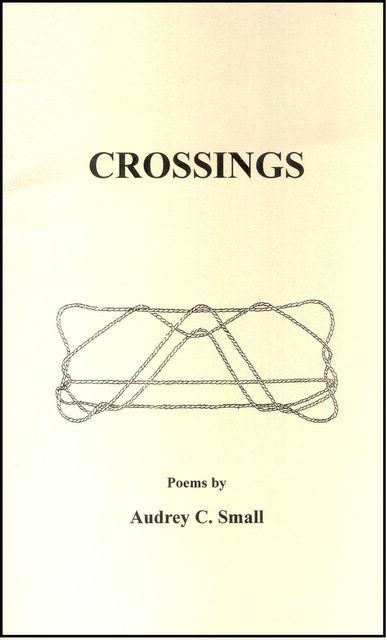
Small's first chapbook, "Crossings" ($6 in paper from PWJ Publishing, www.wellinghamjones.com, out of Tehama), collects more than two dozen poems, about half previously published, and illustrates them with three of the author's carefully drawn string figures.

According to a note on the author, Small often uses these figures -- cat's cradles -- when she presents her poetry or short stories. "Her mother, Paula Collinson, originally taught her some string figures and encouraged her to use written sources to expand her interest in this ancient art form. Audrey has taught and shared this interest in the San Francisco Bay Area and Butte County, as well as in travels with her husband overseas." The book lists several sources on constructing string figures, among them Caroline Furness Jayne's "String Figures and How To Make Them: A Study of Cat's Cradle in Many Lands" (Dover Publications) and Camilla Gryski's "Cat's Cradle, Owl's Eyes: A Book of String Games" (William Morrow and Company).

The poems in "Crossings" don't tell a single story but rather stories of multiple crossings that weave themselves into a pattern, as string weaves in and out to produce "Caribou in the Willows," or "Many Stars" or "the Salmon River with the Last Peak on the Plain" (shown on the cover), each lending its title to a poem. "String Figures" reminds us there was a World Wide Web long before the Internet:

Figures one by one
enact in fact or memory
an endless line of circle oval pentacle.
Lizard / bird / marsupial
may move away
but come back
another way
to dance or play
caught in the web
of infinite variety.

Here are deep forces at work, suggests the poet in "Forces":

In spring
when we were young
we planted gnarled sweeds
in our gravelly yard
and the sun-warmed earth
of summer brought yellow
and orange bursts
of nasturtium.

There is another force too, between human and human, evoked not only by this poem but by "Countless":

Some things in numbers
lend a beauty
single objects lose:
the clustered grape
and heather.
Days spent together.

There are crossings of oceans, from "Martin Mere, Lancashire" and "Ullet Road Church, Liverpool," "over the sleeping Aegean" to Greece ("The moon grows round as a chariot wheel, / turns to bronze, then a silver shield / fielding spears of stars."). In "Sibling" there were

Welsh pebbles shifting,
slipping with delicious friction
beneath our dashing feet ...
Life carried us seaward.
Gone now the Irish Sea
of childhood, sounds of the shingle beach ...
Today a golden sun
washes my pebble paths --
boundaries of my wedded home
by Contra Costa's echoing shore.
There are memories that cross our minds and shape our years.

January 4th is "My Father's Birthday":

As rain falls on snow
large white patches
that were pasture
stand out across the canyon,
but trees, ever darker,
guard winding paths
out and away.
Ridge pines remain erect
while these housebound shrubs
bent beneath snow-load need help
some probing, some shaking.
Facing the wrong direction
they harbor both cold
and heavy burden. ...
The snow is heavy and the wind fierce,
but what is left at twilight
stays: dark trees,
new green of lawn
and those smooth, faraway fields.

In "Siberian House," the "name of a Chukchee Indian string figure," the poet writes:

Have you ever played cat's cradle?
My mother and I did.
She would insert her hands
in the closed loop of string
and, drawing it taut,
start us with the "Cradle."
Best was to watch her make,
in slow motion, a Navajo "Butterfly"
and feel her delight in its fluttering.
But of all the string figures --
not the easiest she taught me -- I come back to "Siberian House."
I feel in my hands
the building of the house
the throwing loose of the loop
the collapse of the roof
and the running away of two figures.
Yet it wasn't like that.
Yes, the slates fell in,
walls and floor were smashed
by the bomb's blast,
but the figures had already left.
In the end war and separation never happened:
the string always came out whole.

In 2006, may we be spared as well.

Dan Barnett teaches philosophy at Butte College. To submit review copies of published books, please send e-mail to dbarnett@maxinet.com. Copyright 2006 Chico Enterprise-Record. Used by permission.
Thursday, December 29, 2005

Summing up the year in book reviews

By DAN BARNETT

Of the 51 books I reviewed in 2005, all but four had some north state connection, coming either from area writers or visiting guests.

Seven works by local novelists caught my attention: "Fatal Embrace" by Aris Whittier of Oroville; "Memoirs of the Messiah: A 98% True Story" by Chico's own DNA; "The Angel in Wax: A Love Story" by retired Chico State professor David Downes; "On the Bumpy Road to Heaven With the Devil in Hot Pursuit" by Michael Ramon, another retired professor, writing as "Robert Marlowe"; "SASP," children's adventure tales by Orland resident Jonathan Perez; and two from Redding writer and columnist Steve Brewer: "Bank Job" (about bank robbers) and "Boost" (about car thieves).

The interest in local history was given a boost by a long list of publications. The column paid tribute to issues of "Wagon Wheels" and "Diggin's." Chico State historian Michael J. Gillis produced a detailed account of "The Soper-Wheeler Company: A Century of Growing Trees." Durham's Adriana Farley published "Durham's World War II Honor Roll: A History of Service." Jane B. Schuldberg told the story of "Kennett" (now buried under Shasta Lake). Bob Colby and the late Lois McDonald took the reader from "Magalia to Stirling City."

In addition, Chico State historian Stephen E. Lewis published "The Ambivalent Revolution: Forging State and Nation in Chiapas, 1910-1945" and Butte College historian Dan Ostrander came out with a Chinese edition of "'Read My Lips: No New Taxes.'"

In biography and memoir, I reviewed "Spiritual Business: The Amazing and True Story of Magical Blend Magazine" by its Chico-based founder, Michael Peter Langevin; "Beyond the Public Eye: One Teacher's Journey" by longtime Las Plumas High School history teacher James Dale Shelby; "A Fish Flew Through the Porthole: A Sailing Adventure Narrated By a Very Reluctant Sailor" by Gerri Miller; "Fools Rush In: A True Story of Love, War, and Redemption" by former Chicoan Bill Carter (about U2 and the siege of Sarajevo in the mid-1990s); "Ishi in His Second World: The Untold Story of Ishi in Oroville" by Feather River College anthropologist Richard Burrill; "Bonhoeffer As Martyr: Social Responsibility and Modern Christian Commitment" by Simpson University theology professor Craig J. Slane; "Jones At War: A Sailor's Story, 1935-1956" by Los Molinos resident Roy Lee Jones; and "As I Remember: A Collection of Newspaper Columns" and "Still Remembering," both by Willows resident Shari Edwards.

For the outdoors: "Wildflowers of Table Mountain" by Samantha Mackey and Albin Bills of Butte College; "Geology Trails of Northern California" by Robin C. Johnson and Dot Lofstrom; "Reading the Trail: Exploring the Literature and Natural History of the California Crest" by University of Nevada, Reno, environmental literature instructor Corey Lee Lewis; and the sumptuous "Creative Fly Tying" by Mike Mercer of Redding.

A variety of religious perspectives: "Deceived On Purpose: The New Age Implications of the Purpose-Driven Church" by former Paradise resident Warren Smith; "Relax, You're Already Home: Everyday Taoist Habits for a Richer Life" by retired Chico State biologist Raymond Barnett (no relation); "Lucid Living: by Timothy Freke (which I found far from lucid); and "The Problem of Pain" by C. S. Lewis (the writer of the Narnia tales).

Poetry: "Confessions of the Hare and Other Old Tales" by Skyway poet Joy Harold Helsing" and "Skunk Talk" by Albert Garcia (who grew up south of Red Bluff).

Next, two Hollywood guidebooks from former Chicoan Kristin Burke: "Going Hollywood: How to Get Started, Keep Going and Not Turn Into a Sleaze" and "Costuming For Film: The Art and the Craft" by Burke and Holly Cole.

In the category of true crime: "Justice Waits: The UC Davis Sweetheart Murders" by Davis resident Joel Davis.

Humor: "Good Spousekeeping: A His and Hers Guide to Couplehood" by Dave Meurer, a field representative for Republican Congressman Wally Herger.

Computers? "The Culturally Customized Web Site: Customizing Web Sites for the Global Marketplace" by Nitish Sing (Chico State Associate Professor of Marketing) and Arun Pereira.

Photography? "Third Views, Second Sights: A Rephotographic Survey of the American West)" with contributions by Byron Wolfe, Associate Professor of Photography and Digital Imaging at Chico State.

Food? "Some Like it Hot: Dining In and Out of Chico" by "Henri Bourride."

Finally, two collections: "Under the Big Top," essays, reminiscences and poetry written by members of Hannie Voyles' senior writing class; and "Best Christian Writing 2006" by former Paradise resident John Wilson.

Read on!

Dan Barnett teaches philosophy at Butte College. To submit review copies of published books, please send e-mail to dbarnett@maxinet.com. Copyright 2005 Chico Enterprise-Record. Used by permission.
Friday, December 23, 2005


Former Paradise resident publishes new edition of 'Best Christian Writing'

By DAN BARNETT

It's been more than 10 years now since John Wilson began editing the bimonthly "Books and Culture: A Christian Review," published by Christianity Today, Inc. out of Chicago. The answer to the secularist New York Review of Books, Books and Culture is far less predictable in the books it reviews and the reviewers selected.

The November-December 2005 issue, for example, boasts an appreciation of Jan Karon's "Mitford" novels, an examination of Hebraic purity laws, reviews of the latest Harry Potter tome and books about polio, and an essay on mythologizing Einstein. Reviewers come from Calvin College, Yale University, Duke Divinity School, and the Christian Vegetarian Association.

Wilson's picture shows up in the 1965 "Argo," the Paradise High School yearbook. He's a junior; I was a sophomore. He went on to become, in the words of an article a few years ago in The Atlantic, a "polymath"; I went on to become someone who had to look up the word "polymath." But God's ways are past finding out and over the last few years I've been graced by being in John's company.

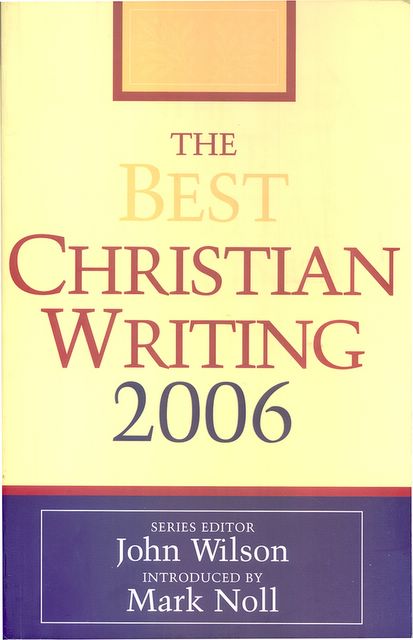
"The Best Christian Writing 2006" ($17.95 in paperback from Jossey-Bass), edited by Wilson, with an introduction by Wheaton College historian Mark Noll, is another grace. The 20 pieces here assembled offer spiritual reportage from the trenches, but by "spiritual" I don't mean a nebulous new-agey focus on the ethereal. I mean instead the attempt by Christians of many stripes -- Orthodox, Catholic and Protestant -- to come to grips with the call of God on their lives.

An interview with Eugene Peterson (author of "The Message" Bible paraphrase) makes this clear. Peterson tells Mark Galli, managing editor of Christianity Today, that "spirituality" defined as "becoming emotionally intimate with God" is "a naive view of spirituality. What we're talking about is the Christian life. It's following Jesus. Spirituality is no different from what we've been doing for two thousand years just by going to church and receiving the sacraments, being baptized, learning to pray, and reading Scriptures rightly. It's just ordinary stuff.

"This promise of intimacy is both right and wrong. There is an intimacy with God, but it's like any other intimacy; it's part of the fabric of your life. In marriage you don't feel intimate most of the time. Nor with a friend. Intimacy isn't primarily a mystical emotion. It's a way of life, a life of openness, honesty, a certain transparency."

Arranged by the authors' last names, the book juxtaposes the "Confessions of a Traveling Calvinist" (by Fuller Seminary president Richard Mouw) with "The Persistence of the Catholic Moment" (by First Things editor Richard John Neuhaus, a former Lutheran). Canadian Gideon Strauss writes of "My Africa Problem ... and Ours" (about the contemplation of action) which abuts American Daniel Taylor's meditation on a visit to the former monastery on Skellig Michael, "a seven-hundred-foot-high pinnacle of water-and-wind-worn rock that rises like Excalibur out of the Atlantic waves off the southwest coast of Ireland" (about the action of contemplation).

The authors of the selections try to think "christianly" about their world -- about Islam; about what children are for; about those with mental illness.

Two articles confront Mel Gibson's "The Passion of the Christ." Frederica Mathewes-Green, from an Orthodox perspective, sees the bloody crucifixion in the film as a focus foreign to the New Testament Gospels. Gregory Wolfe, publisher and editor of Image: A Journal of the Arts & Religion, has a different take. "However individual and controversial and subject to criticism his rendition may be, Mel Gibson's message is nourished and shaped by his respect for an ancient tradition. And at the heart of that tradition is the belief in the unimaginable depth of God's passion for us."

This is echoed in "Brother John" by August Turak, the winner of the John Templeton Foundation's "Power of Purpose" international essay competition. The author reflects on his frequent visits to Mepkin Abbey near Charleston, S.C., and specifically on Brother John, a monk who one evening offers an umbrella to the visitor who has forgotten his own. The essay quotes a line from Pascal, as if God is speaking, and looks to the great gift that is celebrated this, and every, Christmastide:

"You would not seek Me if you had not already found Me, and you would not have found Me if I had not first found you."

Dan Barnett teaches philosophy at Butte College. To submit review copies of published books, please send e-mail to dbarnett@maxinet.com. Copyright 2005 Chico Enterprise-Record. Used by permission.
Thursday, December 15, 2005


In Chinese edition, Butte College instructor defends Bush 41's political pragmatism

By DAN BARNETT

In 1999 Butte College history instructor Dan Ostrander published "'Read My Lips: No New Taxes.'" The book, reviewed in this column, defended George H. W. Bush's signing of the "budget deal of 1990" which, writes the former president in his foreward, "included budget cuts and a tax increase of almost $500 billion (over five years). ... Along the way, I lost the support of many people in my own party, and also had to break my pledge of 'no new taxes' from the 1988 campaign."

Rather than see this as a failure of leadership, Ostrander celebrates the budget deal as the triumph of political pragmatism in which a leader rises above partisan commitments to do what is best for the country -- at great political risk to himself.

It was this pragmatism that earlier led Bush to become ambassador to China in the mid-1970s, living in Beijing and endeavoring to widen the opening made by Richard Nixon in his controversial trip to China in 1972.

Last month both Bush and Ostrander attended a conference in China in which the bilingual edition of Ostrander's book was unveiled. The handsome hard-bound features photographs of Bush meeting with various Chinese leaders, including Chairman Mao, Deng Xiaoping and President Hu Jintao.

With the English text on the left and the Chinese translation on the right, the book, which sells for 48 Yuan (about $6), includes a new foreward "to the Chinese people" from the former president, a foreward to the Chinese edition from economist Li Yining of Peking University, a new foreward by Ostrander, a commentary on China-United States relations by translator Su Shijun of the Beijing Institute of Graphic Communication and Ostrander's recounting of the development of political pragmatism in the Chinese government. As far as I know, the book (ISBN 7-300-06919-3) is not distributed in the United States, but, for those who read Chinese, it is listed at http://sinobook.com.cn.

President Bush writes in his new foreward that "successful world leaders throughout history have learned through experience that they often have to make pragmatic, and often unpopular, decisions that will benefit their country in the long-term."

Ostrander writes that "during my (first) visit to China in 1979 I was impressed by how well the Chinese government and its leaders had provided adequate food and clothing for almost 1 billion people. ... Certainly this was an improvement over what most of the Chinese people had experienced before Mao. What all of this meant to me was that there is not one system or one way of thinking that will meet the needs of both countries and it is a mistake to judge the choices of one country by the standards of the other. The choices of a country's leader should not be judged by ideology but by their impact upon the quality of life their leadership provides for their people as well as the impact it has upon humankind."

For Ostrander the 1990 budget agreement represents visionary leadership and flexible attitude. "China's leaders too have demonstrated pragmatic leadership. ... China's annual per capita income has risen ... from over $1,000 in 1990 to $5,806 in 2004. As China's leaders have tried to reach their 'greater goal' things have not always been easy and will not always go well as this economic transition continues. A basic principle of leadership is for the leaders to have the courage of their convictions. China's leaders need to have faith in their vision and the direction in which they are moving the country."

If there is a hero in the evolution of Chinese communism it is Deng Xiaoping, who famous said, "it doesn't matter if it is a black cat or a white cat. As long as it can catch mice, it's a good cat." Ostrander writes that "Deng's pragmatism led to China's new economic policy of a 'socialist market economy with Chinese characteristics.' ... Deng in his December 1978 speech urged the CCP (Chinese Communist Party) to focus on development and modernization and let facts, not ideology, guide the country's development." Ostrander says that "Deng's pragmatic leadership and reform policies, 1979-1994, have brought about the biggest single improvement in human welfare in history."

In his book's introductory materials Ostrander offers an intriguing glimpse into geopolitical reality, into a world in which the "American century" may well give way to the "Chinese century."

Dan Barnett teaches philosophy at Butte College. To submit review copies of published books, please send e-mail to dbarnett@maxinet.com. Copyright 2005 Chico Enterprise-Record. Used by permission.

Thursday, December 08, 2005


A first novel introduces three young sisters and their adventures in Orland

By DAN BARNETT

Jonathan Perez is a writer worth watching. According to an author's note, he lives in Orland with his three daughters, Suede, Alex, and Sara, and has just published a book about the fictional Piper family. James is a divorced father of three girls named, curiously enough, Suede, Alex and Sara. Together they live in a small and rather rundown house in the Orland countryside, right near the Robbins Deli and down the road a bit from the Shady Oaks trailer park, where young Nitsy Blu lives with her divorced mom.

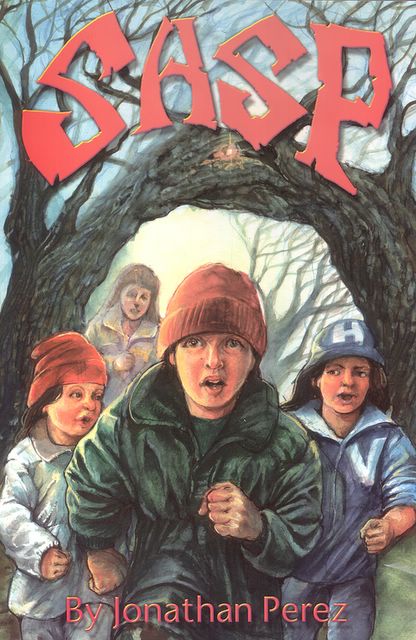
Nitsy is something of a rival who calls Suede, Alex and Sara Piper "SASP" for short. "SASP" ($13.95 in paperback from Stansbury Publishing in Chico), illustrated by Steve Ferchaud and appropriate for pre-teens, tells two tales, "The Yellow Road" and "Honey Jar."

"Suede was 10, the oldest of the three," Perez writes. "Besides her sisters, she had two very special friends: a tattered beige bear named Colby, given to her by her mother, and a little wooden sword, given to her by Grandma Cookie (who, we are told "could do just about anything except bake cookies"). Suede was tall and thin with milky white skin and her eyes were two different shades of brown.

"Alex was 8. Being the middle child was at times difficult for her. She was too young to have the same privileges that Suede had and too old to get away with the things that Sara got away with. Her chocolate eyes matched her wavy chestnut-colored curls and dark skin. Unlike Suede and Sara, Alex referred to her dad by his first name. James didn't seem to mind.

"Sara was 6, the youngest of the three and quite the jester. To get a quick laugh, she would stick her spaghetti strand hair in the corners of her almond shaped mouth, then put two fingers under her upper lip and stretch her bottom eyelids down with the other hand. If this didn't work, she'd flare her freckled button nose and cross her eyes."

The first tale has the sisters, egged on by Nitsy, sneaking out of the house early one morning after a heavy rain to look for the legendary "yellow road," allegedly guarded by the white droll, near Stony Creek on the outskirts of Orland.

A droll? Why, part deer and part troll, of course.

The children were not growing up privileged. James made an honest living at one of the two tire shops in Orland. The roof leaked on the family's house and Suede had holes in her socks.

Nitsy fared no better. "She was wearing an old torn jacket that had a broken zipper," Perez writes. "She was using safety pins to keep the flaps of her jacket closed, but as she moved around, they would separate, letting in the coolness of the morning. Her jeans had holes in the knees and her beanie looked more like an old sock that was stretched to fit just the top of her head."

As the reader might guess, all does not go well in the quest for the yellow road, the "trail of gold." There are hijinks aplenty and the author has opportunity to talk about the various stages of fear as the children seem to encounter the stuff of legend.

The second and longer tale takes place in springtime, and Perez revels in description: "Like melting snow, the shadows of early morning dripped away with the light of a new day. In an open field, just outside of Orland, wild daisies, daffodils and orange poppies were awakening. They stretched, opened and reached for the sun's warmth with their oblique petals. Opposite the field was an almond orchard in full bloom. Like specks of pepper, droning honeybees slowly appeared on the bouquets of white and pinkish blossoms."

It's a story of "two of Fairview Elementary School's meanest bullies," Billy Jones and Mickey Stalls (whose parents refuse to believe their children could do anything wrong). Most of the action takes place at Mr. Robbins' store and in the end the sisters find they have more things in common with Nitsy Blu than they thought. Everyone learns a honey of a lesson -- even James, who comes to understand the importance of listening to his daughters.

"SASP" is an engaging escapade; I look forward to more of the Piper family adventures.

Dan Barnett teaches philosophy at Butte College. To submit review copies of published books, please send e-mail to dbarnett@maxinet.com. Copyright 2005 Chico Enterprise-Record. Used by permission.
Thursday, December 01, 2005


Former Chicoan's poems offer quiet and captivating glimpses of small-town life

By DAN BARNETT

Bear Star Press, founded in 1996 and based in Cohasset, has as its mission the publication of "the best poetry it can attract" from Western and Pacific states.

The other day, publisher Beth Spencer wrote me about Albert Garcia, who "was born in Chico and grew up on a walnut orchard just south of Red Bluff." She has just published his new book, "Skunk Talk" ($14 in paperback from www.bearstarpress.com) which collects many of his poems previously published in anthologies and literary magazines.

Garcia, Spencer wrote, "fell in love with poetry while attending Chico State University (he was a student of Gary Thompson) and later obtained a master's degree from the University of Mon-tana. After teaching for many years at Sacramento City College, he is now dean of its Language and Literature Divi-sion. He lives with his wife, artist Terry Steinbach-Garcia (who provided the cover painting), and their three children in the small farming community of Wilton, where he tends fruit trees and a garden."

Garcia will appear at 7 p.m. Friday at Lyon Books in Chico to read from "Skunk Talk." The public is invited. If you think you don't like poetry because it's too difficult to understand, Garcia will change your mind. His conversational poetry is accessible but never trite; the words seem to flow effortlessly onto the page as they celebrate nature (figs and ficus and especially melons) and humanity (wives and children, gardeners and grandfathers).

One poem in particular, "August Morning," has pride of place in the book and, says Spencer, will be featured this coming spring by Ted Kooser, the nation's current poet laureate, in his syndicated column "American Life in Poetry."

The poem begins with sweetness.

It's ripe, the melon

by our sink. Yellow,

bee-bitten, soft, it perfumes

the house too sweetly.


It's early morning, and he poet has awakened: "What is happening in the silence / of this house?"


I wander from room to room

like a man in a museum:

wife, children, books, flowers,

melon. Such still air. Soon

the mid-morning breeze will

float in

like tepid water, then hot.

And then the poet asks, amid the smell of sweetness: "How do I start this day. ... ?"

And, one might ask, how does one continue the day? What new relationships will be established, what relationships broken? The poem that follows, "I Watch You Paint," is my favorite.

The poet watches as the artist paints a man and a woman.

I see now

the man's hand

is on her shoulder. There

is wind. Her white dress

blows tight against her body.

I want to ask you

what is happening

but it seems

the wind is in you.

And then the poet realizes the man

... has the very expression

I sometimes get when I'm

angry.

You hate that look,

but there it is

in the man's eyes, ...

I haven't spoken

for hours.

The man clearly

is losing the woman.

You've washed

a darker gray

into the sky.

Finally, you sit back

and look across the room.

Then you glance at me,

and it seems

I haven't seen you in years.

I say the painting is sad.

You say

it's not finished.

In another poem, the poet has some fun at his own expense. The title is also the first line.

The Day I Was Born

the shad were running.

On a slow green stretch of river

a man hoisted three pounds

of flapping, mouth-gaping silver

onto hot smooth rocks

the way God, I imagine, lifted

me from nothingness

and plopped me gasping

into Enloe Hospital, Chico, California. ...

I want to say something extraordinary occurred --

a cure for a disease,

the discovery of a new species.

But I've researched the date: nothing happened.

I've even made up the part

about the shad fisherman.

Sometimes one's lazy banter can carry on a bit too long.

"We're talking skunks. I say / I like the smell--not / the overbearing fog / left on a dog's snout, / but the gentle scent / they carry everywhere. // She says I'm nuts. They stink / plain and simple. She / wants more wine. ... // She won't look at me / and hums softly to herself."

The poems are wise and luscious, evoking what Garcia calls "days of ordinary wonders." Feast.

Dan Barnett teaches philosophy at Butte College. To submit review copies of published books, please send e-mail to dbarnett@maxinet.com. Copyright 2005 Chico Enterprise-Record. Used by permission.

Thursday, November 24, 2005


Talking turkey about podcasts -- what, where and doing one's own

By DAN BARNETT

Last June my wife and I headed to Grass Valley to begin a multi-state vacation. She was anticipating the impending family wedding in Idaho and so was I. Then the thought struck me, out of the blue, as we were making the long climb up from Marysville. My school needs a podcast!

As the miles flew by I realized that with a few simple pieces of equipment the dream could become a reality. Not long afterward my first campus interview was online and listed in Apple Computer's popular iTunes, the free jukebox software. Faster than you can list all the cliches I've used in these first two paragraphs, my free little podcast was ready for the world!

"Little" is the operative word here. My podcast boasts a few dozen listeners while others, like the immensely popular "This Week in Technology" (TWiT) with Leo Laporte, claim hundreds of thousands of listeners. But never mind that. Podcasting is not about reaching a large audience; it's about reaching the right audience. There's one podcast that features avant garde music from Scotland and another, called "Baking with the Bard," that is hosted by a 16-year-old chef. We're talking niche market here. But that's the beauty of podcasting. It's like radio for peculiar people. And we're all peculiar.

If the world of podcasting is fairly new to you, one of the best places to turn is to a new book from Bart G. Farkas, "Secrets of Podcasting: Audio Blogging for the Masses" ($19.99 in paperback from Peachpit Press). "In a nutshell," Farkas writes, "podcasting is a World Wide Web-based form of broadcasting that allows anyone with a computer and/or a digital media device to download and listen to content. Formed by the combination of the words iPod and broadcasting, podcasting involves the creation of 'radio' shows that are not intended to be broadcast over Marconi's invention. Indeed, these podcasts can be downloaded and enjoyed only through access to the World Wide Web." (Farkas does note later on that a few radio stations have now begun airing podcasts.)

Do you have to have an Apple iPod to listen to a podcast? Certainly not. As Farkas points out, the podcasting name is an homage to the leading MP3 player, but you don't really have to have a special music player to listen to a podcast. A computer will do. You can visit Web sites and download podcasts for later playback on your computer.

Farkas notes that podcasting really gained impetus with the development of what is called RSS, or "really simple syndication," a bit of behind-the-scenes code that enables content to be sent out on the Internet for anyone to download. The other big development is iTunes 4.9, released at the end of June, which was the first version of the software to feature a podcast directory. Way back then (five months ago) there were about 4,000 podcasts in the directory. Now there are many times that. Mac or PC users with iTunes can simply click on a podcast to subscribe, and presto! Every time a new show is released, it's automatically downloaded to the subscriber's computer. Free.

You don't even need iTunes. Farkas reviews 15 other podcast "aggregators," some free, some inexpensive, which can be quickly downloaded and installed on a computer to give the user access to the vast podcast universe. There are now dozens of podcast search directories (such as Podcast Alley), and Farkas looks at them, too. He includes interviews with various podcasters, a resource guide, and a simple glossary.

"Secrets of Podcasting" is divided into four chapters: podcasting basics, jumping in (finding podcasts and podcast players), creating a podcast (from script to finished product), and distributing the podcast (with a look at free or low-cost Web site packagers). The book's text is clearly and cleanly presented, and jargon is kept to a minimum -- though you will have to know about "Ogg Vorbis," a type of audio compression format that might one day replace the good old MP3 format. You need to learn this terminology because one day someone will ask a difficult question and you'll need to change the subject.

I should try that in my classroom. When my students ask me a toughy, I can just ask them, "But what about Ogg Vorbis?" My luck, one day I'll have a room full of podcasters. And they'll know!

Dan Barnett teaches philosophy at Butte College. To submit review copies of published books, please send e-mail to dbarnett@maxinet.com. Copyright 2005 Chico Enterprise-Record. Used by permission.

Thursday, November 17, 2005


True crime: Local connections to the 1980 UC Davis 'sweetheart murders'

By DAN BARNETT

Longtime Paradise resident and retired school teacher Anna Davis told me recently her nephew had just published a book reporting recent developments in the 1980 murders of UC Davis sweethearts John Riggins and Sabrina Gonsalves. Joel Davis grew up in Davis and is a now a Sacramento-based journalist and editor.

"Justice Waits: The UC Davis Sweetheart Murders" ($24.95 in hardcover from Callister Press) is gripping and gutsy reportage about the crimes and the subsequent missteps in the investigation and how Davis himself has become part of the story.

"A mostly forgotten mess," Davis writes. "That was the status of the Riggins-Gonsalves case when I started looking at it in the summer of 2000. Boxes upon boxes of case files gathered dust in Sonoma and Yolo courthouse basements known derisively as 'tombs' or 'dungeons'." Though David and Suellen Hunt, husband and wife, and crime partner Richard Thompson, had all been charged in the case in 1989, the lack of any DNA match led to charges against them being dropped in 1993. (Hunt, the half-brother of serial killer Gerald Gallego, had been arrested in Chico in 1981 for helping Thompson escape San Quentin.)

The parents of the murdered couple faced the prospect of never learning the identity of the killer or killers.

Davis never met Sabrina Gonsalves, and, though he had gone to junior high and high school with Riggins, did not know him well. But Davis was shocked, as were many in the area, when the two 18-year-olds, on a foggy December in 1980, were abducted and murdered. Their bodies, thrown into a ravine in a wooded area between Folsom Boulevard and Highway 50, were discovered after the Riggins family van was spotted nearby, empty of any passengers, on Dec. 22.

In 2000 Davis decided to write the story of the open case and interviewed family members and investigators. He planned to take a year, but the project stretched into five, and in the midst Davis was diagnosed with Parkinson's disease.

"The Davis of Dec. 20, 1980," he writes, "had a population of 36,640 and was more of an intellectual Mayberry than the hectic, more vibrant, even impersonal, university city of 65,000-plus it has become."

Riggins and Gonsalves were good kids. John's shock of red hair was well known in the community. Sabrina "was the girl you wanted to baby-sit your kids, the girl any boy would be proud to bring home to Mom. ... With her smooth Anglo-Portuguese features, trim athletic build, candy kiss brown eyes and flowing dark brown hair, Sabrina was a looker."

Riggins and Gonsalves that fateful night finished their ushering job for a children's 'Nutcracker' production and then left in Riggins' van to attend a surprise party for one of Gonsalves' sisters. They never arrived.

Gonsalves' body "suffered two deep, savage cuts that severed her jugular, and she died instantly. ... John had been beaten with five blows to the head, and his throat cut, but the knife avoided major arteries. It likely took hours to die in that soggy ravine."

But the case against Hunt and his associates could not be sustained. Astoundingly, a blanket found in Riggins' empty van -- likely a gift for the surprise party -- was never thoroughly examined until 1992 when several "obvious" semen stains were found but there was no match to members of the Hunt group. Pushed by Davis to re-examine the blanket with improved DNA testing, in 2002, "like a delayed sonic boom that took more than 21 years to strike, a DNA 'cold hit' was made on the blanket semen sample after the semen DNA was retyped and compared to DNA from a national database."

The match led to convicted child molester Richard Joseph Hirschfield. He and his brother, Joe, had grown up in Colusa County and lived in Arbuckle after the killings. Richard was arrested on Sept. 25, 2004, and, says Davis, justice waits again in the discovery process (updates are available at www.justicewaits.com).

The book is frankly critical of some of the investigators and Davis acknowledges that he has made more than a few people angry with his pursuit of the case. But Davis is convinced that Riggins and Gonsalves, all these years later, deserve the justice that has so far eluded them. The story he tells is harrowing, and the end is not yet in sight.

Dan Barnett teaches philosophy at Butte College. To submit review copies of published books, please send e-mail to dbarnett@maxinet.com. Copyright 2005 Chico Enterprise-Record. Used by permission.

Thursday, November 10, 2005


Former Chicoan produces comprehensive, practical guide to costume design for film

By DAN BARNETT

Imagine: "It is 7:30 a.m. on an already hot summer day. I've just pulled into the parking lot of a red brick church, in the San Fernando Valley. ... Today is the big day on the set of 'The Mating Habits of the Earthbound Human.' The costume designer is Kristin Burke. That's me. This is the day we shoot the Wedding Scene. ...

"Every principal actor and day player to hit celluloid on this shoot is going to be in this wedding scene, and everyone needs to look great. The greatest-looking of all, though, needs to be Carmen Electra, our leading lady. In the wedding scene, Carmen's character, Jenny Smith, is supposed to be nine months pregnant. Reading the script, I remember thinking, How charming, until the reality of the words 'Maternity Wedding Gown' sunk in. Who makes maternity wedding gowns? I knew that, in the interest of time, money and aesthetics, we would be building this gown."

The whole story is detailed in "Costuming for Film: The Art and the Craft" ($49.95 in oversized paperback from Silman-James Press) by Holly Cole and Kristin Burke. Cole teaches costume design at Ohio University and has worked as a costumer with the Muppets and the Metropolitan Opera. Burke, who spent some growing-up time in Chico, and who now lives in West Los Angeles, has worked as costume designer on dozens of TV shows, music videos and independent film projects, including "The Cooler," starring William H. Macy and Alec Baldwin.

Divided into 11 parts, "Costuming for Film" moves from basic principles of costume design to how costuming integrates into the sometimes heady, sometimes frustrating work of producing a movie: design development; breakdowns (where the costume designer uses the script to create lists of costume elements); prep (getting costumes made in the time allotted and within budget); shooting (including nude scenes and handling conflict); and final wrap (including wardrobe sales and re-shoots).

Two final parts deal with getting one's first job and tips for working in Los Angeles and New York. Appendices provide sample resumes, union guidelines and more, and the book is enhanced with interviews of working designers, dozens of photographs from film productions and a special color section illustrating creative design.

Why put up with this high pressure job? The authors have a ready answer: "It's a gas and a half. ... You cope with all the pressures of this field by getting into the Zen of the work. Most of all, you have to have passion. When faced with the fact that you have to style several hundred extras in short order, you embrace improvisational styling, creating characters in a matter of minutes, out of a stock of costume goodies."

And the money? "Union costume design salary minimums of $1,404 to $2,500 a week, even the lowly costume department production assistant rate, starting at $13.56 an hour, may seem enticing. But it can be startling ... how underpaid you can feel when you're working in this high risk business."

Burke and Cole add that "Film costuming -- whether you are interested in designing, supervising, shopping, working on set or building costumes -- is essentially a freelance job, and as such, getting work is all about who you know

"Still interested? To get into the costume groove, first check your ego at the door. If you want to work in this field, you must be really hungry to do it. The unions are tough to break into and job sources are often a jealously guarded secret. ... To be brutally honest, unless you have film contacts who will vouch for you, the film professionals doing the hiring care more about your stamina than your fabulous portfolio. Even with an MFA or two years of Broadway or fashion-industry experience, on a film, you can still find yourself ironing shirts and sorting dirty socks." An interview with Burke herself toward the end of the book shows her tenacity in getting work on a (horrors!) Roger Corman film; she ended up on nine of them.

For Burke, the costume is more than just window-dressing; it's about creating a character. "My job is to move people," she says. "If I can do that by creating characters visually, then I have done my job."

"Costuming for Film" is a captivating technical guide to reel life. Burke and Cole have done their jobs well.

Dan Barnett teaches philosophy at Butte College. To submit review copies of published books, please send e-mail to dbarnett@maxinet.com. Copyright 2005 Chico Enterprise-Record. Used by permission.

Thursday, November 03, 2005


Legendary Redding fly tier shows his artistry step-by-step in living color

By DAN BARNETT

I've caught a cold, but never a trout. That separates me big time from master fly tier and angler Mike Mercer of Redding.

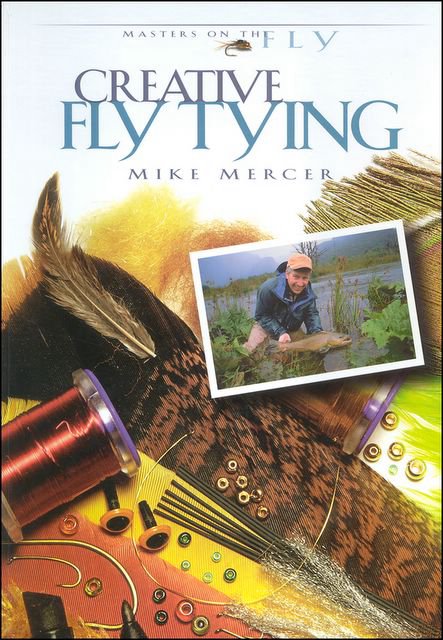
The son of Wes and Sandy Mercer of Chico, Mike has been associated with the Fly Shop in Redding for decades, and today, in addition to fly tying, he arranges international fishing expeditions. I bumped into a fly fisherman the other evening and he used the word "legendary" to describe Mercer's flies. That seemed to confirm the sense I was getting reading Mercer's new book, "Creative Fly Tying" ($39.95 in hardback, spiral bound, from Wild River Press). Mercer writes with humility (he learns most about his flies when the fish don't bite) but his careful work at the vise is evident on every colorful page. The book will open flat for those who want to follow along and try some of Mercer's techniques.

Fly tying is a world unto itself, and a good many fly tiers don't actually fish much. Mercer does, though, and the beautiful step-by-step close-up photographs of how to tie a dozen flies are surrounded by fishing tales of Hat Creek and beyond. The publisher calls Mercer's book one of a series of "technical fly-fishing books written by today's cutting-edge experts," and that description is apt indeed.

The first chapter details the tying of a poxyback green drake mymph, and Mercer acknowledges that he has the reputation as the guy who uses epoxy -- Devcon 5-Minute Epoxy, to be exact -- in part to mimic the shiny features of the nymph. A list of materials is prominently displayed for each fly; for the green drake nymph Mercer uses pheasant tail fibers, copper wire, a turkey tail feather and a gold metal bead.

One key to Mercer's fly tying success is his belief "that fish often respond more specifically to the contrast of varying colors on a fly than they do to the colors themselves"; his color dubbing technique reflects this insight.

Mercer's focus is on how the fish sees the fly; in fact, he includes an introductory section on reading the fish -- and the water. He's convinced that presentation is more important than the choice of fly (a poor fly with just the right wiggles can catch a fish) but more important yet, he says, is "reading the water" -- figuring out where the fish are likely to be.

"Case in point: Probing the deep jade runs and riffle drops of California's McCloud River one crisp autumn day, I was surprised by a lack of bigger fish. This time of year, the resident rainbows always feed aggressively, putting on the feed bag before the cold weather sets in. In addition, huge, lake-run browns have left Shasta Lake and are scattered everywhere, ascending to their natal spawning grounds. Wading to my thighs, I had fished all of my favorite slots, using nymphal imitations of the giant orange caddisflies that were helicoptering clumsily around me. All I caught were a bunch of small fish, though, and I was beginning to lose confidence."

After lunch Mercer tries again, wading out and casually dropping his nymph "into the shallows between the bank and me. Trying to pick (it) up again, I discovered I'd hung the bottom. Berating myself for this annoying lapse of diligence, I waded up to the shallows where it was hung and commenced yanking the rod in different directions. The water explosion was so violent and unexpected it actually frightened me." The "snag" turned out to be a large rainbow trout. But why the shallows? That's where the caddisflies were "as they migrated there to emerge. A classic case of finding the fish by finding the food, despite a total lack of traditional deeper holding water."

Eventually, says Mercer, one's eye becomes trained to "register the slight nuances of hydraulics and streambed -- you unerringly see where the fish will lie. No longer do you search out only those specific water types you understand -- now you see nearly all water as holding promise. You fish with confidence and a delicious sense of anticipation."

Mercer celebrates God's grandeur with every fishing foray, even if his breakfast is "cold Pop-Tarts and Gatorade," and with each of his carefully wrought creations. "Creative Fly Tying" is the work of a master, full of expertise and good humor, from a man in love with his art.

Dan Barnett teaches philosophy at Butte College. To submit review copies of published books, please send e-mail to dbarnett@maxinet.com. Copyright 2005 Chico Enterprise-Record. Used by permission.
Thursday, October 27, 2005


History of Magalia, Stirling City, Ridge ghost towns fitting tribute to Lois McDonald

By DAN BARNETT

Bob Colby is editor of Tales of the Paradise Ridge and co-author, with Lois McDonald, of the just-published "Magalia To Stirling City" ($19.99 in paperback from Arcadia Publishing).

In a telephone interview he expressed his admiration for McDonald, the premiere Ridge historian and former longtime editor of Tales, and his sadness at her passing.

McDonald died earlier this month at the age of 85, just as the book was being released. Her legacy includes "This Paradise We Call Home" and "Annie Bidwell: An Intimate History," a wonderful biography which deserved all the acclaim (and there was much) that came to its author.

In publicity materials for "Magalia To Stirling City," Colby says this "history through photographs" (gathered from back issues of Tales and from private collections, some never before published) is the ideal book to give to someone who wants to know the story of the upper Ridge.

With more than 200 black and white photographs - beautifully reproduced - the book (as Colby puts it) "pulls together ... information on the Butte County Railroad, the Gold Rush town of Magalia (Dogtown), Diamond Match logging operations, the mill town, Stirling City, and Ridge ghost towns."

The book is part of Arcadia Publishing's "Images of America" series. According to a news release, "Arcadia - founded in 1993 - become the largest publisher of regional history books in North America."

Each of the seven chapters of "Magalia To Stirling City" begins with a brief narrative and is followed by historic photographs (mostly from the first half of the 20th century), with detailed captions that add to the reader's appreciation. For example, the chapter on the Diamond Match Co. notes that it bought "over 69,000 acres of timber in Butte, Plumas and Tehama counties" (containing over two billion board feet) in 1901 and completed a sawmill in Stirling City (named after the Stirling Consolidated steam boilers that powered the plant) two years later. Logging began on nearby Bald Mountain in 1904 and a rare photograph shows "four Big Wheel log haulers, called 'Katydids'" pulled by horses. Diamond set up camps using "bunkhouses on skids" which were loaded onto railroad flatcars and a picture, from 1915, says that "logging camp buildings were moved this way ... well into the 1930s."

There's a 1906 picture "taken at the intersection of Laurel and Granite streets" in Stirling City, complete with a wagon drawn by four horses. In the background a sign advertises Simmens and Suggett's Clothing Store and their line of Can't Bust 'Em work clothes.

In Magalia it was mining. "The first gold seekers came in 1849 up the canyon of the west branch of the Feather River, or they followed Butte Creek and its several branches. Climbing up from the canyons, they came together in a small saddle between the streams. Here a tented trading post was erected by one man as an easier way to make money - taking it from the hungry, ill-clad miners rather than from the cold wet streams. Flour, sugar, coffee, and tobacco were hauled by mules and wagons from Marysville or farther. A sawmill or two followed. Saloons appeared, and so did more stores. ... Few women came in the early 1850s, but one miner's wife, who had insisted on coming herself and bringing a dog or two on the trip across the plains from Iowa, did not miss the glint of joy in the eye of every lonesome miner who spotted her mongrel puppies cavorting among the tent houses. Sales were brisk for Susan Bassett. As the reputation of the town grew, the name Dogtown naturally came to the miners' lips, and the name of the town was set."

No doubt Bassett was hounded. You just can't make up stories like this.

For me, the emotional center of the book was the chapter on "ghost towns and memories." Here are Nimshew, Hupp (a mill there "supplied the lumber from which the first houses in Chico were built"), Coutolenc-Lovelock, Toadtown (originally called "Towtown," say the authors, for a family's blond-headed children), Powellton, Inskip, Philbrook, and the landmark Chaparral House (constructed in 1857 "as a hotel and way station on the Oroville-Susanville Road" just up the road from Inskip).

"Magalia To Stirling City" is an evocative journey and an indispensable guide to local history.

Dan Barnett teaches philosophy at Butte College. To submit review copies of published books, please send e-mail to dbarnett@maxinet.com. Copyright 2005 Chico Enterprise-Record. Used by permission.

Thursday, October 20, 2005


Award-winning science-fiction author to speak in Chico on global warming

By DAN BARNETT

Kim Stanley Robinson has written a series of novels of the near future, meshing hard science with ecological speculation, and has won a shelf full of Hugo and Nebula awards for his efforts.

His Mars trilogy is a multi-generational saga of the colonizing -- and terraforming -- of the red planet; "Antarctica" is an exploration of the political and environmental future of the South Pole.

Now, with "Forty Signs of Rain" ($7.99 in paperback from Bantam), Robinson begins a new trilogy in which political inaction and scientific cowardice reap the whirlwind. Washington, D.C., is flooded and then (in the second volume, "Fifty Degrees Below," to be published next month) frozen. With descriptions eerily reminiscent of the inundation of New Orleans and other Gulf Coast communities, "Forty Signs of Rain" reads more like recent history than science fiction.

Robinson will discuss his work, and his views on global warming, in a free presentation at Chico State University's Laxson Auditorium at 7:30 p.m. Friday. Sponsored by Chico State Office of the Provost, Robinson's lecture is open to the public but a ticket is required from the University Box Office, located on the corner of Second and Normal streets.

The driving force of "Forty Signs" is the claim that there is an ecological "tipping point" in which cumulative changes in the oceans and the atmosphere can alter the earth's climate -- in as little as three years.

Robinson's novel is purposely prosaic, with long stretches recounting the happy home life of National Science Foundation statistician Anna Quibler (an appropriate name for someone in her line of work) and her husband Charlie, an environmental advisor to Democratic Senator Phil Chase. Charlie is a telecommuter who cares for young sons Nick and Joe while Anna works at NSF headquarters in Arlington, Va., vetting grant applications from researchers.

Her co-worker, Frank Vanderwal, single, on loan from UC San Diego, had helped found a biotech startup in that city. Frank's interest in Torrey Pines Generique was now in a blind trust, but there are hints that a hotshot biomathematician employed by Torrey Pines has developed a statistical way to increase the likelihood that bioengineered proteins might be more readily accepted by the body. Frank realizes that a patent on such a method might mean a windfall for the company, and part of the novel deals with Frank's efforts to deny NSF funding for the mathematician's proposal (which would have meant public access to his findings).

For the longest time I couldn't figure out how the medical research conducted by Torrey Pines connected with global warming, but there are hints in the book (maybe this is a spoiler) that the technique might be applied to plant materials to enable them to better absorb carbon dioxide from the atmosphere, thus lessening the impact of greenhouse gasses.

All of this is more than theoretical. The story focuses on the political fortunes of a group of pizza-loving Buddhists representing the small island nation Khembalung, which is flooded more and more often. Befriended by Anna and Charlie, they attempt to persuade Senator Chase to push harder on environmental legislation.

Frank, the cynical worshiper of reason, is changed by the Buddhist emphasis on compassion (as well as by an encounter with a mysterious and desirable woman in a stuck elevator). "The truth is," he tells his colleagues near the end of the first volume, "we have enough data already. The world's climate has already changed. The Arctic Ocean ice pack breakup has flooded the surface of the North Atlantic with fresh water, and the most recent data indicate that that has stopped the surface water from sinking, and stalled the circulation of the big Atlantic current. ... Scientists should take a stand and become part of the political decision-making process."

That may not happen; the Republican president's science adviser is, thinks Charlie, "a pompous ex-academic of the worst kind, hauled out of the depths of a second-rate conservative think tank when the administration's first science advisor had been sent packing for saying that global warming might be real and not only that, amenable to human mitigations. ... Easier to destroy the world than to change capitalism even one little bit."

Then it rains, with flooding, rescue boats, hints of looters. D.C. survives. But, says Robinson, the tide has most definitely turned.

Dan Barnett teaches philosophy at Butte College. To submit review copies of published books, please send e-mail to dbarnett@maxinet.com. Copyright 2005 Chico Enterprise-Record. Used by permission.

Thursday, October 13, 2005


Redding novelist serves up tale of bank robbery, stupid crooks and cagey seniors

By DAN BARNETT

Vince Doman was a serial bank robber. Eventually caught, he did his time in Soledad but couldn't stand his parole officer. So he disappeared with his wife, Maria, a prison nurse he had met while in the stir. Vince, now 72, settles down to a life of retirement near Old Shasta, not far from Redding.

He promised Maria he would go straight. And, writes Redding novelist Steve Brewer in "Bank Job" ($24 in hardcover from Intrigue Press), "he'd stuck to his word for more than 5 years now. Never so much as a parking ticket. But the system never forgot. ... Vince Doman had violated his parole, which meant he was supposed to go back to prison for the rest of his original sentence. Fifteen more years, which would be a life sentence for a man his age. Vince would do anything to prevent that."

Enter a trio of ne'er-do-wells, Leon Daggett and his brother Junior, and Roy Wade, a violent time-bomb of a man who, we're told, "was terminally stupid, but he projected absolute certainty about absolutely everything." They were on a crime spree, "roaring around rural California in Leon's sleek black car, knocking over gas stations and convenience stories for small change. Swilling Buds and smoking Marlboros and whistling at passing women." As Junior observes, "it was like a typical redneck Saturday night in Bakersfield."

Zooming north in his Trans Am to unfamiliar territory, Leon and company decide to make a beer run at Shasta Liquors. And why pay when you can send in Junior, the shaky-legged amateur, for some easy pickin's? But Junior didn't figure on the owners, the Bingham sisters, who brain Junior with a fifth of whiskey when he bobbles his stick-up announcement in a hilarious but unprintable spoonerism.

Managing to escape, Junior and the other two hightail it up the road between Old Shasta and Redding, and, as luck would have it, pull into a certain driveway and take the old couple there hostage. Maria volunteers (at gunpoint) to pick the glass out of Junior's head and bandage him up. Vince, meantime, sizes up the intruders, Roy especially. "The sides and back of his head were shaved and tanned. The dark strip of hair on top was short and slicked straight back. The hairstyle was like a billboard saying, 'Moron.' But Vince recognized something in the hard glitter of the man's eyes and amended the assessment: 'Dangerous moron'."

Hoping to get some traction, Vince brags about his past, laying it on pretty thick. The trio's little brains begin to formulate a plan for the big time -- meaning banks instead of liquor stores. And guess who, under threat Maria's death, gets to do the dirty work? And guess who still has his bank robbing equipment stowed away?

Meantime, Shasta County Sheriff's Deputy Debra Kemp tends to Shasta Liquors. She finds the Bingham sisters a handful (they play the tape of Junior over and over and talk of stardom) and dreams of how she can make a name for herself and get promoted to detective. She tries to track down the getaway vehicle and, relying on instinct and a few clues (like blood all over the walkway from Junior's wound), rolls into Vince and Maria's driveway. Oh, oh: What's a reformed bank robber who is about to do it again to do? Kemp gets a cock-and-bull story from the kindly couple and Kemp leaves almost satisfied. But not quite.

Brewer puts the plot into motion and 50 short chapters and a truckload of expletives later the book comes to a satisfying conclusion. "Bank Job" (it might have been called "Nose Job" given what happens to the trio) is a made-for-TV shoot-'em-up with the north state an integral backdrop. As Kemp wonders where the injured liquor store crook might have landed, she muses: "No place to hide in the village of Shasta. More a tourist stop for history buffs than a real town, it was called 'Old Shasta' by the locals to distinguish it from all the other Shastas in the area -- Lake Shasta, Shasta Dam, Shasta County, Shasta College, Shasta Lake City, the village of Mount Shasta and the daddy of 'em all, Mount Shasta itself, a snow-covered, 14,000-foot peak, which on clear days floated above the northern mountains like an iceberg."

Buy the book. You'll enjoy the withdrawal pains.

Dan Barnett teaches philosophy at Butte College. To submit review copies of published books, please send e-mail to dbarnett@maxinet.com. Copyright 2005 Chico Enterprise-Record. Used by permission.
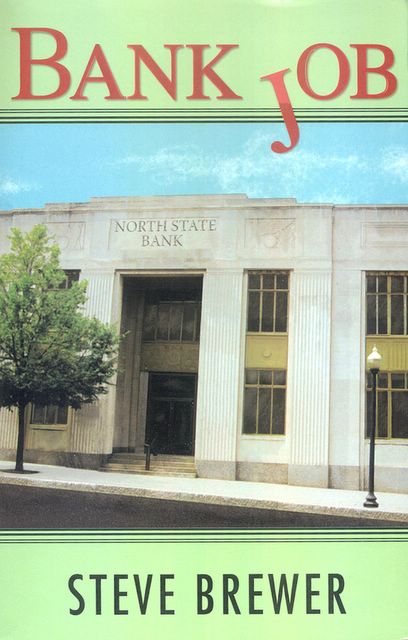
Thursday, October 06, 2005


Book signing scheduled for Willows columnist

By DAN BARNETT

In 1996 Willows resident Shari Edwards, after a 40-year absence, returned to her hometown to care for her ailing father. Her column of reminiscences began a year later, running in the Tri-County Newspapers until budget cutbacks ended it in 2001. Those columns were collected as "As I Remember" ($22.95 in paperback from iUniverse), which I reviewed favorably last July.

Heartbroken at being a writer without a home, Edwards found a new champion in the form of Sacramento Valley Mirror publisher Tim Crews, who allowed her to continue "As I Remember" until August 27, 2003, when "my column abruptly disappeared from the pages of yet another newspaper because of economics, cutting short my column writing life. I was saddened that I had not been able to write a farewell to all my wonderful readers."

That has now been rectified with the publication of a second collection, "Still Remembering ..." ($16.95 in paper, also from iUniverse). In it, Edwards is able to publish not only all the columns from her days with the Mirror, but to add four more, tributes to her husband, Ted, who died of cancer in December 2002, and to her father, Alan Fisk, who died a month later. "My father," she writes, "was born in a small cabin in a little area above Redding, now known as Lamoine. It was 1908. He was the first child of a Wintu woman and a train engineer."

In her evocative reflection on her late husband, Edwards writes that "now, it has been two years since my sweet Ted passed on to a more comfortable place, leaving me to find my way out of the wilderness. The road has been long, dark and full of detours. For a time, I wrote furiously believing that words would lead me to safety and comfort. They did not! I roamed empty rooms only to find the ghosts of residence past, all assuring me that being alone would be O.K. It was not! ... It had taken two years for those grief monsters to climb from the depth of the prison I banished them to ... and still I thought, I'll cry tomorrow. It has taken a family and many friends to put this humpty-dumpty girl back together again. ... Now I have to learn how to reach for the hand of God."

And then this: "My vision of Ted is starting to fade. Sometimes he stands only in shadow. Sometimes I cannot see him at all. I'm losing him. He appears to me far away, tall and mysterious as the first time I saw him across that room long ago." During that time, Shari was given a Cabbage Patch doll by her daughter and granddaughter, one with Ted's birthday. "When that doll was placed in my arms, my heart suddenly burst into flames. An uncontrollable wildfire raged. Only a huge flood of tears could put it out."

Edwards will be doing several book signings in Willows this weekend during the Willows school reunion of the 10 classes from 1950-1959. Books will be available Friday night at the Elks Lodge, 150 S. Shasta in Willows, and at a dinner Saturday night at St. Monica's Parish Hall, 1129 Wood Street. The "official" signing event will take place from 10 a.m.-noon Saturday at the Willows Christian Church Fellowship Hall, 200 S. Plumas Street, featuring a '50s "Jeopardy" game which comes complete, she says, with "set and all."

Among the dozens of columns included in "Still Remembering..." are pieces about local schools and businesses as well as remembrances of the Red Hat Society and a Fourth of July celebration in Orland. Edwards interviews locals but also ties the oral history together with diligent library research. There's the story of the old Beacon Cafe, where Shirley Shumin explains that "when her grandfather, Les Sims, arrived in Willows in 1946" he purchased the little restaurant that "served breakfast, lunch and dinner and coffee was a dime. Shirley mentioned it was later raised to a quarter with all the refills you wanted. She laughed when she said, 'We never made any money on coffee'."

By turns moving, wistful and humorous, Edwards' columns invite the reader to pour their own cup of coffee and set a spell. The conversation is not to be missed.

Dan Barnett teaches philosophy at Butte College. To submit review copies of published books, please send e-mail to dbarnett@maxinet.com. Copyright 2005 Chico Enterprise-Record. Used by permission.