Thursday, September 29, 2005


"Book in Common" author to visit Chico State

By DAN BARNETT

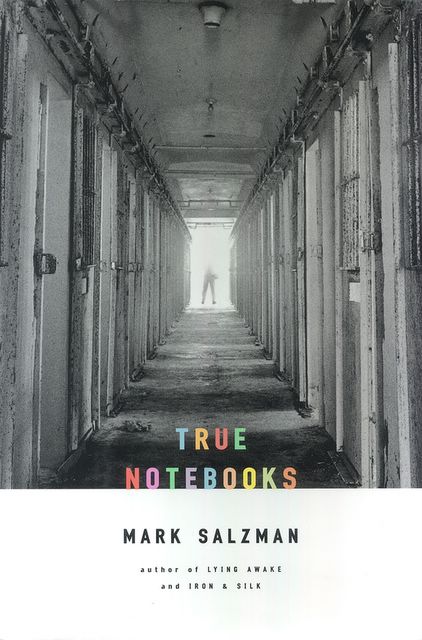
Mark Salzman, author of "Lying Awake," one of my favorite recent novels, will speak at Laxson Auditorium on the Chico State University campus at 7:30 p.m. Oct. 11.

The talk, which is free and open to the public, will center around his work of non-fiction titled "True Notebooks" ($24 in hardcover from Knopf), selected as this year's "Book in Common" at the university.

A free ticket is required for admission and can be picked up at the University Box Office, located on the corner of Second and Normal streets.

According to a news release, "The Book in Common at Chico State is the book required to have been read by all entering freshman students. ... The common freshman reading is designed to engage each student in considering and thinking about cultural diversity, immigration, (and) social service institutions."

Salzman began teaching a writing class at Central Juvenile Hall in East Los Angeles after visiting a similar class there in the summer of 1997. At the time, Salzman writes, he was stuck in his writing of "Lying Awake." He wanted to include a juvenile delinquent in the story and hadn't a clue how to do it.

So a friend of his, Duane Noriyuki, a Los Angeles Times writer, invited Salzman to sit in on his course at Central, "in a unit reserved for HROs, or high-risk offenders -- they were, as one law enforcement official put it, 'the cream of the crud.' Most of the HROs at Central were charged with murder, rape or armed robbery, and were declared unfit to be tried as juveniles, meaning that their cases had been shifted to adult court. No Youth Author-ity camps or guaranteed release at age 25 for members of this group; if convicted, they received adult-length sentences and went straight to prison."

Salzman was reluctant to visit but then he met Sister Janet Harris. The nun "was nearly 70 years old but looked two or three decades younger. ... Sister Janet explained that she'd been Catholic chaplain at the hall for years, but the increasingly punitive trend in the juvenile justice system made her feel that ministry was not enough"; she helped form the new "Inside Out Writers" program which, said Sister Janet, gives "these young people a chance to express themselves, and feel that someone is listening."

Soon Salzman has started his own writing class in the K/L Wing. Meeting twice a week for an hour, at first the group is small: Kevin, Patrick, Jimmy and Francisco. Salzman would quietly suggest topics and the group would write for half an hour and then read their essays aloud. One student asks Salzman whether cuss words were OK in class; indeed they were, and "True Notebooks" pulls no punches in reconstructing the conversations in the class and presenting the students' actual writing. Over the months more boys arrived. Some left for prison, never to be seen again.

"My students were violent criminals," Salzman writes, "but I no longer thought of them as bad people. In fact, I felt almost no curiosity at all about what they had done to get arrested; all I cared about was what they wrote and what happened during our meetings. Was that healthy? Was it fair?" Much later he writes that "my primary goal with the boys at K/L had never been to save them or improve them or even to get them to take responsibility for their crimes. I was there because they responded to encouragement and they wrote honestly; surely that sort of interaction between teacher and student has value, even if it does not lead to success beyond the classroom."

The student writing is heartbreaking.

Verbally inarticulate, Dale wrote: "Deep down inside, this angry person awakens. Another day facing perpetual incarceration behind no mercy walls, as we are inmates."

Duc wrote: "Because of my friends, my parents are suffering. Because of my friends, I joined a gang. Because of my friends, I shot someone. Because of my friends, I was sentenced to 20 years. ... I write this poem to apologize to my parents. I write this poem to apologize to the victim. I write this poem to criticize my friends. I write this poem to ask for fairness." It was titled, "This is My Life."

Dan Barnett teaches philosophy at Butte College. To submit review copies of published books, please send e-mail to dbarnett@maxinet.com. Copyright 2005 Chico Enterprise-Record. Used by permission.

Thursday, September 22, 2005


Noted scholar of emotions to visit Chico State

By DAN BARNETT

Martha Nussbaum begins with her mother's death in 1992.

In Ireland to deliver a series of lectures on emotions, Nussbaum learned a routine operation her mother had undergone had had life-threatening complications. "This news," she writes in "Upheavals of Thought: The Intelligence of Emotions" ($27.99 in paper from Cambridge University Press), "felt like a nail suddenly driven into my stomach."

A transatlantic flight took her to Philadelphia, where hospital staff told her she had arrived 20 minutes too late. "In the weeks that followed," she says, "I had periods of agonized weeping; whole days of crushing fatigue; nightmares in which I felt altogether unprotected and alone. ... I felt, again, anger -- at the doctors for letting a routine operation lead to catastrophe, although I had no reason to suspect malpractice; at people who phoned on business as if everything were normal, even though I knew they had no way of knowing otherwise. ... Above all, I felt anger at myself for not being with her on account of my busy career. ..."

Is the intense emotion of grief merely something that comes over us, like a storm surge, uncontrolled and uncontrollable, only to diminish with the passing of time as the emotional waters drain from us? Or can emotions be in some sense "reasonable," are they in fact in some way connected with our very reasoning process itself?

Nussbaum, professor of law and ethics at the University of Chicago, will discuss the nature of emotions, and specifically political emotions, in a free public lecture at Chico State University tonight at 7:30 at Ayers 106. The presentation, sponsored by the university's School of the Arts, is one in a series of lectures by distinguished presidential scholars. Nussbaum will speak on "Radical Evil in the Lockean State: The Neglect of Political Emotions" which will address, according to a news release, "possible solutions to the problem of intolerance, religious or otherwise, in democratic liberal societies."

Nussbaum will also appear at 9 p.m. Saturday in PAC 134 on campus, to give the keynote address for the Society for Women in Philosophy conference.

Nussbaum is the author of a dozen substantial books including "Hiding From Humanity: Disgust, Shame and the Law" and "The Fragility of Goodness." When Simon Blackburn reviewed the book in The New Republic, he said Nussbaum "is among America's most prolific and prominent public intellectuals. ... She has worked extensively on education, on development in the Third World, on law, on homosexuality, and above all on the injustices of gender ... she is a dedicated opponent of all that is glitzy and trashy in modern culture."

Emotions are, says Nussbaum, distinct from appetites like hunger or thirst and from feelings of being down or being irritated, which she calls "objectless moods." Emotions, by contrast, do have objects -- her grief was about her mother, her anger about the doctors. But more than just "about" -- emotions express the way we see things and even involve beliefs about those objects, beliefs that characterize their objects with some kind of value or significance.

Nussbaum has taken lessons on emotions from Aristotle (who taught that emotions could be proper or fitting in a given situation) and, most notably, from the ancient Greek Stoics, who believed emotions did indeed express a kind of thinking but who then condemned all emotions as excessive. The author rejects the Stoic condemnation of emotions but keeps the idea that emotions do express value judgments. (I am angry at the various seemingly feeble early governmental responses to the poorest victims of Hurricane Katrina; my anger is a judgment that something is morally amiss.)

Throughout the book, the intellectual adversary is a philosophical tradition that characterizes emotions as purely irrational. Nussbaum is convinced emotions not only can be reasonable but can in fact be true or false. Societies can properly use education to train emotions since emotions are amenable to reason. She finds compassion a good thing (capable of extending beyond one's familiar circle), while disgust (at sexual or religious orientations not our own; or at criminal behavior) is not so helpful.

"Upheavals of Thought," though technical in places, offers a grand opportunity for the interested reader to see how the music of Mahler and the writing of Augustine, Proust, Joyce and Walt Whitman all illuminate Nusbaum's thesis. Though I have profound disagreements with some of what Nussbaum has to say, her book is indispensable in opening up emotions to thoughtful consideration.

Dan Barnett teaches philosophy at Butte College. To submit review copies of published books, please send e-mail to dbarnett@maxinet.com. Copyright 2005 Chico Enterprise-Record. Used by permission.

Thursday, September 15, 2005


Chico State historian on the Chiapas legacy

By DAN BARNETT

Stephen E. Lewis, a member of the Chico State University history faculty, will speak Friday afternoon about his new book on the Mexican state of Chiapas, beset by poverty and ethnic unrest and, since 1994 (when Mexico became part of the North American Free Trade Agreement) the Zapatista rebellion.

Lewis' talk is scheduled for 3 p.m. in Trinity Hall on the university campus.

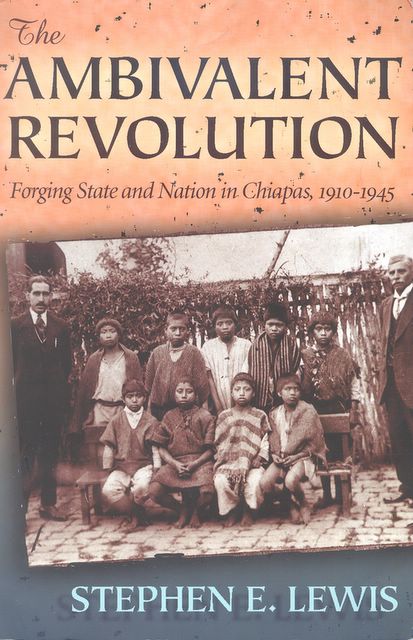
Lewis' book is "The Ambivalent Revolution: Forging State and Nation in Chiapas, 1910-1945" ($24.95 in paperback from the University of New Mexico Press), and it attempts to answer a question few historians have explored: "Why did Mexico's most significant rebellion in decades take root and grow in indigenous Chiapas?" The answer, he affirms, lies in the little-explored history of Chiapas in postrevolutionary Mexico (from 1910 onward). Chiapan archives have been neglected, he writes, but once the story is pieced together what emerges is a vastly complex interaction between Chiapas and Mexico, and, within Chiapas, among the ladino (non-Indian) population and their attempts to exploit the highland Indians -- the Tzotzil and Tzeltal Maya.

In order to make sense of the story, Lewis focuses his research on the ever-changing role of "the federal government's most important state- and nation-building institution ... the Ministry of Public Education (SEP), created in 1921." As the author reports, "The SEP and its teachers tried to modernize and 'nationalize' Chiapas and introduce important federal reforms against a backdrop of grinding rural poverty, inadequate infrastructure, a fiercely independent rancher and planter class, and an ethnically diverse population that vacillated between indifference and open hostility."

Though at times influential, the SEP's "radical pedagogy" ultimately remained powerless to transform Chiapas into an extension of whatever Mexican government happened to be in place at the time. Advocates of centralized government, Mexican presidents tended to have little lasting influence there.

SEP-sponsored nationalism, Lewis writes, tried to use the Emiliano Zapata legacy to its own ends. He appeared in SEP texts in the 1930s "stripped of his drinking, his gambling, his womanizing" and was portrayed, as one historian put it, as "an immaculate symbol of the emancipation of the rural masses." Years later, however, the government itself would be challenged by those claiming loyalty to that very vision.

Lewis writes that "the SEP's nation-building campaign in the 1930s involved an ambitious, quixotic attempt to forge the hearts, minds and bodies of the new Mexican. It first attacked the foundations of Mexico's 'traditional' culture based on Catholicism and rural paternalism. In its place the SEP fought to create a modern, secular, sober culture that emphasized civil and national duty. Teachers and the school were to replace the priest and the church, and an interventionist federal government was to replace the patron (boss)." There were mixed results in Chiapas, though Lewis notes that this "cultural nationalism" did help those in rural areas imagine what it might be like to be part of the larger Mexican state.

Even the progressive Lazaro Cardenas, who instituted land reform in Chiapas in 1939 with the help of the federal teachers, who were engaged in agrarian reform and worker unionization, found that "the institutions of the Mexican revolution that preserved the social and political peace elsewhere in the country either did not have the opportunity to develop in Chiapas or were so thoroughly corrupted that they exacerbated problems instead of solving them. After 1940," Lewis writes, "the state that had been part of Guatemala until 1822 would follow a distinctly Central American pattern of political, economic, and social development, culminating in guerrilla insurgency."

The Zapatistas of the 1990s came about, Lewis concludes, because "the grievances that produced the insurrection" (especially issues of land control, not unique to Chiapas) could not be addressed by failing and corrupt local governmental institutions. "Schooling in the highlands remained ineffective and culturally insensitive"; settlers in other areas had none at all. But because the Mexican state had adopted "neoliberal economic policies" and abandoned "revolutionary nationalism," the rebels in Chiapas adopted the earlier socialist vision of the SEP schools and "not only upset the political order in Chiapas and Mexico and grabbed international headlines, but ... forced Mexican society to conceptualize a multiethnic nation."

But, Lewis adds, even the Zapatistas likely will be "unable to reverse centuries of marginalization, exploitation, institutionalized racism and scarcity in Chiapas."

Dan Barnett teaches philosophy at Butte College. To submit review copies of published books, please send e-mail to dbarnett@maxinet.com. Copyright 2005 Chico Enterprise-Record. Used by permission.
Thursday, September 08, 2005


Los Molinos resident remembers time of war in the Pacific theater

By DAN BARNETT

"Jones At War: A Sailor's Story, 1935-1956" is about a man who seemed, Forrest Gump-like, coincidentally to be at some of the most important crossroads in 20th-century history. These are the reminiscences of Los Molinos resident Roy Lee Jones, now 88, lovingly edited by Roy Helsing of Magalia, whose wife, Joy Harold Helsing, is one of the "Skyway poets."

In an e-mail, Joy writes that "When my husband met Jones he was fascinated by the tales he told, from pulling bodies and survivors from the water at Pearl Harbor on December 7, 1941 to the invasions of Iwo Jima and Okinawa to the A-bomb tests at Bikini Atoll to the Inchon invasion in the Korean War. Not wanting these stories to be lost, my Roy conducted a series of taped interviews with Roy Jones, edited them slightly, and added historical information and photographs to put the tales in context."

The book is published by Jones' wife, Patricia, through her own PWJ Publishing. The large-size paperback is available, for $12, plus $3 shipping and handling, from www.wellinghamjones.com.

According to an editor's note from Roy Helsing, Jones wrote a memoir in 1997, entitled "The First Eighty Years," in which his "all too brief descriptions of his experiences in the Navy in World War II just begged to be expanded because they were based on 'being there'."

Jones was born in 1917 in Clayville, Chesterfield County, Va., and joined the Navy in 1935. Helsing, in the foreword, writes that Jones "was the prototypical sailor -- farm bred and raised -- with no knowledge of the bounding main. He joined the Navy during the Great Depression and rose from the lowest rank to become an officer (Lt. Jg.)."

Jones writes that he led a strike in his junior year at high school. Rather than close the school so everyone could attend the track meet with the school's biggest rival, the superintendent that year allowed only participants to leave class. Jones was miffed and helped stage a student walkout for a couple of hours. When the superintendent asked strike leaders to come to his office for a little talk, only Jones showed. The superintendent "thanked me for being man enough to admit my mistake. No disciplinary action was taken against me. ... In 35 years of supervisory and management jobs I used the same principle. If an employee made a mistake, acknowledged and took responsibility for it, I never took any further action."

Graduation from high school in the Depression era left Jones with no job and no money and, since "student loans and free junior colleges had not been invented then," he signed up with the Navy. Assigned to the submarine tender Canopus, which patrolled near Guam and the Philippines, Jones includes a memento of his transformation from "crawling, sniveling Pollywog" to "Shellback" by virtue of crossing the equator. It was important to pay respects to King Neptune and, says Jones, while the initiation is not "brutal," it "may be boisterous."

The heart of Jones' reminiscence comes in 1941. After reenlisting in August of that year, in October he "boarded the USS Oklahoma, a battleship, for transportation to Submarine Squadron Four at Pearl Harbor for eventual assignment to submarine USS Cuttlefish, which was en route from Connecticut. We arrived at the submarine base at Pearl 31 October 1941. The Oklahoma went on to take its place on 'Battleship Row'."

As Jones recounts, "I had weekend leave Saturday and Sunday, 6 and 7 December. There was a radio ... and we heard that the Japanese were attacking and all hell had broken loose. It must have taken me 25 seconds to get into my clothes and start down to the bus stop." Driven to Pearl by a Japanese civilian worker, Jones "took a temporary job on a tugboat, picking up people from the water -- survivors and bodies. We went past the USS Oklahoma twice. She was sunk. They later raised her and tried to tow her to the States, but she was lost at sea. I had friends on the Oklahoma. Some made it. Some didn't. That's the way it was."

The book includes almost two dozen black-and-white photographs, some from Jones' personal collection, and is a fitting tribute to a member of the "greatest generation" who saw so much and did so much, all in a day's work.

Dan Barnett teaches philosophy at Butte College. To submit review copies of published books, please send e-mail to dbarnett@maxinet.com. Copyright 2005 Chico Enterprise-Record. Used by permission.

Thursday, September 01, 2005


Chico novelist -- Intrigue and terrorism in France and beyond

By DAN BARNETT

Retired Chico State University Professor Michael Ramon, writing under the name of "Robert Marlowe," has produced a fast-paced political thriller with the ungainly title of "On the Bumpy Road to Heaven With the Devil in Hot Pursuit: A Novel of Love, Persecution, Fanatics, Good Samaritans, and Hope" ($17.95 in paper from Infinity Publishing at www.buybooks-ontheweb.com).

It's the love story of beautiful Princess Yasmine Omar, half French and half Arab, "the favorite granddaughter of the King of Omar," and Joshua Wiesel, the stepson "of the next Prime Minister of Israel." Joshua works as a translator for the Israeli secret service but meets Yasmine in the school they are attending in Paris and falls madly in love. Though the couple just wants to be left alone, their attraction for one another causes an international crisis.

Joshua and Yasmine come under the sway of Professor Leon Carnot, Yasmine's world-renowned philosophy instructor. Carnot preaches "peace, understanding, and tolerance" and he is portrayed in the novel as a modern-day Socrates, accused by his Jewish, Christian and Muslim students of being an atheist. His teachings are deeply influential in the couple's lives, holding the pair together as both Arab and Jewish interests offer huge rewards for the capture of Yasmine and Joshua, the latter (falsely) accused of killing several of Yasmine's guards and kidnaping the princess.

At one point, sipping hot chocolate, Joshua tells Yasmine that "they have no right to tell us whom to love or to marry. That's strictly between us and God. ... We pass through this life only once, and we should do it our way, not theirs. I'll fight them until we're happily married. That I promise you on what I hold most sacred." For Joshua, it's all about being "free to create your own future," as Carnot had taught.

Later, asked how he might "stop the hatred and carnage in Palestine" Joshua responds idealistically: "By making both sides realize that if things stay as they are, hatred will lead to more war, misery and suffering, and that will lead to more hatred. ... I'm just a young liberal Jew who's proud of his ancestry and heritage, but who doesn't want to repeat the mistakes of the past. I know what thousands of years of oppression and the Nazis did to my people, and I refuse to do the same to the Palestinians. I want to live and let live."

Perhaps the most dangerous opponent the couple faces is Karim Kassim, a billionaire Arab businessman who is really the director of the Paris-based cell of al-Qaida. Later in the story, Chief Inspector Picard muses with reporter Rick Sorel (who is contributing pieces on the couple to the Paris Gazette) about the terrorists. "They've been radicalized by a group of Islamic demagogues who want to gain political power by using them as cannon fodder," Picard says. "If they were educated, they would interpret true Islam as a religion of love, forgiveness, and compassion, but they aren't. ... They're ignorant, superstitious and easily deceived."

That provokes a response in Sorel: "You know, we have the same problem in Christian America. Millions of fundamentalists have been brainwashed by TV evangelists into believing that if they support the violent policies of Jewish warmongers, they'll bring about Armageddon, the second coming of Christ and the kingdom of God!"

Marlowe's writing style was distracting for me. Characters talk in cliches and seem to be either very good or very evil and, most disturbingly, are little affected by the carnage around them, escaping near death one moment and worried about lunch the next. It's the same feeling I used to get watching "Murder, She Wrote."

The plot itself is what kept me turning the pages, and it gets very complicated. Joshua and Yasmine are befriended by Sorel and Andree de la Roche, a female reporter also working for the Gazette; Moses Bloom, an arms dealer with a good-as-gold heart whom Joshua calls "uncle"; and quite a few other characters including detectives and editors. The bodies of their friends begin to pile up, and Rick and Andree are almost strangled to death ("this isn't a romance novel, you know," he says), but in some sense Carnot's philosophy triumphs in the end amid a wealth of political deal making. Better that, Marlowe might say, than shooting at each other.

Dan Barnett teaches philosophy at Butte College. To submit review copies of published books, please send e-mail to dbarnett@maxinet.com. Copyright 2005 Chico Enterprise-Record. Used by permission.

Thursday, August 25, 2005


Revisiting C.S. Lewis -- If God is good and all powerful, why do we suffer?

By DAN BARNETT

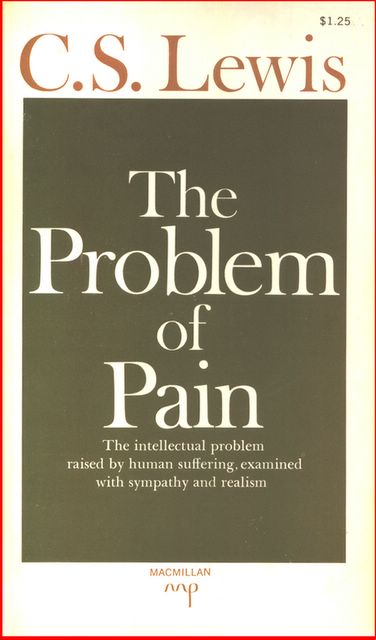
Back in 1979, when I first read C.S. Lewis' "The Problem of Pain," the paperback was published by Macmillan and sold for just $1.25. Today there are a number of softcover editions; a popular one, sold by HarperSanFrancisco, is $10.95. Just recently I've reread the book (my old paperback has crinkled with age, but then so have I) and can heartily recommend it as a cogent -- and surprising -- defense of Christianity.

Lewis' specific focus is the so-called "problem of evil": If God is good and all powerful, why is there pain? Wouldn't such a God eliminate it? So if pain is real -- and it is -- maybe God is not.

Lewis' defense is surprising because rather than arguing that God exists because of some supposed order of the universe, he acknowledges that the world of nature is decidedly ambiguous -- or even downright hostile -- to any such "proof." His book begins with a litany of misery: Pain in nature, pain in human relationships, the death of civilizations.

In his days as an atheist this was Lewis' own argument against a "wise and good Creator." Now, looking back, Lewis realizes that "the spectacle of the universe as revealed by experience can never have been the ground of religion: It must always have been something in spite of which religion, acquired from a different source, was held." In other words, no great religion has ever made, in its beginning, "an inference from the course of events in this world to the goodness and wisdom of the Creator."

That's a bit startling in our own time, especially with proponents of what is called Intelligent Design, such as William Dembski, maintaining that the natural world shows evidence of a Designer, and evolutionary biologists, such as Richard Dawkins, arguing that random changes over time mimic "design" and that therefore there is no Designer. Lewis would say both are off track.

Instead, Lewis traces the origin of religion to other factors: the numinous (the sense of awe at "something more" in the universe than just the material); morality; and, especially in Judaism, the revelation that the "something more" was also the guardian of morality, the "righteous Lord."

Finally, there is the historical Jesus, who "claimed to be, or to be the son of, or to be 'one with,' the Something which is at once the awful haunter of nature and the giver of the moral law. ... Only two views of this man are possible. Either he was a raving lunatic of an unusually abominable type, or else He was, and is, precisely what He said. There is no middle way. If the records make the first hypothesis unacceptable, you must submit to the second. And if you do that, all else that is claimed by Christians becomes credible -- that this Man, having been killed, was yet alive, and that His death, in some manner incomprehensible to human thought, has effected a real change in our relations to the 'awful' and 'righteous' Lord, and a change in our favour."

For Lewis the bottom line is this: "Christianity ... is not a system into which we have to fit the awkward fact of pain: It is itself one of the awkward facts which have to be fitted into any system we make. In a sense, it creates, rather than solves, the problem of pain, for pain would be no problem unless, side by side with our daily experience of this painful world, we had received what we think a good assurance that ultimate reality is righteous and loving."

Lewis goes on to consider hell ("that fierce imprisonment in the self" in which the doors are "locked on the inside") and heaven. His vision of heaven -- "All that you are, sins apart, is destined, if you will let God have His good way, to utter satisfaction" -- is one of the most extraordinary descriptions I've ever read.

"The world," he writes, "is a dance in which good, descending from God, is disturbed by evil arising from the creatures, and the resulting conflict is resolved by God's own assumption of the suffering nature which evil produces." In Christ's own suffering lies our redemption. In his resurrection lies the certainty that "every tear shall be wiped away." And we shall be fully ourselves at last.

Dan Barnett teaches philosophy at Butte College. To submit review copies of published books, please send e-mail to dbarnett@maxinet.com. Copyright 2005 Chico Enterprise-Record. Used by permission.
Thursday, August 18, 2005


A God-haunted novel from retired Chico State professor, David A. Downes

By DAN BARNETT

Just a few moments ago, as I write this, I pulled an aging binder from a bookshelf and gazed once again at notes I had taken for a memorable course in "Great Books" at Chico State University.

The year was 1978 and I, yet a whelp, sat under the tutelage of one David Anthony Downes, professor of English literature. Nothing had prepared me for his intense love of the works we studied that semester, from Chaucer's "Canterbury Tales" to Eliot's "The Waste Land." Though he must have taught them often before, I remember his passion for each work, his evident joy in exposition. I wanted to be a teacher like that.

Downes is also an acknowledged expert on the great Victorian poet Gerard Manley Hopkins. From an Anglican family he became a Roman Catholic priest; his poetry never reached the wider world until after his death and he felt himself a failure. One of his sonnets begins: "To seem the stranger lies my lot, my life / Among strangers." Downes has published scholarly works on Hopkins and today Downes' papers, from 1951-1996, reside in the Gerard Manley Hopkins collection at Gonzaga University in Spokane, Wash.

Now retired, Downes has taken to writing novels under the name of "David Anton." His latest, "The Angel In Wax: A Love Story" ($30.99 in hardcover from Xlibris Corporation) is something of an epistolary work. The story begins with Brother Cletus, a member of the Trappist community of monks in the fictional Monastery of St. Bernard "nestled in the valley looking out to the Sierra." A visitor to the guest house for a private retreat, a man named Dennis Dominic Leroy, has died suddenly on the monastery grounds and Cletus, the keeper of the garden, is asked to clean out Leroy's room.

What Cletus finds is "an unbound book. ... He thumbed through the first pages. They appeared to be a book of printed e-mails from a Net chat room called 'The Spirit's Voice.' Only the first pages were e-mails. Most of the remaining pages were handwritten 'real' letters. The first e-mail was from a person named Leila. It read: 'Dear Anyone: I have been chosen. I need a Gabriel to hear of my dark dream. Please, some starlight over my bed'."

Dennis Dominic Leroy answered. "You are a case. I am a writer of bad fiction. Right now I am looking for a model for a female character. You may fill the bill. You may not. Here's the deal. You write me and tell me about yourself ... and I will respond to what I hear. I will not be your counselor, your amateur shrink. I do not want to invade your privacy or your intimacy, yet I do want to hear your soul talking. Is this a contradiction? I hope not."

Leila Skerjanic had become a nun but had left the convent in her mid-30s.

As Cletus makes his way through the letter book, he is disturbed, shaken by fears that he ought not to be reading someone else's letters. As a 10-year-old boy he had idly looked into his mother's diary, only to discover one of those family secrets that forever alter one's life.

"The Angel In Wax" is a story within a story. As the letters from Leroy and Leila become more soul-revealing (Leila wonders if she has turned away from God's grace by leaving her vocation; Dennis responds that Leila is "grace in action and if you keep open to yourself and your self-search, you will come into contact with the Being that is"), Cletus finds confused feelings in his transgression.

Then Leila meets Father Michael Dolan, who awakens her to the sensuality of opera. The two have endless chaste discussions about Jesus' Incarnation and fallen humanity, and what it means to love as a celibate priest. Just as Cletus must decide whether to continue reading the letter book, so Father Dolan is faced with a decision of his own. Who would be his first love?

At the end, the two stories meet. Downes brings together Dolan and Cletus in the aftermath of Leila's untimely death, each in the midst of "a confusing sin that is full of grace." In eavesdropping, the reader, as well, becomes part of this story of higher love and human forgiveness.

Dan Barnett teaches philosophy at Butte College. To submit review copies of published books, please send e-mail to dbarnett@maxinet.com. Copyright 2005 Chico Enterprise-Record. Used by permission.

Thursday, August 11, 2005


Skyway poets, Joy Harold Helsing, featured Saturday at Chico's Art, Etc.

By DAN BARNETT

Patricia Wellingham-Jones of Los Molinos is not only a published poet but owns a small publishing house herself. Saturday PWJ Publishing will host a special reading and book signing featuring the "Skyway Poets." The event is free and open to the public, and is scheduled from 7—9 p.m. at Art, Etc., 122 W. Third St. in downtown Chico.

Invited authors include Patricia Wellingham-Jones, Sally Allen McNall, Audrey Small, Lara Gularte and Sylvia Rosen, along with Kathleen McPartland and featured poet Joy Harold Helsing. PWJ Publishing has printed a number of chapbooks from several of these authors; Wellingham-Jones' own broadside, "Mill Race Cafe" ($4.50 from Rattlesnake Press) contains "Three Queens," about poetry, and begins slyly as follows:

They hunch over a table

scattered with papers,

scratch out phrases,

toss away adjectives, crush

adverbs,

get rid of i-n-g endings.

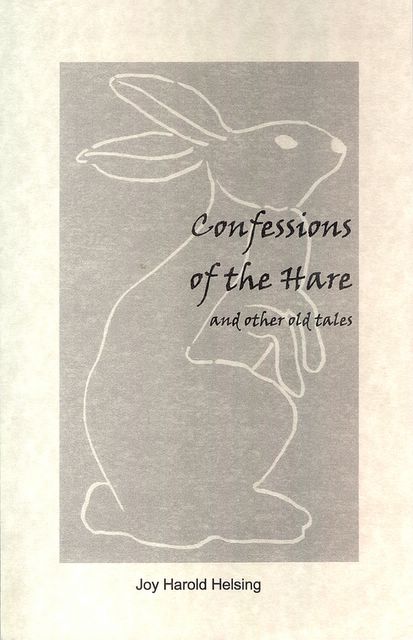
Helsing herself is both funny and sly, and her new book of poems, "Confessions of the Hare and Other Old Tales" ($15 in paperback, which includes shipping and handling, from www.wellinghamjones.com) brings new twists to Greek myths, Biblical stories, Shakespeare, nursery rhymes and Don Quixote.

According to an author's note, Helsing earned a doctorate in clinical psychology, "won two top awards for poetry in the Atlantic Monthly college writing contests," and, after life in the Bay Area, now joins the Skyway Poets.

The layout of the poems in "Confessions" is open and inviting, and for each thematic section Helsing includes a list of characters with brief descriptions so each reader can partake of the fun. In the poem that gives its title to the book, the hare laments that "I could have won that race / without a doubt." But the hare was "young and foolish" and his running ability caused only resentment: "First came boos and jeers, / then clods of earth, rotten fruit, / even stones. I stopped, / not to go to sleep / (that's all a lie), / but to mourn the loss of friends." Then:

I let him pass to win the cheers

that I would never get

even if I won.

Now I run fast

only

when no one's there.

Several of the five poems in the section called "Testaments" exchange the humor of the other sections for serious theological questioning. Eve rebels and as she looks back there is an edge to her remembrance:

I miss those days. But they are

past.

And I no longer blame the

snake. We are

as we were made to be. It was

the serpent's nature

to seduce, ours to yield. If God

made us to seek

and question, was it such a sin

temptation overcame us?

Of Cain, Eve sighs, "He should not / have harmed his brother. I do not excuse him. / But he too did as he was formed to do. ... / Though I worship Him / as He requires, obey as He commands, / I will never till my final breath forgive / this God."

Then Noah, with a similar complaint:

Were they all so bad? We

knew our neighbors

sinned, but children, newborn

babes?

Did they have to be destroyed?

Enough, enough. I must not

question

His judgment. ...

In the first section Greek myths are retold. Cassandra, the prophetess of Troy, laments that "There is no limit to the cruelty of the gods" who "remain impassive on their Olympian peak."

At other times the grand forces of the world seem not to be impassive at all. The sirens, those deadly mermaids whose song lures sailors to certain death, are here as well.

As the ship draws near, they

start to sing,

first one, then another, and

another,

a bell-tone chorus weaving

tendrils of promise and mystery

into a net of seduction.

Helsing's own simple verse has something of that mystery and seduction. But there are romps here as well as in "Soliloquy, Hamlet, First Draft." The first lines read: "To exist, or not to exist: That is the conundrum." Then: "To die, to sleep; / To sleep: perchance to dream: aye, there's the abrasion. ..."

Helsing's poetry seems effortless, yet there is craft here, and a writer not too timid to wrestle with the gods and, in "Them," to warn that

Grown-ups are coming

with well-meaning schemes

to rob you of wonder

and trample your dreams --

hide, children, hide!

Dan Barnett teaches philosophy at Butte College. To submit review copies of published books, please send e-mail to dbarnett@maxinet.com. Copyright 2005 Chico Enterprise-Record. Used by permission.
Thursday, August 04, 2005


The boy, the number singing parrot and Sherlock Holmes

By DAN BARNETT

Berkeley novelist Michael Chabon, who won the Pulitzer Prize for "The Amazing Adventures of Kavalier and Clay," returns with a superb Sherlock Holmes pastiche, "The Final Solution: A Story of Detection" ($16.95 in hardcover from Fourth Estate). Though the famous detective is referred to only as "the old man," it is clear that the game is still afoot and that the murderer will meet his match.

It is midsummer, 1944, wartime, and the old man, now 89, lives alone in the English countryside as a keeper of bees. But then he spots him: "A boy with a parrot on his shoulder was walking along the railway tracks." It was, Chabon writes, "a promising anomaly." In an effort to warn the boy of the danger of the electrified third rail the old man gets up. Chabon describes the event in telling detail.

"Even on a sultry afternoon like this one, when cold and damp did not trouble the hinges of his skeleton, it could be a lengthy undertaking, done properly, to rise from his chair, negotiate the shifting piles of ancient-bachelor clutter -- newspapers both cheap and of quality, trousers, bottles of salve and liver pills, learned annals and quarterlies, plates of crumbs -- that made treacherous the crossing of his parlor, and open his front door to the world."

The boy does not speak, but the parrot does. "'Zwei ens sieben funf vier sieben drei,'" the parrot said, in a soft, oddly breathy voice, with the slightest hint of a lisp. ... The old man blinked. The German numbers were so unexpected, literally so outlandish, that for a moment they registered only as a series of uncanny noises, savage avian utterances devoid of any sense."

The boy, it turns out, is named Linus Steinman, 9 years old, seemingly mute, a refugee from Nazi Germany with only the exotic African gray as his companion. He and the bird are living in a vicarage near the old man. Mr. Panicker, the vicar, tells the new lodger, Mr. Shane, that the boy "formed part of a small group of children, most of them Jewish, whose emigration to Britain was negotiated by Mr. Wilkes, the vicar of the English Church in Berlin."

Mr. Shane takes little interest in anything but the bird, Bruno. Later, when Shane is found murdered and the bird purloined, Reggie Panicker, the vicar's ne'er-do-well son, is arrested, charged with both crimes. When Detective Inspector Michael Bellows (whose grandfather had known the old man) and Detective Constable DC Quint show up at the old man's door, he takes little interest in the crime -- until the missing parrot is mentioned. "I am retired," the old man tells the two officials. "As indeed I have been since the 10th of August, 1914."

But still: "'I have considered the needs of my bees. And I believe that I can spare a few hours. Therefore I will assist you.' He held up a long, admonishing finger. 'To find the boy's parrot.' ... 'If we should encounter the actual murderer along the way, well, then it will be so much the better for you.'"

The vicar, Mr. Panicker, "was a faithless middle-aged minister, drunk and in flight from the ruin of his life." The old man finds himself in the company of the vicar as the two journey to London, past military checkpoints, to solve the crime. Mr. Panicker "felt a mounting sense ... that they were penetrating to the heart of some authentic mystery of London, or perhaps of life itself; that at last, in the company of this singular old gentleman whose command of mystery had at one time been spoken of as far away as Kerala, he might discover some elucidation of the heartbreaking clockwork of the world."

The title of the book, of course, has a double meaning, and while the case is solved and the parrot found (there is a chapter from Bruno's point of view), the central mystery of the numbers sung by the bird -- are they the key to a Swiss bank account? A secret German code? -- reminds the reader that though the existence of detective stories speaks to some measure of order and justice in the world, those mysterious numbers speak of a disorder and injustice in the world, "devoid of any sense," that Sherlock Holmes could never fathom.

Dan Barnett teaches philosophy at Butte College. To submit review copies of published books, please send e-mail to dbarnett@maxinet.com. Copyright 2005 Chico Enterprise-Record. Used by permission.

Thursday, July 28, 2005


Chico visitor's book promotes a gnostic philosophy of 'Waking Up'

By DAN BARNETT - The Buzz

When Chicoan Robert A. "Bob" Mayfield visited me some while ago to present me with a review copy of Timothy Freke's new little book, "Lucid Living" ($12.95 in paperback from Sun Wheel Books), I explained that -- given the content -- it was unlikely this reviewer would have many kind things to say.

Mayfield encouraged me to take the book and read it more carefully. Now that I've done so, I'm more convinced than ever than Freke's little treatise is wrongheaded.

Freke, of Glastonbury, United Kingdom, was scheduled to present his "stand-up philosophy show" at the Chico Women's Club Wednesday night, all part of his U.S. tour promoting his notion of "lucid living" based on his interpretation of Gnostic Christianity. Freke is something of a star of the New Age/Gnostic movement, and, according to one of Freke's earlier books, "Jesus and the Lost Goddess," was an inspiration for Dan Brown's "The Da Vinci Code."

Freke calls himself a "philosophical provocateur." His little book asks readers to consider that the so-called waking world is really a dream and that, at the very core of reality, we are not separate selves but rather a single "awareness" dreaming the dream of life. This dream of life is not a bad thing as such, so long as we realize it is a dream. We are not in the world but, says Freke, the world (our dream) is in us. There is but one awareness dreaming different selves (why that is is unclear).

And that realization leads to love: "Love is what we feel when we realize we are one. ... When I wake up to oneness I feel a limitless love which is so deep and poignant it embraces life in all its ecstasy and agony." Such feeling will mend divisions between people, stop war and lead to a "selfless desire to end all suffering and create universal well-being."

Who could object to a desire to end suffering? But such a noble goal does not prove that one's philosophy is true.

Freke is a modern-day Descartes, a philosopher looking for knowledge that is absolutely certain. "Can you be certain of the common sense understanding of reality taken for granted by most people in our culture? I don't think so." In good Cartesian fashion he proceeds to ask the reader whether one can be sure of memories of the past, or of things others have said, or even of one's own current convictions. For Freke, as for Descartes, knowledge must be grounded in something totally certain, and that's our "experience of this moment." It's "not a belief that can be questioned. It is a self-evident certainty. Your experience of this moment is all you can be absolutely sure of." Thus -- and this is where the book falls apart for me -- the only thing we can base our lives on is "our own immediate experience of living."

That means, for Freke, that anything else (including the teachings of revealed religions) simply has no place in determining how we should live. Freke moves beyond Descartes' "I think, therefore I am" by saying that since the only thing we cannot doubt is awareness, even the notion of a person, an individual "I," must be dismissed. Freke reasons that since only "awareness" is absolutely certain, that's all there really is. This brings him to a form of Gnosticism which has affinities with Eastern thought.

But why should I deny common sense? Scientists could be wrong about gravity, but I ought to think twice before jumping out of a high building. I may not understand the whole meaning of life, but that doesn't mean I'm sleeping. My editor could be a space alien, but I'm betting he's not.

In an earlier book, "The Laughing Jesus," written with co-author Peter Gandy, Freke maintains that the Hebrew Bible is fiction, that Jesus never existed and that Muhammad was a rather disreputable fellow.

Freke is bothered by the particularity of monotheistic religions which, in his view, are decidedly unholy divisive forces; he favors a philosophy of universal oneness.

But how does he know that his awareness is universal? "We appear to be many separate individuals. But actually we are all different characters in the life-dream that is being dreamt by the one life-dreamer. And that's who we really are. ... That's right, isn't it?"

Uh, no.

Dan Barnett teaches philosophy at Butte College. To submit review copies of published books, please send e-mail to dbarnett@maxinet.com. Copyright 2005 Chico Enterprise-Record. Used by permission.

Thursday, July 21, 2005


Michael Frayn -- "Noises Off" to nuclear secrets

By DAN BARNETT

Who is Michael Frayn? A British playwright, to be sure, but one I hadn't heard of until my wife and I saw the hilariously rambunctious "Noises Off" some while ago in Ashland, Ore. (The play was presented locally by Theatre on the Ridge and Paradise Performing Arts Center about a year ago.)

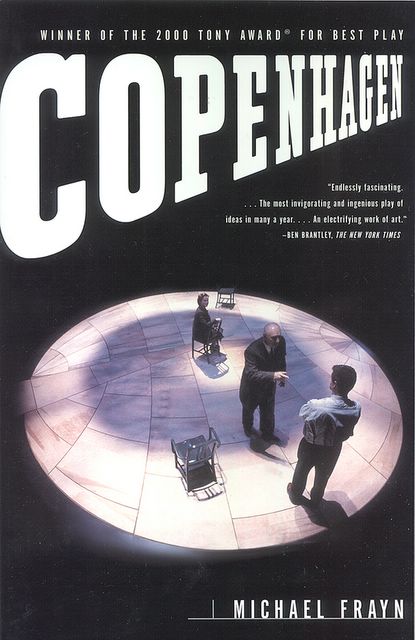
Even then, Frayn's name didn't stick until, just recently, I read the book version of his award-winning play, "Copenhagen" ($12 in paper from Anchor Books), and realized the same hand was at work (a publisher's note helped considerably!).

The joy of "Noises Off" comes only seeing its intricate machinery; the pleasures of "Copenhagen" (which received the 2000 Tony award for best play) are there within the printed page. It must be mesmerizing to watch but it is equally captivating to read.

"Copenhagen" probes the meaning of a strange meeting in 1941 between two giants of physics, Werner Heisenberg and Niels Bohr, at Bohr's Copenhagen residence. History records that the meeting took place; but what was said, and what was meant, is shrouded in ambiguity. Even Bohr and Heisenberg themselves, when they were alive, could not -- or did not want to -- dispel the mystery. "Copenhagen" explores the intricacy of human motivation.

There are only three characters present in this two-act play: the two scientists, and Bohr's wife, Margrethe. (In this edition of the play, Frayn has added a long postscript that helps the reader more clearly see what is speculation and what is supported by the historical record.)

As the first act opens, Bohr and his wife are on stage. In just a few lines the entire play comes into view:

Margrethe: Why did he come to Copenhagen?

Bohr: Does it matter, my love, now we're all three of us dead and gone?

Margrethe: Some questions remain long after their owners have died. Lingering like ghosts. Looking for the answers they never found in life.

Bohr: Some questions have no answers to find.

Margrethe: Why did he come? What was he trying to tell you?

Bohr: He did explain later.

Margrethe: He explained over and over again. Each time he explained it became more obscure.

Bohr: It was probably very simple, when you come right down to it: He wanted to have a talk.

Margrethe: A talk? To the enemy? In the middle of a war?

Bohr: Margrethe, my love, we were scarcely the enemy.

Margrethe: It was 1941!

Bohr: Heisenberg was one of our oldest friends.

Margrethe: Heisenberg was German. We were Danes. We were under German occupation.

Bohr: It put us in a difficult position, certainly.

Margrethe: I've never seen you as angry with anyone as you were with Heisenberg that night.


Heisenberg's "uncertainty principle," formulated in 1927, said that, for a subatomic particle, "the more accurately you know its position, the less accurately you know its velocity, and vice versa." The theme of uncertainty plays out in the meeting with Bohr as well.

In 1928 Bohr recognized that Heisenberg's uncertainty principle was incomplete as a description of a particle. He integrated Schrodinger's wave theory to produce the "Copenhagen Interpretation" of quantum mechanics. But the wartime question for the Nazi government was whether such theory could be turned to practical use, either in the construction of a nuclear reactor -- or a nuclear bomb.

Germany began its research into atomic fission in 1939; by contrast, the Allied program began only in 1942. Why weren't the Germans successful? Heisenberg didn't think developing a bomb was possible, since it seemed tons of U235 would be needed, painstakingly separated from the more common form of uranium, U238. But did Heisenberg do the calculation? If he had, he would have seen that only a comparatively small amount of U235 would be needed. Did he do the calculation, but make a mistake? When he reported to Albert Speer after the meeting with Bohr, did Heisenberg convince Speer that a bomb project had little chance of success?

Why did Heisenberg meet with Bohr? To convince his mentor to join the German effort, or to leak the fact that there was such a program? To find out whether the Allies were working to build a bomb? To explain how he was impeding such development by his lack of enthusiasm? But then why did Bohr become angry? Did he misunderstand his former friend? Did his former friend want to be misunderstood?

Uncertainty abounds.

Dan Barnett teaches philosophy at Butte College. To submit review copies of published books, please send e-mail to dbarnett@maxinet.com. Copyright 2005 Chico Enterprise-Record. Used by permission.
Thursday, July 14, 2005


Literature and activism along the Pacific Crest Trail

By DAN BARNETT

For Corey Lee Lewis, who teaches environmental literature at the University of Nevada in Reno and a wilderness survival class at Truckee Meadows Community College, also in Reno, we are in the midst of an ecological crisis: "Today, we are witness to such a rapid eradication of biodiversity, massive disruption of the planet's life-support system and permanent despoliation of natural ecosystems that the very future of biological evolution seems to be threatened."

If this is true, how should higher education respond? What should students be learning?

His answer comes in "Reading the Trail: Exploring the Literature and National History of the California Crest" ($24.95 in paper from University of Nevada Press). The 2,650-mile-long Pacific Crest Trail, part of the National Scenic Trails System, "runs from Mexico to Canada, crossing three Western states -- California, Oregon and Washington -- and five distinct ecological regions." Lewis focuses on three environmental writers associated with California regions of the trail.

Mary Hunter Austin (1868-1934) explored Southern California in "The Land of Little Rain" (published in 1903) and unsuccessfully "opposed the diversion of life-sustaining waters from the Owens Valley to the city of Los Angeles."

John Muir (1838-1914) is associated with the "high Sierra Nevada to the Yosemite Valley floor. ... And running right through the middle of it ... lies the central portion of California's Pacific Crest Trail."

Finally, Lewis writes of a poet, born in 1930, who finds his home in the Northwest where the trail winds "its way through moss-covered California black oak, Douglas fir, bracken fern and mountain misery, or, as the native Wintu and author Gary Snyder call it, ‘kitkitdizze.’ ... Snyder's poetry has fused ecological insights and Native American wisdom with Buddhist teachings and practice to offer an alternative paradigm for Americans who wish to ‘reinhabit’-- or become native to -- their own home places."

Each of these writers represents another fusion: literature and activism. They are exemplars for Lewis. "An environmental education cannot simply stop after imparting information; it must also alter students' basic worldviews, values and actions if it is to be effective." Since for Lewis human culture is responsible for the environmental crisis, the goal of environmental education must be nothing less than cultural transformation. He hastens to add that, "far from being an authoritarian imposition of the instructor's personal values or political opinions, transformative education promises to liberate students from the chains of apathy and ineffectualism with which our current educational practices bind them."

Central to the kind of education Lewis proposes is a combination of ecological science, field work and what is called "ecocriticism." Scientific quantification alone cannot address "environmental values, beliefs and aesthetics." And too often ecocritics have explicated an environmental text (such as a Snyder poem) without adequate field experience or scientific expertise. As an example, Lewis quotes Snyder's "On Climbing the Sierra Matterhorn Again After Thirty-one Years":

Range after range of mountains
Year after year after year.
I am still in love.


In love with what? Textual critics are mystified about the meaning of the last line; but when Lewis and a group of students climb the mountain, west of Bridgeport, looking down on the Pacific Crest Trail, it all comes clear: "As I read the poem again, amid the roaring wind, thin air, and sunlight, all of which seemed to be stretching space and vision out to eternity, the words seemed to come alive in my hand. ... Snyder's ‘love’ refers to the land beneath his feet, to the mountains and forests of Turtle Island's great western shores."

Lewis and his students, venturing in Muir's footsteps, examining individual plants for their field journals, can more readily understand the naturalist's sarcastic observation that the measure of the value of poison oak or mosquitoes is their usefulness to human beings. Lewis sees in Muir "the beginnings of an ecocentric philosophy."

Lewis calls, then, for a new environmental pedagogy, one that teaches students to "love and protect this miraculous planet" by converting not just minds but hearts as well. This is an accessible and thoughtful book, but one sure to stir controversy among at least some readers who will dispute the author's claim that we are living in a human-made global ecological crisis -- and that the only way out is through social change.

For others, though, the book will be a breath of, well, fresh air.

Dan Barnett teaches philosophy at Butte College. To submit review copies of published books, please send e-mail to dbarnett@maxinet.com. Copyright 2005 Chico Enterprise-Record. Used by permission.

Thursday, July 07, 2005


Growing up in Willows -- Writer's columns evoke old memories

By DAN BARNETT

"I left Willows after high school, in search of adventure," wrote Shari Edwards. "Now, 40 years later, I find myself where I began. I've come full circle. But where is my hometown? I left a town full of friends, a town of innocence. ... There was time to gossip and drink lemonade, doors were left unlocked and neighbors helped neighbors. That was my hometown -- Willows, in 1956."

But in 1996, when Edwards returned, "I found a town closed to outsiders. ... The few old friends that remained had gone on with careers and families, as I had, and we seemed strangers when we met. Years of football games, parades, Tattler reviews and 13 years of school together -- a faded memory."

Edwards was no stranger to feelings of isolation. "As a Native American, displacement is a way of life. ... I began to seek a path, a path into a community I no longer knew and one that had long forgotten me."

She credits "Down Memory Lane," a Butte College writing class taught by Mary Ann Hansen, with helping her see the path. Then, through the good graces of John Taylor, former manager of the Tri-County Newspapers, "who took a chance with this inexperienced writer." Edwards wrote a column of reminiscences, researching the past and visiting again those almost-forgotten places of her childhood. Those writings are now gathered into book form.

"As I Remember: Collection of Newspaper Columns Volume 1 -- 8/19/98 -- 10/17/01" ($22.95 in paperback from iUniverse) is available on-line -- or from 76 Joy Street in Willows.

This rather unusual name for a gift shop is chronicled in the chapter titled "Bridget Patricia McLaughlin." "Patsy" was born and raised in Ireland -- the family lived at 76 Joy Street -- but came to Willows in 1949 ("the same day the Tower Theater opened"). "I remember our sixth-grade teacher preparing us," Edwards wrote. "She told us we would be getting a new student."

Patsy, Shari and another student, Helen, soon became the best of friends. "We spent one entire summer practicing for cheerleading tryouts. Can you imagine that fall, when an Irish immigrant, a Native American and a beautiful black girl became high school cheerleaders? Patsy's father had been right: America was the land of opportunity."

One year Patsy was chosen Lamb Derby Queen. Later she married John Enos and, wrote Edwards, "Patsy and I gave birth to our first child on the same day at Glenn General Hospital. In 1984 Patsy finally brought 76 Joy Street to America," opening the shop in the old Welzold Building on Butte Street.

Edwards remembered that "in the days I grew up in Willows there was a 'Coat Culture' ... The first 'fad' coat I remember was a Teddy Bear coat." Then came "car coats" and "sweater coats."

One must not forget the tea parties. "I was about 5 when Grandmother decided it was time for me to have my first tea party. Grandmother led me to the big walk-in closet and let me dress up with clothes pulled from her old leather trunk. ... When I was dressed Grandmother applied rouge to my cheeks and I took my place at the table. ... In their places were my brown curly-haired bear with only one eye, Topsy-Turvy, and my baby doll in her best party dress." Edwards connects that tea party with the one given her many years later by her daughter and granddaughter. "After tea I opened gifts. ... When I opened a Nancy Ann Doll I couldn't stop the tears. My treasured doll collection ... was destroyed in an earthquake and I had never stopped dreaming of owning another." This was a bittersweet memory, for there was another kind of earthquake just ahead: The dream-come-true tea party was held September 8, 2001.

Edwards' writing is mixed with joy and loss. Her heart was broken when, after a three-year run, "As I Remember" was terminated for budget reasons. Yet there would be more to come: another newspaper, and another set of columns, and the loss of her father and her husband.

For now, it's enough to cite a line from one of her Father's Day celebration stories: "Memories keep us from unraveling -- but it doesn't hurt to have a little peach ice cream along the way."

Dan Barnett teaches philosophy at Butte College. To submit review copies of published books, please send e-mail to dbarnett@maxinet.com. Copyright 2005 Chico Enterprise-Record. Used by permission.

Thursday, June 30, 2005


Redding novelist's crime caper -- Car thieves and drug runners

By DAN BARNETT

Steve Brewer and his family moved to Redding after spending 20 years in New Mexico, when "my wife's career took us to Northern California in 2003." According to interview materials supplied by his publisher, Brewer syndicates a regular humor column through The Albuquerque Tribune and has published a number of well-received mysteries, such as "Bullets," which, says Tony Hillerman, "gives crime fiction fans all the unforgettable characters and fast, fierce action we crave, plus a flavorful overlay of the wry Brewer humor we've come to love."

The author also writes the Bubba Mabry series and his new novel, "Bank Job," to be published in October by Intrigue Press, is set in Northern California.

"Boost" ($24 in hardcover from Speck Press) is the 11th novel Brewer has published, and it's less a mystery than a rollicking and rambunctious adventure tale of almost-heart-of-gold car thieves pitted against Phil Ortiz, a dastardly businessman whose insatiable greed for acquiring and showing off classic cars has driven him to a lucrative drug-running sideshow. All the main characters are pretty much adrenaline junkies.

The word "boost," of course, is a slang expression for stealing a car, and that's exactly what 37-year-old Sam Hill does. He's in cahoots with the lovely Robin Mitchell, who continues to run Mitch's Auto Salvage the way her late father did. Old Mitch would hire Sam to deliver just the right car to special clients -- though Robin, with a computer science degree from the University of New Mexico, was making more money selling legitimately-obtained car parts over the Internet.

This is how it used to be: "Some customer would tell Mitch he wanted a '71 Mustang fastback like the one he drove in high school. Sam would steal such a car and deliver it to Mitch, who'd lovingly restore and repaint it, give it a new identity, and sell it to the nostalgic client for thirty grand. Sam and Mitch make money, the client gets his car, insurance pays off the stiff who lost the Mustang. And if the poor victim wants a car like the one he lost, well, he should come see Mitch."

But this is now. "Boost" is a story of a boost gone awry, about "a hot 1965 Thunderbird with a gold metal-flake paint job" with a stiff in the trunk. And no ordinary stiff -- the man was a drug informant. Someone had specifically asked for Sam to appropriate the car, and tipped off the police, and Sam is hopping mad. He is a car thief, after all, and not a murderer. Who would have it out for Sam Hill?

Our hero is determined to find out. What follows is a page-turning exposition of scheme and counter-scheme (Sam gets the stuffing beaten out of him on more than one occasion) as he tracks down the perp. But Sam has more than revenge on his mind. When Robin visits him in the hospital as he is recuperating from one of his encounters, she brings Sam flowers in a "howling coyote vase. The Trickster," Sam thinks. "She had him pegged. All his life, Sam had a fetish for practical jokes. To see others flustered and confused by some trick he'd arranged was the sweetest little thrill." Ortiz had met his match. Or had he?

When one is facing some pretty bad dudes, one needs some muscle of one's own. That's where Waymon Wayne Henderson comes in. A nightclub bouncer, Way-Way was "six-foot-seven, 290 pounds, maybe 5 percent body fat" -- a rather impressive character. Way-Way, Sam, Robin, and Billy Suggs -- an orphan Sam had befriended and saved from a life of crime by teaching him the boosting business -- pit brains and brawn and sarcasm against the real bad guys.

This is the kind of story that has you rootin' for the car thieves (who, of course, will all go straight after just one more trick). Brewer's dialogue is snappy and his descriptions wonderful. Lorena Alvarado, Sam's hard-bitten bulldog of an attorney, "dug around in her leather handbag, came up with a thin brown cigarette. She clamped it between her teeth and torched the end of it with a Bic lighter, then pulled her overcoat tighter around her bulging body. A sharp wind riffled her short black hair . . . smoke trailing out her snout."

"Boost" is a sweet little thrill.

Dan Barnett teaches philosophy at Butte College. To submit review copies of published books, please send e-mail to dbarnett@maxinet.com. Copyright 2005 Chico Enterprise-Record. Used by permission.

Thursday, June 23, 2005


Former Chicoan is Hollywood costume designer, writer

By DAN BARNETT

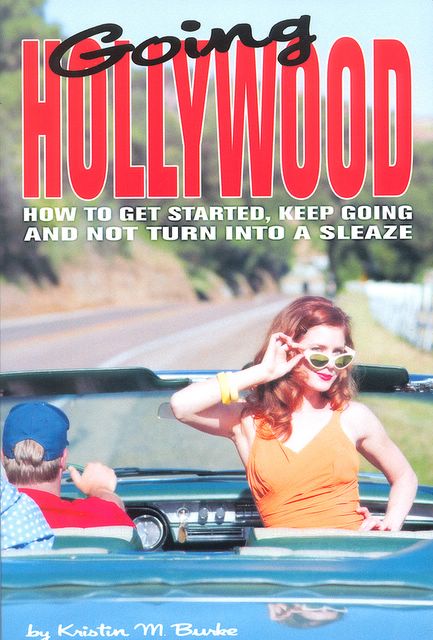
OK, I sighed to myself, it's time to review that book with the rather garish cover -- "Going Hollywood: How to Get Started, Keep Going and Not Turn Into a Sleaze" ($16.95 in paperback) by Kristin M. Burke. I'll bet it's one of those tomes on how to make it big as an actor probably written by someone who once had a bit part in a Lifetime Channel disease-of-the-month movie starring Meredith Baxter Birney (they all star Meredith Baxter Birney).

How wrong I was.

The book is not for aspiring actors. It's for folks who want to be behind the camera, to work in the L.A. entertainment biz as key grips or directors or line producers or costume designers. Burke is herself a successful costume designer; the Internet Movie Database lists some 35 screen credits since 1993, including "Walker," now in production, starring Bruce Dern, Jason Patrik and Sam Shepard. Her book is sane, sensible, well-researched, and very frank.

Chico is Burke's hometown; educated at Northwestern University in Evanston, Ill., she moved to Los Angeles in 1991. A note about the author says that "she has also designed costumes for music videos, commercials and two television series."

The book's 12 chapters each include a brief interview -- of producers, assistant directors, writers, executives, agents -- and some sage advice on everything from how to pronounce L.A. street names (Wilshire is "WILL'-shurr") to money and dating tips ("Never, EVER, date a co-worker while you are still working together").

Burke begins with a reality check: "In preparing for your life in Los Angeles, you should make sure to have the following: a cell phone ..., a minimum of 15 copies of your resume, a minimum of $5,000 in accessible funds, and a reliable motorcycle or automobile." The money mostly goes for getting an apartment, paying first and last month's rent and a security deposit, and a month's living expenses. Forget public transportation: "We have a bus system that runs city-wide, but you will need 8 million schedules, 65 bus route maps and a master's degree in engineering to figure it out."

Burke advises registering with a temp agency, and she lists several. (Later in the book, in a chapter on bad choices, she is not shy: "Do not participate in the production of porn, soft-core or adult entertainment.' Say no to these job offers, even if you are flat broke. There is nothing wrong with temping.") She also offers a two-page listing of the best places to do deals -- spas, malls and restaurants, from Roscoe's Chicken and Waffles to Spago.

The author analyzes three fictitious resumes and provides "the rules" for those beginning their first jobs: always arrive early, cut out the gossip, be honest, get enough sleep, and "grow a rhino hide": "Your assignment, from day one, will be to cultivate a skin so thick, not even the acrylic nails of ego, greed and jealousy can pierce it." Develop hobbies, too. Burke lists gyms, yoga studios, tennis courts, museums, charitable organizations and book groups.

"Love can make you crazy," she observes in the chapter on dating. It's easy to think one really knows someone else well when you spend long hours together on a film project. She warns about the dangers of "dating up" ("you could go broke paying for expensive dates with someone in a different financial league"), "dating down" ("you may be accused of favoritism"); and dating celebrities (think paparazzi, stalkers, living in a fishbowl). And be on the lookout, she warns, for the "helpless opportunist" and the "essence sucker" ("this is the charismatic alley-cat, the three-week-maximum relationship" of the player).

But things don't have to be grim. Half the book is devoted to getting a good agent, finding wise financial advice and even how to learn to rejoice when your friends succeed ("It may be hard to celebrate when you are silently suppressing a jealous rage that would wipe out half the city. If you are really freaked out, and can not bring yourself to be happy for your friend, excuse yourself for a day or two. ... Adjust your attitude.")

So I adjusted my attitude. I can recommend "Going Hollywood" as a practical and eyes-wide-open guide. Hollywood is for you if you have "courage, gall, cheekiness, bravery, flamboyance, shock value, brilliance, tempered arrogance, daring, pluck, nerve, guts." Seize the day, my friends!

Dan Barnett teaches philosophy at Butte College. To submit review copies of published books, please send e-mail to dbarnett@maxinet.com. Copyright 2005 Chico Enterprise-Record. Used by permission.
Thursday, June 16, 2005


Simpson University professor: Was Bonhoeffer a martyr?

By DAN BARNETT

Craig J. Slane, associate professor of systematic theology at Simpson University in Redding, also serves on the board of directors for the International Bonhoeffer Society.

Dietrich Bonhoeffer, Lutheran pastor and theologian, was deeply opposed to Hitler's regime; the "Oxford Dictionary of the Christian Church" puts it simply: "He was arrested in 1943 and after imprisonment in Buchenwald he was hanged by the Gestapo at Flossenbrg in 1945."

Bonhoeffer is best known for such works as "The Cost of Discipleship," "Life Together" and "Letters and Papers From Prison," in which he articulates a Christianity lived in solidarity with the oppressed, a Christianity that takes Jesus' Sermon on the Mount seriously. But Bonhoeffer was arrested and executed not for his profession of Christ but for his complicity in a failed attempt to assassinate Hitler. It is that fact, Slane says, that makes Bonhoeffer so controversial.

In "Bonhoeffer As Martyr: Social Responsibility and Modern Christian Commitment" ($22.99 in paperback from Brazos Press), Slane acknowledges that "Bonhoeffer never attempted to justify his conspiratorial activities" and certainly "did not excuse himself from guilt." Nevertheless, Slane argues, this man deserves to be called a true Christian martyr. Yet for such an argument to make sense, Slane must overcome the stereotype of a first-century martyr:

"Images of brave Christians standing heroically before the worldly powers giving unequivocal, lucid confession of their faith before being consigned to beasts, burnings, and boilings are forever etched in popular memory. The pointed encounter between persecutor and persecuted ... makes absolutely clear why these persons went to their deaths: They confessed Christ! Yet given the ... Roman context, it is more likely that these conspicuous encounters derive from the vicissitudes of history than from the essence of martyrdom. Confessing Christ is surely the obligation of every Christian generation, but confession may assume a variety of forms, dependent on the rich texture of God's creative Spirit and human response."

What Slane means is that genuine Christian martyrdom has always included political action, but it was masked in the first century. To confess that "Jesus Christ is Lord" in the context of the Roman Empire is to confess that Caesar is not. In modern times, however, verbal confession excites little attention; it is the development of a Christian community in which servanthood is paramount, and works of justice part of one's daily life, that is the real threat to the powers and authorities. Bonhoeffer, Slane maintains, confessed Christ in working to save a small group of Jews from the Nazis and in building "life together" at the Finkenwalde preacher's seminary in the years prior to his arrest.

Slane takes pains to argue that even though Bonhoeffer, as a man of his times, was not immune from the rabid anti-Semitism of the so-called "Confessing Church" in Germany, he nevertheless identified "with the Jews of the Holocaust" and died "in solidarity with the Jews." This is a crucial (though controversial) claim in Slane's understanding of Bonhoeffer as martyr.

The essence of being a Christian martyr, says Slane, lies in living a life in which the knowledge of one's death, one's finitude, suffuses one's life in a way that the person comes to participate by baptism in the death of Christ. "The cunning of God resides in the fact that my temporal limit is simultaneously a message and a means of grace. By establishing the limit God, ever the respecter of my freedom, encourages me in the strongest way possible to come to terms with that limit, remember him and resolutely present this earthen vessel back to him. I must not complain when death comes," Slane continues, "because wrapped within the sobriety of my sin and guilt before God is also a summons to my final and most important episode of faith. For the Christ-ian, death is the final act of faith wherein one casts one's whole self into the hands of God."

That, says Slane, is what is means to "die a Christian death." Thus, he says, did Bonhoeffer.

"Bonhoeffer As Martyr" is not an easy book. It's a scholarly philosophical exploration of the meaning of Christian martyrdom and how Bonhoeffer's life can be understood in light of it. Bonhoeffer did not seek martyrdom (for such is not the goal of the Christian life) but freely accepted it when it came. That's Slane's claim, and it is worthy of consideration.

Dan Barnett teaches philosophy at Butte College. To submit review copies of published books, please send e-mail to dbarnett@maxinet.com. Copyright 2005 Chico Enterprise-Record. Used by permission.

Thursday, June 09, 2005


A humorous look at marriage from a Redding writer

By DAN BARNETT

Dave Meurer is a field representative for Republican Congressman Wally Herger. Last time I looked, Meurer and his wife, Dale, and their two sons, Brad and Mark, lived in Redding, peacefully going about their business. Well, almost. Seems that in the last few years Dave has been bitten by the writing bug and has published five books on family matters. These are not thick, technical, holier-than-thou tomes. These are books with such titles as "Daze of Our Wives -- A Semi-Helpful Guide to Marital Bliss" and "You Can Childproof Your Home, But They'll Still Get In."

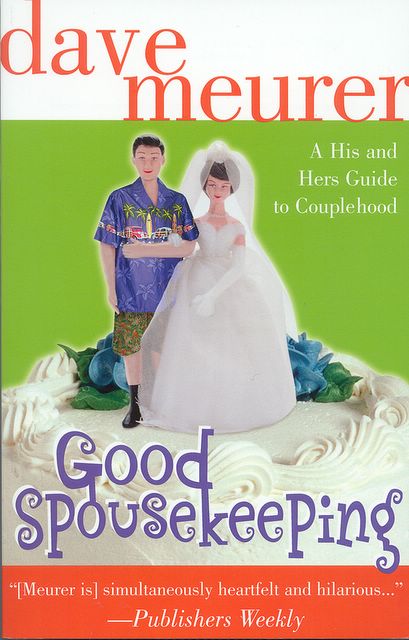
His latest is "Good Spousekeeping: A His and Hers Guide to Couplehood" ($12.99 in paper from Life Journey). Meurer is a Christian Dave Barry who uses the 35 short chapters in the book to raise some important issues for all marriages (there is a discussion guide at the back of the book). He recommends C. S. Lewis' "Mere Christianity" and Lee Strobel's "The Case for Christ" for those who want to further explore the Christian faith; in "Spousekeeping" he's content to paint a picture of a marriage under construction, even after almost a quarter century.

Early on Meurer anticipates the kind of mail he will get about his title and offers to write the letter himself: "Dear Male-Chauvinist-Swine Author of the So-Called Book' Titled Good Spousekeeping': We hate your new book, which implies that a spouse is to be kept' by her domineering, possessive male partner. It is repressive, belching, idiot cavemen like you who are perpetuating the patriarchal, condescending, oppressive culture that enlightened persons have been working to improve. ... We haven't read the book, because the tile says it all, you fathead. Sincerely, the Entire Faculty of the Women's Issues Department, The University of Sensitivity, New York."

In his defense Meurer explains that "the title of this book does not indicate that only one gender is keeping' the other. ... I simply mean to convey that both partners are called by God to be good' to each other and to keep' their vows, thereby keeping' their marriage. Good Spousekeeping' is fundamentally about encouraging husbands and wives to understand each other, work together, and protect their marriages--and laugh more. Also, I needed a clever title, and the good ones like Gone with the Wind' and Jaws' were already taken."

Meurer admits he has anger problems sometimes but is working on it. He praises his wife for helping him become more responsible and in turn he sees that he has helped Dale become more spontaneous.

But differences remain. In "What's in a Name?" Meurer talks about his fascination with fancy sports cars with nicknames like "Fang." "Regrettably," he writes, "none of my ... cars were British convertibles. At one point, I owned an AMC Pacer, which was voted Ugliest Car of the Year' by a major automotive magazine. The Pacer looked like an enormous metal toad, and it handled with the precision and speed of a diseased buffalo. It was not the kind of car you could even name Molar,' much less Fang'." (Empathy from reviewer: I once bought a Gremlin.)

Dave's idea of naming the family's present car "Thunder Lizard" doesn't go over big with Dale, Brad or Mark. " That is the lamest thing you have ever said,' replied Brad. Why can't you act like a normal father?' asked Mark. Dave, it is a white Chrysler sedan--a recliner with a steering wheel,' Dale commented. But "Fang" was already taken,' I pointed out. Dale got that involuntary twitch in her left eye and stood up to take a nap."

Eventually Dave relents and realizes he needs to put childish things behind. But: "I am still working on convincing (Dale) to call me by my preferred nickname. I don't want to be known merely as an author'; I prefer the more noble title of Awe-Thor,' which combines reverent fear ('awe') with the name of the mythical Viking god of thunder ('Thor')." Dave, not a chance.

Other chapters take up spontaneous gift giving, Brad's medical emergency, sex ("sex within marriage is sublime ... and it even burns up extra calories! A mean God would have made sex fattening. God is nice!"), handling money, taking risks, spiritual coldness, and putting in a new sprinkler system before reading the instructions.

I laughed out loud.

Dan Barnett teaches philosophy at Butte College. To submit review copies of published books (no manuscripts please), or to make comments, please send e-mail to dbarnett@maxinet.com. Copyright 2005 Chico Enterprise-Record. Used by permission.
Thursday, June 02, 2005


Feather River College anthropologist: Ishi in Oroville

By DAN BARNETT

Thursday, June 02, 2005 -

Almost a century has gone by since Ishi was discovered at the Charles Ward Slaughterhouse in Oroville the night of Aug. 28, 1911.

Alfred Kroeber, head of the University of California's new anthropology department which housed Ishi at its San Francisco museum until his death from tuberculosis in 1916 believed the Indian to be a kind of time traveler. Ishi could reveal a world unspoiled by "progress" if only he could be removed from Oroville to more scientific surroundings.

Kroeber's wife, Theodora, wrote "Ishi in Two Worlds" when she was 60; first published in 1961, the book became the standard reference but it has not lacked critics. In 2003 Alfred and Theodora's sons, Karl and Clifton, edited an anthology, "Ishi In Three Centuries," which is a kind of apologia for their father's treatment of Ishi as an anthropological wonder and not as a man. The repatriation issue was the focus of "Ishi's Brain: In Search of America's Last Wild' Indian" by Orin Starn, also published in 2003.

Dozens of articles on Ishi have also appeared, including work by Steve Schoonover, city editor at the Enterprise-Record.

Feather River College anthropology instructor Richard Burrill published "Ishi Rediscovered" in 2001 and now "Ishi In His Second World: The Untold Story of Ishi in Oroville" ($21.95 in paperback from The Anthro Co. out of Chester; write rburrill@earthlink.net for information).

Replete with many black and white photographs of Ishi and his surroundings in Oroville, the book is an attempt to pull together newspaper accounts and oral histories of the "eight days and seven nights" Ishi spent in town. The first part of the book is structured around speeches given in the 1960s and 70s by Adolph (Ad) Kessler, "one of the four butchers working at the slaughterhouse when Ishi was surrounded, handcuffed, and taken by sheriff's buggy to the Butte County Jail"; Kessler was 19 years old at the time. He later said, "I remember it pretty well because it was so unusual at the time, and also because ever since then people will ask, . . . tell us how you found Ishi."

Kessler, who served as Oroville's police chief for 18 years, said Oroville Sheriff "John" B. Webber, who had put Ishi in a padded cell to protect him from other prisoners causing rumors that Ishi was "wild" kept hearing "who is he?", "what is he?" from the inmates. "The sheriff just shortened it to Ishe' and," says Kessler, "told everyone his name was Ishe."

The book also takes up the story of UC Berkeley anthropologist Thomas T. Waterman, who, under the auspices of Alfred Kroeber, arrived in Oroville Sept. 1 in an effort to communicate with Ishi; three days later Waterman and translator "Indian Sam" Batwee brought Ishi to San Francisco.

The author takes issue with a number of statements made in the popular press and in Theodora Kroeber's book. For example: Ishi may have been hungry the night he was captured, he writes, but he was not "emaciated to starvation" as Kroeber claimed.

The photograph on the cover, taken Sept. 4 by Florence Danforth Boyle with a Kodak "box" camera, shows Ishi and Bill Collett, the pipe-smoking owner of Collett's Express baggage delivery service. (Boyle's memory is that Waterman called him "Ici," "man.")

"Ishi In His Second World" reprints many contemporary newspaper stories in which, Burrill says, "Ishi was promoted ... as a curiosity, not a fellow human being. Ethnocentric thinking and racism were common. Few of the nation's leaders believed that the Indians (non-whites) had a right or a title to the land that they had inhabited for so many eons."

Burrill adds that "Ishi, little by little, recovered his spirit and the last years of his life" were mostly serene. "On the whole, Ishi took very kindly to civilization... (He) lived without self-pity even though all had been taken from him."

The book includes a plea for an Ishi stamp to be issued by the Post Office Aug. 28, 2011, to commemorate Ishi's appearance in Oroville.

* * *

A Fish Flew Through the Porthole: A Sailing Adventure Narrated bya Very Reluctant Sailor by Gerri Miller ($19.95 paperback) has just been reprinted. It is available in Chico at Lyon Books and Galleria Books as well as from Stansbury Publishing and online. My enthusiastic review appeared earlier in The Buzz. Think summertime reading!

Dan Barnett teaches philosophy at Butte College. To submit review copies of published books (no manuscripts please), or to make comments, please send e-mail to dbarnett@maxinet.com. Copyright 2005 Chico Enterprise-Record. Used by permission.

Saturday, May 28, 2005

The Meaning of "Musable"

For more than 15 years I've been reviewing books each week for the Chico (California) Enterprise-Record. The Biblio File column, currently appearing each Thursday in the newspaper's Buzz tabloid insert, is one of the few places local authors can find some measure of recognition for their work.

This blog celebrates the authorial Muse and, in time, I hope it can be a gathering place where I can post previously published columns, add reviews published by others, and encourage authors, publishers, bookstore managers, and readers to come together in conversation.

Think of each posting as a "muse-able" — something the Muse is able to use to enrich (or antagonize) thoughtful readers.


Dan Barnett teaches philosophy fulltime at Butte College, Oroville, CA and writes the weekly "Biblio File" book review column for the Chico Enterprise-Record Posted by Hello

Wednesday, May 25, 2005


Former Chicoan inspires U2's "Miss Sarajevo"

By DAN BARNETT

The irony of a beauty pageant in the midst of the siege of Sarajevo in the mid-1990s was not lost on Bono, whose guiding spirit plays a major role in the second part of Bill Carter's memoir, "Fools Rush In: A True Story of Love, War, and Redemption" ($14.95 in paperback from Wenner Books).

The U2 leader shepherded Carter's award-winning documentary "Miss Sarajevo" and contributed its theme song, where there's a reference to the winner "surreal in her crown." Luciano Pavarotti adds that though love is supposed to come to the "thirsty lands," "I cannot wait for love anymore."

Carter found himself part of The Serious Road Trip -- an oddball collection of Aussies and Brits and Irish and Americans driving trucks painted with cartoon characters, dedicated to delivering tons of food and other essentials to Sarajevo in the midst of war. In the first part of the book the reader is confronted with war in all its insanity, lots of alcohol, sex and drugs, the corrupt stupidity of Big Organizations (especially the United Nations) and sadness that approaches poetry.

A quarter million were killed in all of Bosnia; 1,600 children were killed in Sarajevo -- that city where Coats and Serbs and Muslims had lived peacefully side by side -- by artillery or snipers.

Yet "Fools Rush In" is not really about the ins and outs of the Bosnian War. Instead, it's a story of personal grief as it is mirrored, and transformed, by the surreal conditions in Sarajevo.

Years earlier Carter escaped an abusive father and traveled the world -- until he got a job in Alaska. "It was in Naknak that I fell in love with Corrina, a 19-year-old college student who sat in the back of the lunchroom eating green apples and reading."

Eventually they hook up, soulmates and move to Chico. Corrina is pregnant and Carter is away polishing cars for a commercial when she is involved in a traffic accident. She was never to leave the hospital.

"I walked a few miles until I reached the banks of the Big Chico Creek. It was dawn when I put my feet in the cold water and watched the sun rise. How did the sun possibly find the strength to rise that day, of all days? ... It wasn't until weeks later ... that I realized she had died on 19 June, exactly one year to the day from when we first met."

The pain is searing and he cannot seem to escape. "God. This is Bill here. So, now what? You give us life so we can love, then lose it and live with the pain? That's it?"

And yet he begins to realize something: "Grief produces an abundant energy that must find a way to burn itself up. ... The truth, which is rarely admitted in Western cultures, is that grief has a way of making you feel more alive." He is impelled to deliver humanitarian aid in Bosnia. "What is it about love, or the grief of losing love, that makes a person want to swallow the wide world whole?" He learns he must "build a new chamber inside my old self. One that doesn't replace the old love, but allows room for a new one." And the spirit of Corrina is finally at rest.

In the book's second part Carter explains his crazy notion of bringing the plight of Sarajevo live by satellite during U2's Zooropa concert tour and how Bono befriended him. A third, shorter part brings the war to an end and an epilogue notes that on "23 September 1997, nearly two years after the signing of the Dayton Peace Agreement marking the end of the war in Bosnia, ... U2 finally played a concert in Sarajevo."

For all Carter's media attention (he's working on a screenplay of the book for a new Hollywood studio) "Fools Rush In" is about a love made expansive by grief, a profane chronicle tempered by the divine.

"And the dead? Don't worry about them, they are never far. They're always around to remind us of our ultimate fate. The trick, I had learned, was not holding on so tight to life that you became too scared to live. That was the same as living to die. No. The thing was to live like you had already died."

Dan Barnett teaches philosophy at Butte College. To submit review copies of published books (no manuscripts please), or to make comments, please send e-mail to dbarnett@maxinet.com. Copyright 2005 Chico Enterprise-Record. Used by permission. Posted by Hello